Get Full Government Meeting Transcripts, Videos, & Alerts Forever!
Get email alerts on the Comprehensive Plan topic
No spam. Unsubscribe anytime.
New Kent presents draft 2045 comprehensive plan, flags growth and land-use guidance
Summary
Consultants for New Kent County presented a draft comprehensive plan on March 26 that updates growth projections, a nine-category future land-use framework and a transportation project list built from public input and state data for officials to review.
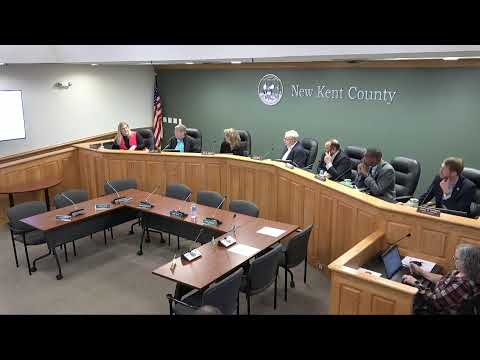
Todd Gordon, a planner with EPR, presented the draft New Kent 2045 comprehensive plan at a joint meeting of the New Kent County Board of Supervisors and the Planning Commission on March 26, 2025, in the county administration boardroom. The plan updates land-use guidance and transportation priorities to reflect recent growth and public engagement.
The plan matters because it is the county’s long-range guidance document under Virginia law for land use and transportation decisions. Gordon said the update builds on the county’s 2021 Envision New Kent strategic plan and recent public input; it does not itself change zoning but is intended to guide future zoning and capital decisions.
Gordon told members the document draws on analysis and public outreach undertaken since the last full plan update in 2012. He summarized the key elements: a future land-use map organized into nine place types that range from conservation to village centers; a transportation chapter with a list of proposed roadway, pedestrian and bicycle projects; and an implementation chapter that ties tactics to responsible departments, timing and general cost bands. "This has been our attempt to summarize a 100‑page comprehensive plan in 15 minutes," Gordon said at the meeting.
Consultant Alan Simpson described the plan’s chapter structure: for each topic it lists public-input summaries, existing-condition data, goals pulled from Envision New Kent, tactics and measurable metrics for tracking progress. The implementation chapter collects all tactics into a single table that indicates a lead department, supporting parties, short/medium/long‑term timing and a rough cost estimate shown with dollar‑sign bands rather than precise budgets.
On demographics, the consultants said New Kent’s population—recently reported in the lower 27,000s—will continue to grow. Citing projections from the Weldon Cooper Center at the University of Virginia, the presentation said the county could exceed roughly 36,000 residents by 2050, requiring planning for additional households, roads, schools and public safety services.
The future land‑use map is the principal policy product: it designates where more intensive development would be appropriate (village centers, interchanges) and where conservation or rural character should be preserved (river edges and scenic corridors). Gordon explained that the draft map intentionally does not depart dramatically from the existing plan; it adjusts place‑type boundaries to align more closely with current zoning, utility service and development that has occurred since 2012. "Agricultural land ... speaks for itself — it's farmland," Gordon said when asked to clarify the difference between agricultural and rural land; he added that rural lands typically contain houses on large lots rather than active farmland.
The transportation chapter includes an appendix with a more detailed projects list, example street sections, and multimodal recommendations intended both for new development and for targeted improvements. Gordon and Simpson emphasized that many recommended roads would be built in conjunction with new development and that the chapter also includes safety and trail recommendations drawn from public input and VDOT/VTrans data.
Members of the board and planning commission asked clarifying questions about the plan’s length, level of detail and how tactics were chosen. The steering committee that guided the process was recognized during the presentation for its role in outreach and drafting. Commissioners praised the emphasis on balancing growth and preservation and the streamlined list of tactics intended to be achievable by county departments.
The presentation closed with consultants and staff offering to answer questions; no formal adoption or final action was taken at the March 26 meeting. The draft remains before the board and planning commission for further review.
Ending: Board members and planning commissioners indicated support for a measured approach and said they would review the draft further before any zoning or ordinance changes are proposed.