Get Full Government Meeting Transcripts, Videos, & Alerts Forever!
Get email alerts on the Marijuana Regulation topic
No spam. Unsubscribe anytime.
Redmond council approves four ordinances to allow and regulate retail marijuana; tax, buffers and licensing set
Summary
The Redmond City Council completed second readings and voted to adopt four ordinances establishing a 3% retail marijuana tax, time/place/manner rules, sign restrictions and a business-license framework including a population cap and application fees. Several councilors registered abstentions during votes.
The Redmond City Council adopted four ordinances on the sale and regulation of retail marijuana on the council’s April meeting night, advancing measures that set a 3% city tax, establish time/place/manner (TPM) controls, limit advertising to minors and create a licensing process with population- and fee-based limits.
Council members approved the tax ordinance (Ordinance 2025-02), the TPM ordinance (Ordinance 2025-03), a sign-code amendment (Ordinance 2025-04) and a business-license ordinance (Ordinance 2025-05) after second readings and roll-call or voice votes. The ordinances will take effect 30 days after adoption; city staff said that puts the effective date at May 8.
Why it matters: the package implements regulatory guardrails while enabling retail marijuana commerce in Redmond after a citizen advisory vote earlier this year. The measures include local taxation for municipal revenue, limits on storefront location and advertising, and a capped licensing process intended to limit the number of dispensaries in the city.
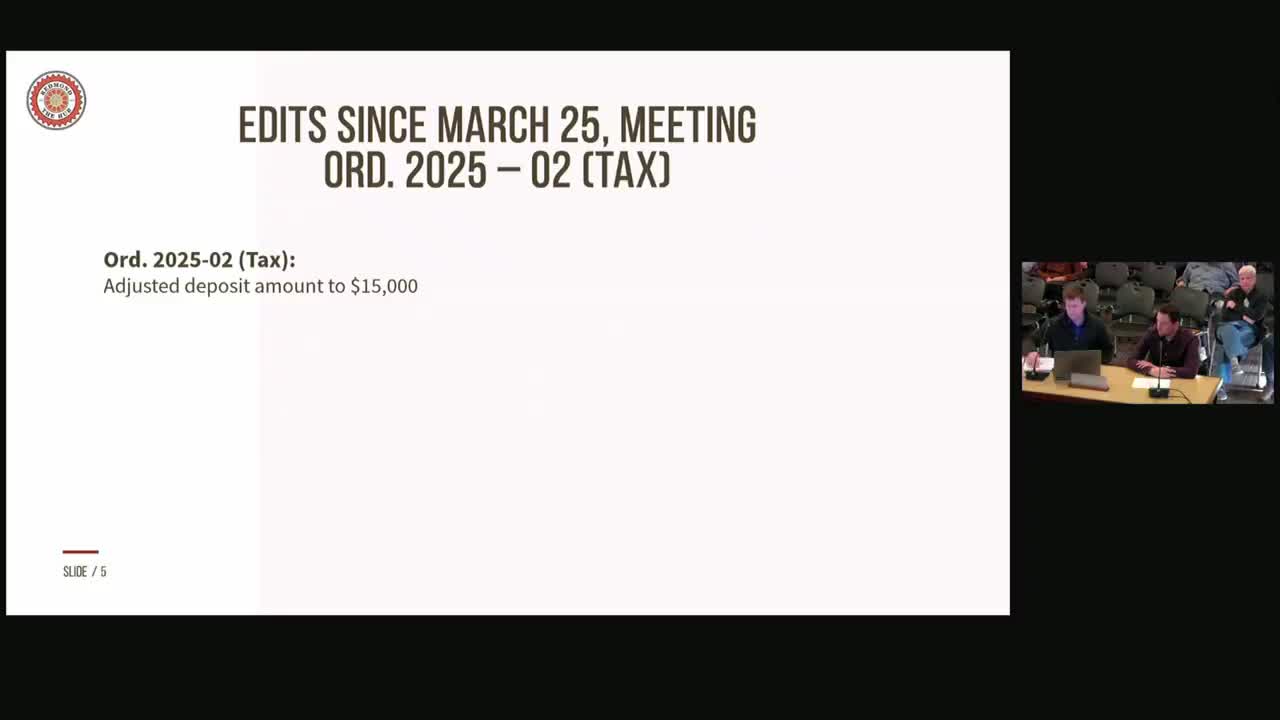
Key provisions and council discussion - Tax (Ordinance 2025-02): The council approved a 3% tax on retail marijuana sales. Finance Director James Woods said staff changed the security deposit from $5,000 to $15,000 to provide the city “security against the collection” of taxes while monthly remittances are processed. Woods summarized the change: “we adjusted the deposit from being $5,000 to $15,000.”
- Time, place and manner (Ordinance 2025-03): Planning Director Kyle Roberts said staff revised buffer rules to add limited flexibility and clarified how distances are measured. The code allows a reduction in buffer distance of up to 25% where a physical or geographic barrier (for example, a railroad or Highway 97) would prevent minors from reaching a dispensary. Roberts said the draft also “strictly prohibit[s]” mobile delivery from retailers and set hours of operation at 8 a.m. to 8 p.m., narrower than the state allowance. Roberts told council that buffer distances are measured from the property line of the use creating the buffer to the facade of the dispensary, which matches how entry to the store would occur.
- Signs (Ordinance 2025-04): Staff narrowed the sign restrictions to focus on preventing advertising aimed at minors and removed broader language about unproven health claims. Roberts explained the changes were intended to make sign rules more defensible under review.
- Business licensing (Ordinance 2025-05): The new license rules include a cap of one dispensary per 10,000 residents and create an application and processing fee structure. Roberts and staff said the initial application fee will be $1,500 and is intended for cost recovery; Roberts said, “That’s a cost recovery fee. So that’s not a refundable fee.” The code adds a procedure for application processing and an annual renewal requirement.
Votes and abstentions - The council approved the ordinances by roll call or voice vote. Multiple councilors voiced support during the readings; the meeting record shows at least two instances of recorded abstentions during votes. One council member, identified in the record as Jay, said publicly before a vote: “I will abstain in the vote.” The record also shows an abstention recorded as “Keith” during one vote. Where the roll call named council members, those recorded as voting in favor included Mayor Fitch, Councilor Evelyn, Councilor Nielsen, Councilor Osborne and Councilor Zwicker; several motions passed with vocal “ayes” from the council.
Next steps City Manager Keith Akoski said staff will prepare an application process for retail dispensary licenses over the next month. He told the council the process is expected to be qualitative (not a lottery or strictly first-come, first-served) and that decisions on license applications will likely be made in May or June, after staff develops the application materials and evaluation process.
Councilors and staff repeatedly framed the ordinances as an attempt to balance the voter-approved option for local retail with protections for youth and the community’s character. Some councilors voiced personal opposition to permitting retail marijuana while still voting to implement the voter-approved policy or abstaining; others emphasized respecting the advisory vote.