Get Full Government Meeting Transcripts, Videos, & Alerts Forever!
Get email alerts on the Emergency Response topic
No spam. Unsubscribe anytime.
Redmond emergency partners outline how wildfire, derailment and mass‑casualty responses would coordinate
Summary
Fire, state and county officials, the Red Cross and the airport described layered mutual‑aid, dispatch, and shelter steps Redmond would use if a severe brush fire or other disaster threatened the city.
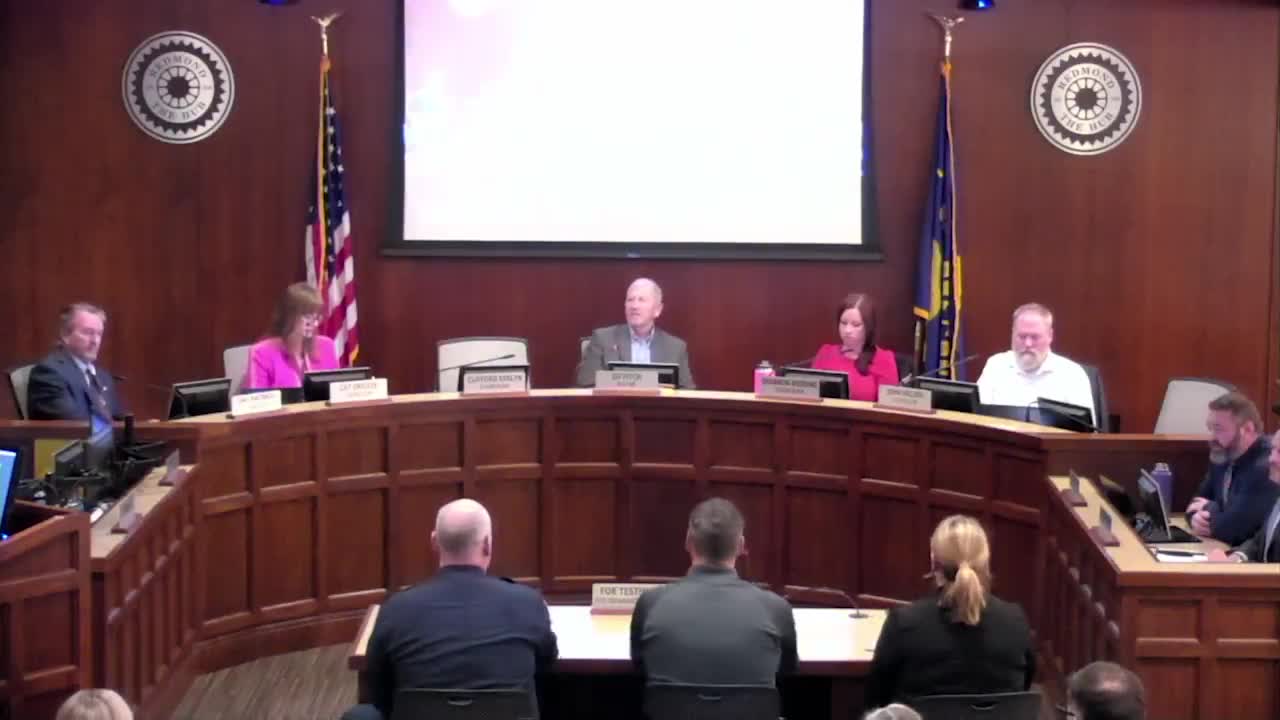
Council heard a multi‑agency briefing on how Redmond and regional partners would respond if a wildfire, train derailment or other large incident threatened the city. Presenters from Redmond Fire & Rescue, the Oregon State Fire Marshal (OSFM), Deschutes County emergency management and the American Red Cross described how local dispatch, mutual‑aid agreements, state resources and sheltering systems would be used together.
The panel opened with Chief Herrera of Redmond Fire and Rescue, who described local dispatch and initial scene assessment: “someone will call 911 and they will provide a location, an incident type … they will get a series of questions that will determine the severity.” Herrera said the department operates out of four stations (one at the airport) and uses mutual‑aid and the National Incident Management System for unified command when needed.
Dennis Lee, emergency response manager for the Oregon Office of State Fire Marshal, explained state support and the mutual‑aid escalation process. “Where it starts, really is at least initial responsibility for dealing with that incident,” Lee said, and he described how local requests go to county fire defense boards and then to OSFM for regional mobilization, aircraft requests and, in extreme cases, a governor’s conflagration declaration and an incident management team.
Deschutes County emergency operations leader Nathan Garrabee emphasized pre‑season preparedness, public alert systems and targeted evacuation notices. He urged residents to sign up for Deschutes Alerts and noted the county maintains a public information dashboard and pre‑identified temporary evacuation points to shorten decision time when evacuations are ordered.
Morgan Schmidt of the American Red Cross outlined the nonprofit’s volunteer‑driven sheltering and recovery services: “our ability to respond is based on 90% of a volunteer workforce,” she said, and described services the Red Cross can provide immediately after displacement, including reunification, health and mental‑health supports.
Airport director Zach Bass described how the airport participates in triennial drills and tabletop exercises that bring hospitals, life‑flight, law enforcement and other agencies together to practice mass‑casualty and hazardous‑materials scenarios. He noted the airport’s triennial drill is FAA‑required and that the next large exercise is scheduled for October.
Councilors asked about chemical identification after a derailment, gaps if mutual‑aid resources are committed elsewhere, and how to identify residents with access and functional needs. Panelists said responders rely on placards/ERG guides for hazardous‑materials identification, that mutual‑aid requests can be denied when statewide commitments exist, and that the county and partners are working to share information for people who need assistance during evacuations.
The presentation closed with an outline of ongoing local exercises and invitations for further briefings; councilors and several residents praised the session and asked staff to explore making this content actionable for citizens and neighborhood groups.