Get Full Government Meeting Transcripts, Videos, & Alerts Forever!
Get email alerts on the Photo Enforcement topic
No spam. Unsubscribe anytime.
Redmond staff propose studying photo-enforcement cameras to cut fatal and serious-injury crashes
Summary
City police and traffic staff presented an overview of a traffic safety working group and proposed studying photo radar and red‑light cameras as tools to reduce fatal and serious‑injury crashes, seeking council feedback and possible authorization to issue an RFP to vendors.
Redmond police and traffic staff told the City Council informal session that they are asking for feedback on studying photo‑enforcement cameras for speeding and red‑light violations and, if the council directs, to start a vendor RFP process.
The presentation described the city’s Traffic Safety Working Group and framed camera technology as another tool to reduce crashes with serious injuries or fatalities. "The idea being the goal is to get ... to 0 fatal crashes in the city of Redmond," said Police department staff member, summarizing the program goal.
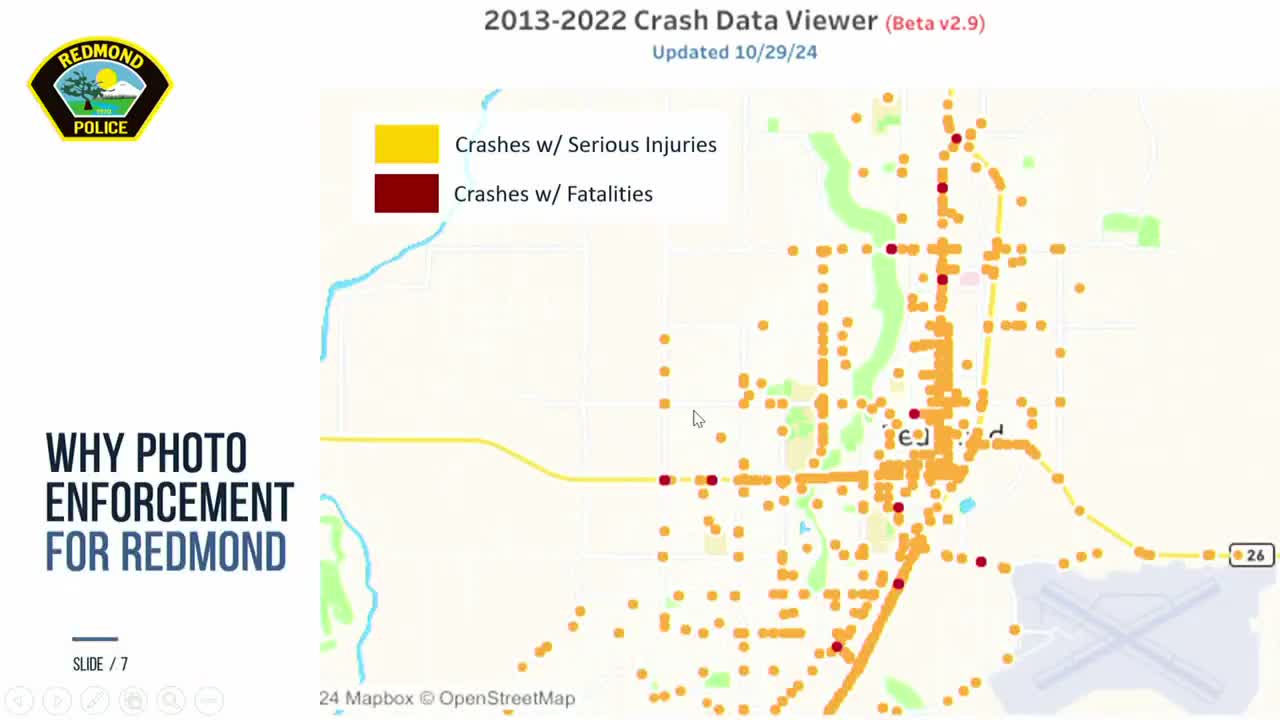
The nut of the proposal is that recent changes in Oregon law allow cities to operate two kinds of automated enforcement: photo red‑light and photo radar. Presenters cited a statewide ODOT analysis and local examples — Beaverton and Tigard — that staff say reported reductions in serious crashes after cameras were installed. Staff described candidate locations on arterial corridors including Highway 97 and central city arterials and said they would prioritize intersections and school and residential areas with the highest crash counts.
City staff walked the council through how requests land in the Traffic Safety Working Group, how staff conduct site visits and speed studies, and how engineering, enforcement and public‑works tools are layered. "We would be able to see the totality of the entire incident and make an informed decision," Police department staff member said of the review process for potential violations, noting each automated allegation would be reviewed by a trained local reviewer and that video would accompany still images.
Staff listed several implementation requirements: advance warning signs on major entry routes and ahead of specific camera locations; municipal‑court processing of citations; and options for fixed or mobile cameras. They said Oregon law permits photo radar in school zones and residential areas, and allows city council proclamation to extend radar to other locations, and that citations are mailed to the vehicle’s registered owner (or to an identified driver) within 10 days.
On staffing and operations, staff said vendors commonly supply, install and maintain equipment and are often paid through a share of citation revenue or a negotiated flat fee. Staff reported vendor models vary and described a typical evaluation period of six to 12 months before deciding whether to create a dedicated traffic‑enforcement position. "Technology is advanced ... the camera systems ... are able to track multiple vehicles at the same time and can show you how fast each vehicle is potentially going," Lieutenant Curtis Chambers said when describing radar‑enabled camera capabilities.
Council members asked about municipal‑court workload, evidence review for weather or emergency situations, public outreach and data on who receives citations. Staff said they had spoken with municipal court staff and the municipal judge, who were “in support of this program,” and that Beaverton’s 2023 report showed roughly three‑quarters of photo citations were issued to drivers from outside the issuing city, a statistic staff said could be relevant for Redmond because of through traffic.
Staff recommended a public outreach campaign during the vendor study period, early signage and a formal council presentation before cameras are activated. The immediate next step offered to the council was authorization to draft and release an RFP that would include ODOT requirements and any council‑requested specifications.
No formal council motion or vote was recorded during the informal session; staff left the decision point to the council for next steps.
Ending: Staff said, if council is interested, they will return with a formal council presentation and an RFP outline; they suggested a formal presentation could be scheduled in the coming weeks to allow public notice and comment.