Get Full Government Meeting Transcripts, Videos, & Alerts Forever!
Get email alerts on the Budget topic
No spam. Unsubscribe anytime.
Chesapeake staff present final budget amendments to fund enhanced public-safety package; manager authority and grant rules proposed
Summary
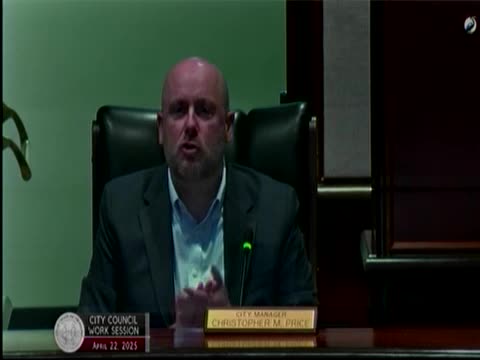
Chesapeake City Manager Chris Price presented final operating and capital budget amendments April 22 as council moved to close out the fiscal‑year 2026 budget and implement its selected enhanced public‑safety package.
Chesapeake City Manager Chris Price presented final operating and capital budget amendments April 22 as the council moved to close out work on the fiscal‑year 2026 budget, saying staff could fully fund the council’s chosen enhanced public‑safety Option A while also accommodating a suite of school board requests and ordinance clarifications.
Why it matters: The amendments shift recurring and one‑time revenues and change how the city will account for some expenditures — steps that affect Mosquito Control, the public‑utilities CIP, the proposed Fire Station 4 timetable and the city’s internal budget controls. Council direction during the work session will feed the budget ordinances scheduled for adoption on May 13 and final amendments on June 10.
City staff laid out several linked actions to fit the public‑safety funding package into a balanced budget. Price and a finance presenter summarized the biggest transactions: reduce the proposed 2¢ real‑estate tax dedication used in the manager’s original plan; redirect the personal‑property tax levy that had funded Mosquito Control so that 8¢ of that revenue supports enhanced public safety; and replace the lost Mosquito Control revenue with fund‑balance appropriations to preserve mosquito operations. Jonathan (staff member) described these as “summary‑level” transactions that will require additional accounting mechanics in internal service funds.
School funding: The school board requested using FY‑24 reversion and a revenue‑sharing true‑up to appropriate roughly $20.7 million in one‑time funding for operating, athletics and cell‑tower accounts. Jonathan said those amounts currently sit in the general‑fund balance and would be appropriated and transferred to school funds if council approves the changes.
Capital program changes: On the general‑government CIP, staff showed reduced increases for Fire Station 4, Fire Station 14 and the fifth police precinct to pull year‑one costs down; turnout‑gear purchases initially planned over two years as PAYGO from a city lockbox will instead be accelerated and funded by a one‑time transfer from the general fund. In public utilities, staff presented transactions that would restore parts of the Avalon Water and Sanitary Sewer project to prior program buckets (reversing a move to a stand‑alone South Norfolk TIF‑backed project) and produce a net decrease of about $20.9 million in year‑one public‑utilities CIP.
Project timing and Station 4: Price and staff advised council that acquiring land for a replacement Fire Station 4 is the immediate next step and can proceed this year regardless of whether council includes the projected $1.6 million in annual debt‑service for construction in the FY‑26 budget. The $1.6 million is ongoing debt service estimated for construction bonds; staff said land acquisition and design are separate near‑term steps and would not be advanced faster solely by adding debt service in the current budget.
Administrative and ordinance changes: Staff recommended four ordinance updates to align practice with policy and to tighten internal controls: - Restore authority to the city manager to reallocate appropriations within the healthcare fund to match actual, calendar‑year healthcare expenditures (Jonathan said “healthcare expenditures are very volatile” and that restoring this authority would not change the fund’s total budget). - Authorize the manager to reduce grant appropriations when the final award is less than the original budget estimate, a safeguard against spending appropriated but not yet received grant funding. Staff also said they moved grant positions and grant funding into departmental resource summaries for FY‑26 to improve transparency. - Clarify the legal level of budgetary control (department and fund level) to remove ambiguity in the budget ordinance language. - Add language treating grant appropriations like encumbrances so unspent, valid multi‑year grant funds can carry forward at year‑end; staff noted the city charter’s existing Section 5.07 states “Every appropriation... shall lapse at the close of the fiscal year” except CIP projects and recommended adding encumbrance‑style language for grants to avoid unintended lapses.
Grants and healthcare: Staff emphasized these changes are intended to improve internal controls and transparency, not to increase or decrease total budget authority without council action. Jonathan said the proposed grant‑carryover wording is the city’s “safe approach” and that staff could pursue a state‑level charter change later to make it explicit.
Funding tradeoffs: Price presented a list of potential reductions and other revenue options if council wishes to add ongoing debt service for Station 4 in FY‑26. Examples include rescinding some proposed expenditure items; he also identified other longer‑term revenue options — increasing the data‑center tax rate, considering commissioner of the revenue proposals that may bear fruit in later years, continuing to “right‑size” independent authorities and expanding success on congressional earmarks — as ways to address unfunded public‑safety and general‑government needs.
Next steps and timeline: Staff will prepare the final budget ordinances for adoption on May 13. Price told council staff will bring a final set of technical corrections and any last‑minute amendments (for example new state funding) on June 10. Council also asked staff to provide follow‑up information requested during the session, including specific details about the sheriff’s victim‑witness grant and whether the sheriff’s office could sustain services without the proposed $200,000 local supplant.
What council members said: Council members pressed staff for detail on the victim‑witness replacement, the list of sample reductions to find $1.6 million of debt‑service capacity, how land acquisition and design would be funded, and the timing and revenue impacts of redirecting Mosquito Control taxes. Staff repeatedly stressed distinctions between one‑time fund‑balance actions and changes to ongoing budget authority and said some transactions would be reflected differently in the general‑fund presentation once the school transfers and reversion appropriations are shown.
Where this leaves the budget: Staff presented that, after the requested amendments so far, roughly $216,000 remained in the reserve for council priorities. If council approves the ordinance language changes and the appropriation transfers in May, staff will incorporate the legal and accounting adjustments in the published budget ordinance and the public hearing documents.
Ending: Council did not take final adoption votes at the April 22 work session; staff will bring the formal ordinances and motions for adoption on May 13 and technical corrections on June 10. Staff said they will provide the additional detail council requested about the victim‑witness program, the sample expenditure reductions and specific costs tied to the station and CIP changes.