Get Full Government Meeting Transcripts, Videos, & Alerts Forever!
Get email alerts on the System Development Charges topic
No spam. Unsubscribe anytime.
Astoria council signals support to move to second phase of system development charges, asks staff to study deferrals and housing relief
Summary
Councilors reviewed consultant recommendations to raise system development charges (SDCs) in a three‑phase schedule, voiced support for ordinance changes to advance a second-step increase, and asked staff to return with options for payment deferrals and affordable‑housing relief that are backfilled by other revenue.
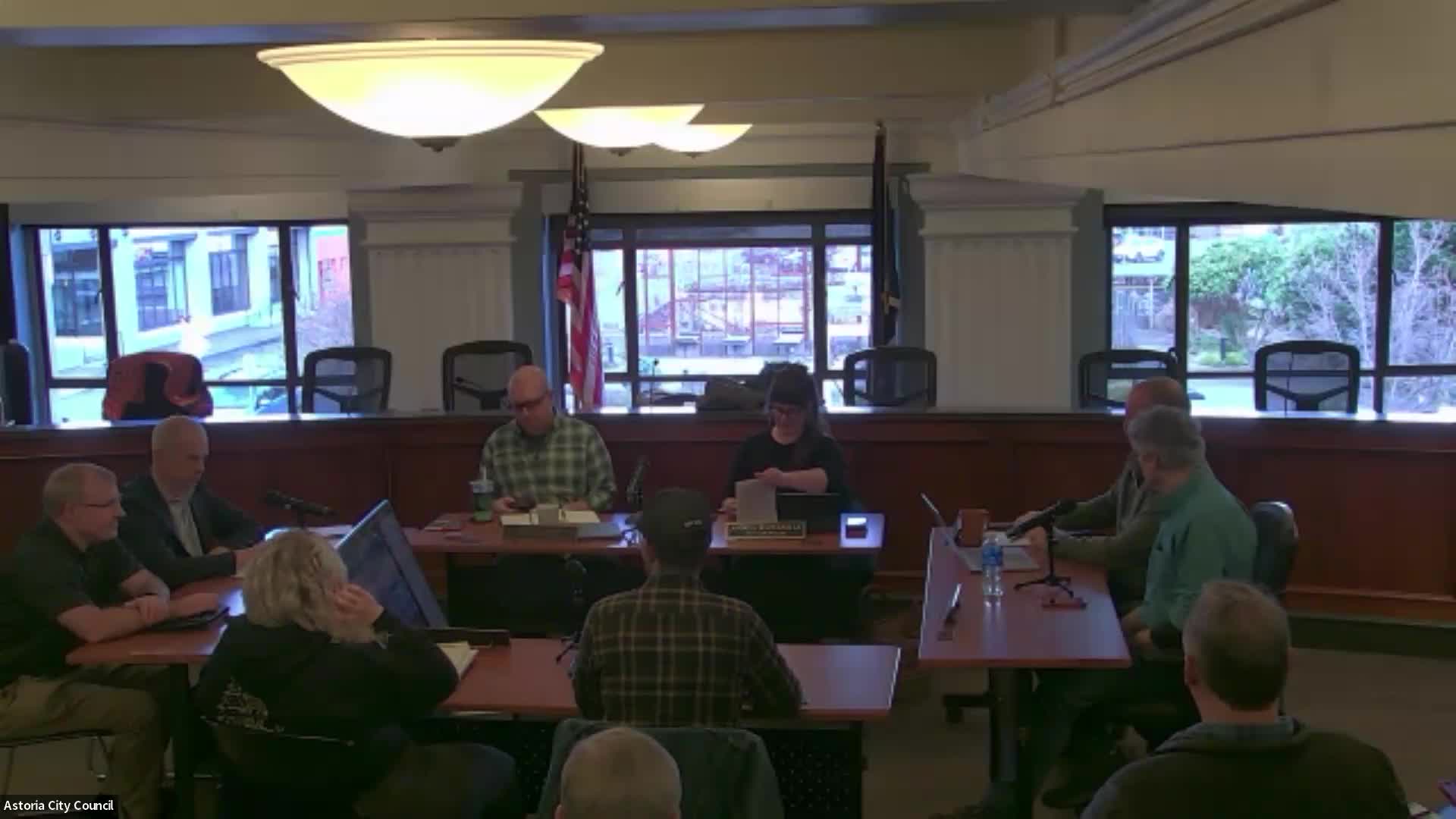
Astoria City Councilors on Monday discussed proposed second‑phase increases to the city’s system development charges, signaling support for ordinance changes to advance the fee schedule and asking staff to return with language on payment deferrals and options to relieve or subsidize SDCs for affordable housing.
John Guillerducci, principal at FCS Group, summarized the state law framework and the city’s calculation method for SDCs, saying: "These are the one‑time fees paid at the time of development by new development." He described two components of SDCs — a reimbursement fee for buy‑in to existing unused capacity and an improvement fee based on planned, capacity‑increasing projects — and warned that SDC revenues may be used only for capital projects, not operations.
The consultant showed the city has collected about $110,000 since the program’s initial phase in 2023 and described the proposed three‑year phase‑in. Under the presentation, a typical single‑family residence would face a total SDC (all five services combined) of roughly $15,000 at full implementation; the staff recommendation for step two would move fees substantially closer to that level, with a suggested effective date of July 1 (date to be finalized by council). Guillerducci recommended indexing SDCs to inflation using the Engineering News‑Record construction cost index.
Guillerducci walked councilors through service‑specific bases: current local charges use meter size for water and sewer, $0.98 per impervious square foot for stormwater, $15.58 per PM peak‑hour trip for transportation (using ITE trip rates by land use), and $95 per residential equivalent for parks. He said the city’s improvement project lists include large totals (water ~$38,000,000 with ~$2,100,000 SDC‑eligible; sewer ~$19,000,000 with ~$1,150,000 SDC‑eligible; transportation nearly $81,000,000 with about one‑quarter SDC‑eligible) and that transportation yields the largest single share of the improvement fee basis.
Counselors focused questions on two policy areas: exemptions or discounts to encourage affordable housing, and deferring SDC payment until certificate of occupancy (COO) or providing financing terms. Guillerducci said Oregon statute provides limited, specific waivers for certain large multifamily projects and noted a statutory companion that authorizes a construction excise tax as a backfill mechanism. "We strongly recommend that if the city decides to provide additional relief for affordable housing, that the city backfill/replace that revenue with an external source of revenue so that the program is kept whole," he said.
Staff and consultants said common backfill sources used elsewhere include general‑fund transfers, construction excise tax revenue, voluntary utility contributions, or other external grants; they cautioned that waiving SDCs without a revenue source could shift costs to other SDC payers and risk legal challenge because impact fees must be proportionate to impacts. On deferrals and payment terms the presentation noted tradeoffs: deferring payment until final COO can ease developer carrying costs but requires clear enforcement and administration to avoid nonpayment and to handle temporary COOs.
Councilors expressed general support for adopting the proposed ordinance language to implement step two of the phase‑in and for staff to return with specific draft language on (1) deferral/payment timing tied to COO (including temporary COO rules), (2) potential financing or city‑administered payment terms, and (3) a formal program for affordable‑housing relief that identifies an external backfill source (fund 140 and the construction excise tax were discussed). No formal motion or recorded vote occurred during the discussion; several councilors said they supported moving forward without delaying the ordinance changes for further study.
The discussion included examples of recent local projects (hotel and commercial developments, a CBH project near the Port of Astoria) to illustrate how SDC improvement fees would fund projects that increase system capacity (water main extensions, signal upgrades, sidewalk infill, and other Transportation System Plan projects such as the Irving Avenue extension).
Next steps: staff was directed to prepare ordinance language for council consideration implementing the second phase of the SDC schedule, to return with proposed deferral/payment terms and draft criteria for any affordable‑housing relief that include a revenue backfill plan, and to continue outreach to the development community. Because no formal adoption occurred, staff will return the ordinance for future action with the clarifications requested by councilors.