Get Full Government Meeting Transcripts, Videos, & Alerts Forever!
Get email alerts on the Public Works Cip Cso topic
No spam. Unsubscribe anytime.
Astoria staff present five-year capital improvement plan and ask DEQ for time to phase final CSO work
Summary
Astoria City public works staff presented a draft capital improvement plan and an integrated plan for the combined sewer overflow program at the Jan. 27 Astoria City Council work session, asking DEQ for extra time to pay down existing CSO debt and scope a large Irving Avenue storm‑separation project that could be eligible for FEMA funding.
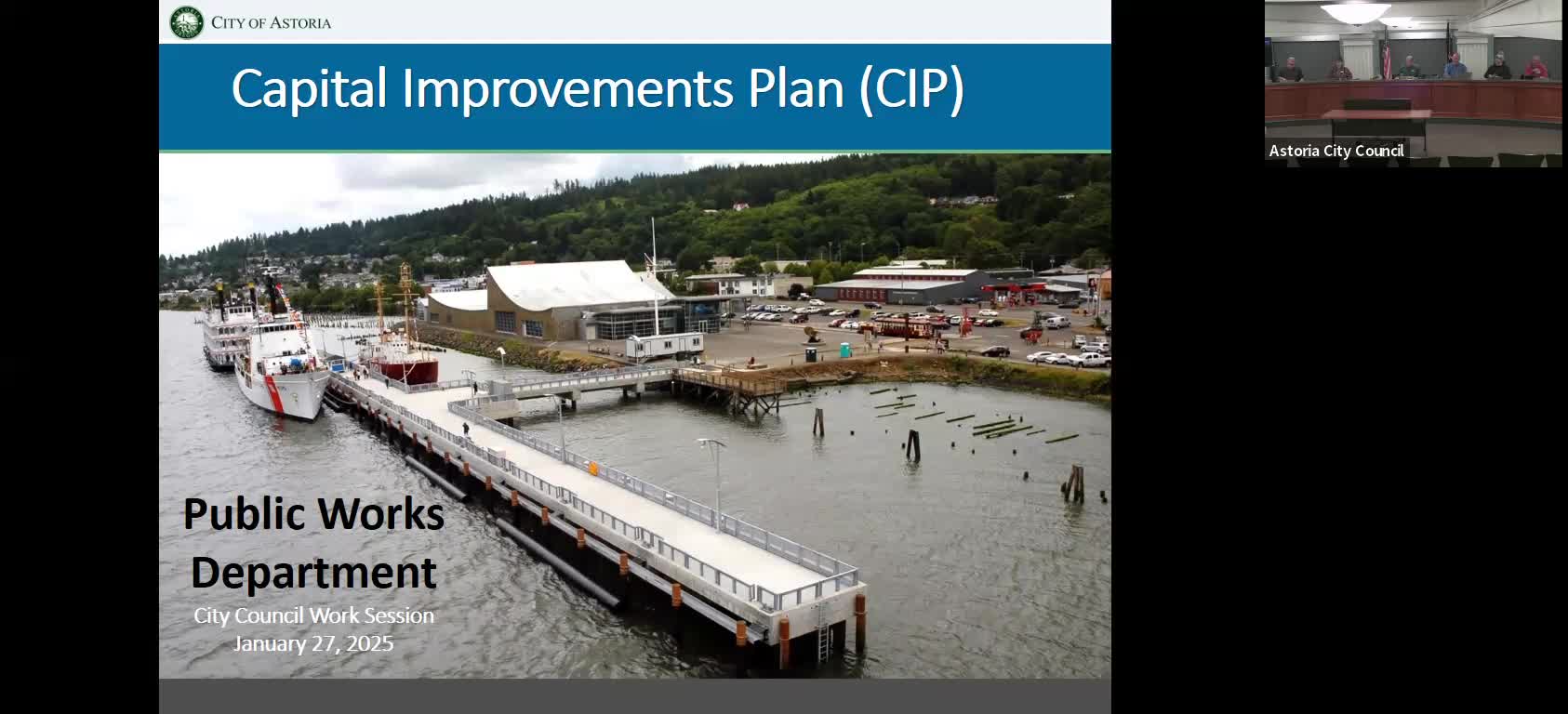
Astoria City public works staff presented a draft capital improvement plan (CIP) and an integrated plan for the city’s combined sewer overflow (CSO) program at a Jan. 27 work session, and asked the council to allow a 30-day public review of the CIP while staff submits the integrated plan to the Oregon Department of Environmental Quality (DEQ) and seeks a schedule extension under the federal integrated-planning process.
Public Works Director Jeff Harrington said the city’s inventory and five-year project list show about $252,000,000 in identified projects over the planning horizon and roughly $1,100,000,000 in infrastructure assets overall. “We have $1,100,000,000 in infrastructure,” Harrington said, urging council members to read appendices showing the asset inventory, project priorities and funding status.
The integrated-plan request centers on Astoria’s remaining CSO work. Harrington and Assistant City Engineer Sydney Moore told the council the city has completed four of five CSO phases and has roughly $18,000,000 of CSO-related expenditures remaining from a program that began in the 1990s and has already spent about $32,000,000. Moore explained that a combined sewer overflow occurs when heavy rain pushes stormwater and sewage past the wastewater plant’s capacity and “some…overflows into our water bodies.” The staff proposal asks DEQ for additional schedule time to pay down existing CSO debt, develop and construct a targeted project in the Phase 5 area and monitor results before committing to other expensive downstream work.
Why it matters: Astoria’s CSO surcharge has been a large portion of sewer bills and has limited the city’s ability to raise general water and sewer rates for capital investment. Harrington said the CSO surcharge is currently about 97% of the sewer bill and described a long history of deferred capital investment and an ongoing “react-and-repair” funding posture. Staff recommended establishing or growing reserve funds and said a minimum 3% annual increase in utility rates would be necessary to maintain existing service levels if no other funding is found.
Proposed pilot project and funding strategy: Harrington outlined a concept to focus Phase 5 work in the Irving Avenue/upper-town area. He said the neighborhood’s geology, drainage and the amount of stormwater entering the combined system make it a strong candidate for a large storm-separation and drainage-capture project that could both reduce landslide risk and substantially cut the volume of stormwater entering the sewer system. Staff told the council the project concept could be eligible for FEMA hazard‑mitigation funding (staff said OEM indicated such funding could cover roughly 75% of a qualifying project), which would reduce the city’s up-front match and lower the CSO program’s net cost to ratepayers if the pilot proves effective.
Staff timeline and next steps: Staff asked the council to 1) review the draft CIP for 30 days and post it for public comment, 2) permit staff to submit the integrated plan and request schedule adjustments from DEQ (and through DEQ to EPA), and 3) continue grant-seeking for the Irving‑area concept and other high-priority projects. Harrington said staff expects to return with an adoption request around March, pending public input and any edits requested by DEQ.
Council discussion and concerns: Council members pressed staff on the scale of the funding gap and the practical impact on ratepayers. Councilor Adams said the arithmetic suggests the city’s shortfall is large — staff and councilors repeatedly noted that fully addressing the CIP would require multi‑million-dollar annual investments and that the CSO debt limits the city’s rate flexibility. Councilors asked about alternatives such as increasing the local fuel tax, using transient lodging tax (TLT) or urban renewal funds, and the timetable for difficult projects (for example, bridge funding cycles and multi‑year construction impacts). City Manager Scott Spence and Harrington said some funding avenues (ODOT, IFA low‑interest loans, ARPA, FEMA, state match waivers under Justice40 and other programs) have been and will be pursued.
What staff did not seek this evening: The council was not asked to adopt rates or approve loans tonight. No formal votes were taken. Instead staff sought direction to proceed with public review of the CIP and to submit the integrated plan materials to DEQ.
Ending note: Harrington and Moore emphasized that the integrated‑plan request is intended to give Astoria time to pay down CSO debt, scope a potentially high‑impact pilot in the Irving area, and — if successful — reduce the need for some other Phase 5 projects. They asked council to consider the CIP draft during the 30‑day review, provide feedback, and allow staff to pursue the schedule relief and grant opportunities they described.