Get Full Government Meeting Transcripts, Videos, & Alerts Forever!
Get email alerts on the Urban Forestry Utility Trimming topic
No spam. Unsubscribe anytime.
Residents and arborist press board on GoNet/NYSEG tree pruning, seek smaller trim box and records
Summary
Residents urged the East Aurora Village Board to halt or limit GoNet/NYSEG trimming after extensive pruning along Main Street and neighborhood streets; an arborist explained safety reasons for large clearances and board members said they have asked NYSEG for specifications and are seeking the franchise agreement and OSHA guidance.
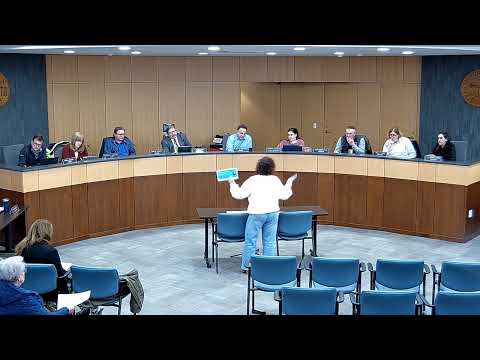
East Aurora residents pressed the Village Board on March 3 about recent utility pruning by O’Connell Electric on behalf of Go Net Speed and NYSEG, saying crews removed large limbs and left fiber-optic cable exposed near sidewalks.
The matter drew sustained public comment and a technical response from the arborist the village brought in. Jared, identified at the meeting as an arborist working with the village, told trustees the clearances crews are using are tied to minimum-approach-distance safety charts and the voltage on lines: “The reason why they're getting these clearances on these lines is because of the potential for electrocution,” Jared said, adding that tree sap can conduct electricity and that crews who are not certified as line-clearance electricians must observe conservative buffers.
The residents’ nut graf: speakers said the scale of cutting has damaged the village’s tree canopy, that crews left fiber cable in snowbanks on King Street on Feb. 19 and elsewhere, and they asked the board to force stricter oversight. “Any child could have pulled these,” Holly Maciaszek told trustees, describing fiber-optic cable she found in a snowbank and citing safety concerns about glass shards inside fiber lines.
Why it matters: residents and the tree board said East Aurora’s mature tree canopy is central to village character and business activity, and they pressed the village for two kinds of relief: (1) an immediate pause or more careful supervision while the village secures written specifications and an independent overseer paid by the contractor, and (2) either a smaller “trim box” for village settings (residents cited 6-foot clearances used in some municipalities) or more frequent trimming so crews can take less each visit.
What trustees and staff said they’ve done: Village staff and trustees said they have already sought reviews and put a short stop-work pause in place while state and utility reviewers examined the work. Shane (staff member) said the village’s attorney and staff have contacted the Public Service Commission and NYSEG, and the board has requested NYSEG provide trimming specifications and the village’s municipal utility franchise agreement so the board can understand its leverage. Shane said he would check with OSHA to see whether the 10-foot distance being enforced is federal OSHA rule or a different standard and to pursue any available variance.
Technical tradeoffs and disagreement: Jared and other speakers explained why trimming distances vary by line voltage and by whether the crew is an electrical-line crew or a communications crew. Jared said minimum approach distances come from line-voltage guidance and that for many of the larger limbs now being removed the work reflects decades of deferred maintenance: “I believe it's almost 30 years since they've come through… So the fact that it wasn't done for so long… they're having to take major limbs off of these trees because it hasn't been pruned.”
Residents pushed back on whether the 10-foot clearance is always necessary in dense, urban village streets. Nancy Smith and others said National Grid and some municipalities in New York operate with smaller trim boxes and more frequent return cycles; Smith said she had spoken that day with a National Grid representative who described smaller-venue trim options and municipal partnerships that allow more frequent maintenance and smaller clearances.
Next steps described at the meeting: staff said they will (a) press NYSEG for written trimming specifications and for a copy of the franchise/agreement that governs utility work in the village, (b) check with OSHA and state regulators about possible variances, (c) continue the village’s review of individual trees for survivability and removal where canopy loss exceeds thresholds, and (d) log and forward safety concerns (fiber left in snowbanks) to the contractor and utility. Trustee Jeff asked DPW to track follow-ups with NYSEG and to insist on a five-year trimming cadence going forward.
Community context and conditions: speakers identified multiple locations affected (King Street, Elmwood, Center Street, Fillmore, Mill Road and Main Street corridors) and said the work has drawn repeated public comment at prior meetings. Jesse Griffiths, chair of the Tree Board, confirmed Stan Puffer is a certified arborist and reiterated the board’s “right tree, right place” planting guidance to avoid future conflicts between utilities and mature-stature trees.
What the board did not do: trustees did not take a formal policy vote at this meeting on trimming standards or penalties for contractors, nor did they adopt a local ordinance changing clearance distances. Staff and trustees instead described outreach and information-gathering tasks they will pursue before any binding action.
Ending: The board invited continuing public submissions of photos and locations of questionable cuts, said it will circulate any NYSEG or regulator responses to the public, and asked residents to use the village website and meeting recordings to follow the item as staff pursues written specifications and the franchise agreement.