Get Full Government Meeting Transcripts, Videos, & Alerts Forever!
Get email alerts on the Septic Maintenance topic
No spam. Unsubscribe anytime.
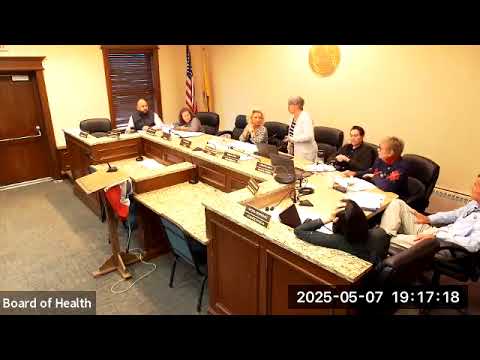
Hopatcong board discusses proposed septic maintenance ordinance, takes no vote
Summary
The Hopatcong Board of Health discussed a draft ordinance to require periodic septic pumping and a tracking system aimed at protecting Lake Mohawk; board members raised enforcement, staffing and exemption questions and directed staff to continue research and consult county, engineer and legal counsel.
Members of the Hopatcong Board of Health discussed a proposed septic maintenance ordinance designed to require periodic pumping and a municipal tracking system intended to protect Lake Mohawk and public health. No vote was taken; the board directed further research and review by county public‑health staff, the municipality’s engineer and legal counsel, and discussed steps necessary to move any ordinance before the borough council and the land use board for adoption.
Board members said the draft under discussion would add requirements to the borough’s septic code. The group discussed a common proposal — pumping every three years — and noted that some new systems are allowed longer intervals (up to six years). Several members emphasized that rules must include exemptions or waivers for larger systems or newly installed systems, and that enforcement procedures need to be spelled out before adoption.
Discussion focused on how the town would track compliance and who would enforce any new requirement. Board members noted the county reviews municipal drafts but does not perform enforcement; enforcement would require placing the requirement in the borough’s land use code and adoption by the council so enforcement could be carried out through land‑use mechanisms. Several participants said staffing and recordkeeping present significant challenges and that the town would need a practical system — for example, tying proof of pumping to an existing municipal process such as tax billing or rental licensing — rather than relying on ad hoc compliance.
Board members also debated prioritizing lakefront properties and short‑term rentals for stricter schedules. One option discussed would require lakefront properties to follow a staggered odd/even year schedule to make enforcement and tracking easier. Short‑term rentals were suggested as candidates for more frequent pumping because of unpredictable occupancy levels.
Speakers raised real‑world examples to illustrate enforcement gaps: one participant described buying a property in a cash sale where an old cesspool had failed and the new owner paid to pump frequently until a replacement system (cost cited about $65,000 in that anecdote) could be installed; board members said the state law that limits sales of properties with failed systems when banks are involved has not eliminated such situations when transactions are cash.
Several board members said they had reviewed sample ordinances from neighboring towns (Jefferson and others) and that local practice varied; Lake Mohawk’s own rule requiring pumpouts at least once every three years for certain systems was cited as an example to consider. The board repeatedly emphasized that any final ordinance must include clear procedures for exemptions, documentation, and enforcement and that community education would be necessary to secure compliance.
Next steps recorded in the discussion: staff will continue research, circulate the draft to the county public‑health office for review, obtain additional input from the borough engineer and municipal attorney, assemble examples from nearby municipalities, and return the revised draft for further discussion. Board members noted that after local board and council review, an ordinance would likely be introduced at council, referred to the land use board, then returned to council for final action.