Get Full Government Meeting Transcripts, Videos, & Alerts Forever!
Get email alerts on the Zoning Policy Partial Destruction topic
No spam. Unsubscribe anytime.
Board discusses 'partial destruction' rule for rebuilding after damage; leans toward pragmatic approach
Summary
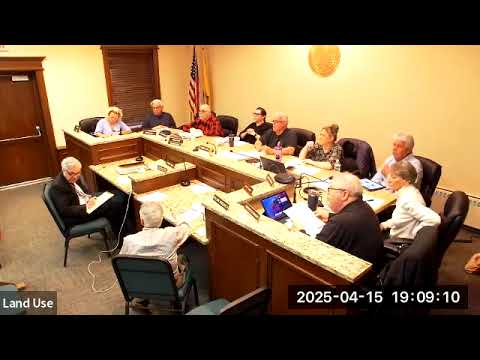
At a work session the Hopatcong Planning Board discussed how to interpret the municipal/State rules on "partial destruction" of structures. The board reviewed guidance from Cox and weighed enforcement risks; members generally favored allowing reconstruction within the same footprint where practical.
Hopatcong Planning Board members spent a work-session segment reviewing how the municipal ordinance and state municipal-land-use law treat "partial destruction" of buildings after events such as fire or storm.
The board discussed prior local ordinance language dating to about 2003–2004 that had allowed rebuilding where partial destruction occurred. The transcript records the board’s examination of the municipal-land-use-law constraints that prompted a change to the local ordinance several years ago and the practical guidance found in Cox (a standard zoning guidance text). As summarized during the session, the zoning guidance commonly used by municipal professionals recommends that if a foundation remains and two walls remain, the situation is often treated as partial destruction that permits rebuilding without the full variance process.
Nut graf: Board members expressed sympathy for homeowners who face substantial reconstruction costs but also recognized legal limits: if a structure is removed down to foundation only, municipal land-use law may require full variance review. The board’s informal consensus at the session was to allow reconstruction that remains within the existing footprint and does not expand dimensional nonconformities, while noting that each case must be assessed individually and that the town’s ordinance must conform to state law.
Although members repeatedly described the practical difficulties of preserving old substandard structures, they emphasized the legal risk if a neighbor appeals and a board had misapplied the statute. A board speaker summarized the commonly used practical test: "if the foundation remains and two walls remain, it’s partial and it can be rebuilt without any of the variances that would exist." The session was explicitly nonbinding: the board held it as a work session to develop an interpretation, not to take a final vote.
Ending: The board concluded with a consensus to apply a case-by-case approach consistent with state law and Cox guidance and said staff would continue to monitor similar cases; when applicants proceed, the board or zoning officer will review structural conditions and whether rebuilding triggers variances before a formal application is approved.