Get Full Government Meeting Transcripts, Videos, & Alerts Forever!
Get email alerts on the Power Infrastructure topic
No spam. Unsubscribe anytime.
Planning commission approves preliminary site plan for DEMCO substation with conditions
Summary
The Livingston Planning Commission voted to approve a preliminary site plan for a new DEMCO substation near 4‑H Club Road, contingent on vegetation buffers, fencing, noise data and further feasibility analysis of an alternate site proposed by residents.
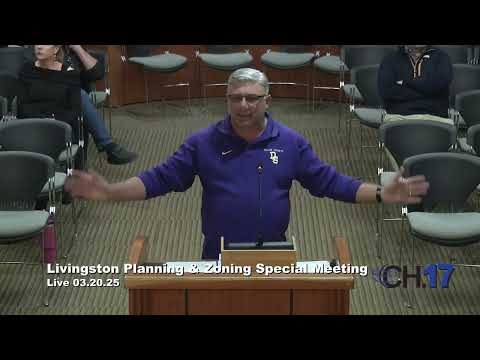
The Livingston Planning Commission voted to approve the preliminary site plan for a DEMCO substation near 4‑H Club Road on March 20, approving the project with conditions that include a visual buffer with vegetation, solid fencing, submission of transformer noise data with the next plan and a feasibility review of an alternate nearby property offered by residents.
The commission’s action came after more than two hours of public comment and technical testimony from DEMCO staff and outside engineers about growing electrical load in the area and why the utility selected the site it did. Clifton Brown, a parish council member who lives in the area, and several neighbors urged the utility to consider a parcel they said is closer to an existing transmission line and would keep the substation farther from houses. “Main transmission line going right through my property,” landowner Kurt Freeman told the commission, saying DEMCO had not contacted him before buying the proposed site.
DEMCO representatives said engineering models and load studies show the chosen site best meets system needs. “So the problem is voltage drop,” Matt Gibson, DEMCO director of engineering, told the commission, explaining that distance from existing substations — not transformer size — causes low voltages on long runs and is the reason for a new local substation. DEMCO’s manager of substations, Eric Huber, said the utility is considering two new substations in the parish to address growth. “This is one of two that we’re looking to add to our system,” he said.
An electrical engineer who advised residents, Darren Gray, urged the commission and DEMCO to consider alternatives such as voltage regulators or a site he said would be cheaper to serve. “Voltage regulators will fix the problem of voltage dip on their existing line,” Gray said. DEMCO engineers responded that regulators and other less‑invasive fixes would not address the scale of load growth they see and that regulators at the required capacity are inefficient and prone to failure.
DEMCO staff described the studies performed during the contract due‑diligence period, including environmental reviews (wetlands, watershed, endangered species) and engineering modeling used to test candidate sites. DEMCO said some nearby parcels were considered but did not meet the combination of transmission access, seclusion from residential yards and roadway access required by the utility and its consultant. Company representatives also said permitting and mitigation for an alternate site could add months to the schedule; DEMCO told the commission it is under a time pressure to relieve low voltages that some residents said are already down to about 106–108 volts.
Commission members repeatedly distinguished their role as applying local ordinances to the submitted plan, not choosing sites for utilities. Commissioners said they were receptive to mitigation measures to reduce the project’s visual and acoustic impacts and asked DEMCO to place commitments on the final plat. The substitute motion that passed — offered by Commissioner Wax and seconded by Commissioner Clemens — requires DEMCO to include a vegetative buffer and solid fencing, provide transformer noise data with the next submittal, and perform an analysis of the feasibility of the alternate parcel identified by residents before final approval.
Vote at a glance: The substitute motion to approve the preliminary site plan with conditions passed; Commissioner Engler abstained; Commissioner Burns voted no; other members voted in favor and the motion passed.
The commission noted that preliminary approval does not remove DEMCO’s obligation to complete required studies, obtain permits (including any Army Corps mitigation for wetlands) and secure financing approvals (the utility cited Rural Utilities Service standards for federal financing) before final construction permits are issued. Opponents said those later steps do not address their immediate concern that DEMCO did not approach certain landowners earlier in the site selection process and asked the commission to attach conditions to protect adjoining residents’ visual and acoustic environment.
What’s next: DEMCO will submit the additional studies and the required noise data and show the committed visual buffer and fencing on the final plat. The commission’s approval covers the preliminary site plan only; DEMCO must return with final materials and permitting documentation before construction can begin.