Get Full Government Meeting Transcripts, Videos, & Alerts Forever!
Get email alerts on the Subdivisions topic
No spam. Unsubscribe anytime.
Ordinance committee forwards draft to council to formalize subdivision review, raise maintenance bond to 20%
Summary
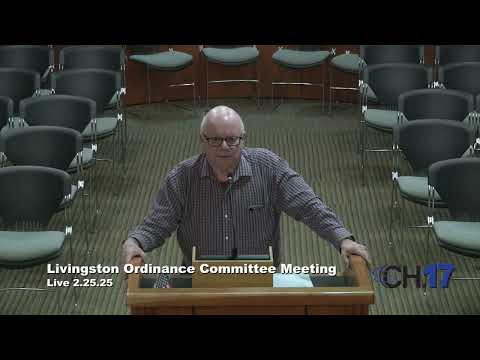
Livingston Parish ordinance committee members on Feb. 25 agreed to forward to the Parish Council a draft ordinance that would formalize how subdivisions with improvements are reviewed and increase the required maintenance bond to 20% of project cost.
Livingston Parish ordinance committee members on Feb. 25 agreed to forward to the Parish Council a draft ordinance that would formalize how subdivisions with improvements are reviewed and increase the required maintenance bond to 20% of project cost.
The proposed amendment to Chapter 125, Section 68 of the parish code would require a formal pre‑application meeting with parish staff, clarify that the 60‑day state review period begins only after a completed application is filed, remove language permitting performance bonds as an acceptable security instrument, and raise the maintenance bond from 15% to 20% of total project cost.
"Section 125‑68 already exists in your code of ordinances. It's under the Unified Land Development Code. What we're trying to do here is formalize the process," Jerome Fournier of JPF Planning Consultants LLC told the committee, describing the draft. He said the pre‑application meeting would bring together the planning director, assistant director, parish engineer and drainage staff to spell out the studies an applicant must submit.
Fournier gave examples of how study scope would scale with project size: a 500‑unit subdivision would typically require a broader traffic and drainage study than a 40‑unit subdivision. "If the application is fully complete ... the planning director will schedule that before the planning commission for either approval, denial, or approval with conditions," Fournier said.
Committee members asked how the draft interacts with state law that automatically approves a preliminary plat if the parish does not act within 60 days. "We're not changing that. That's state law," Fournier said, and added the ordinance would change the local trigger that starts the 60‑day clock by requiring the parish to notify applicants within three days if an application is incomplete so the statutory review period does not begin until the submittal is complete.
Fournier also said the draft removes performance bonds, which he described as riskier for the parish because a developer could record lots without completing improvements, leaving the parish responsible if the developer fails to build them. The draft instead keeps a maintenance bond and raises it from the current 15% to 20% of total project cost to fund post‑completion inspections and any needed repairs.
A committee member asked for clarification on the waiver process and whether some waivers go first to the Planning and Zoning Commission before returning to the council; committee members confirmed that is the typical procedure. After discussion, members agreed to send the draft ordinance to the Parish Council for consideration on the council agenda.
The agenda also included a separate proposed noise ordinance (Chapter 22) filed by Councilman John Mangus; the committee pulled that item for additional work and did not discuss it further.
Next steps: the draft ordinance will appear on the Parish Council agenda for further review. The committee did not record a formal roll‑call vote on the referral at the meeting transcript.