
Livingston Parish planning commission sends subdivision-procedures amendments to council after clarifying definitions and timelines
Get AI-powered insights, summaries, and transcripts
Sign Up Free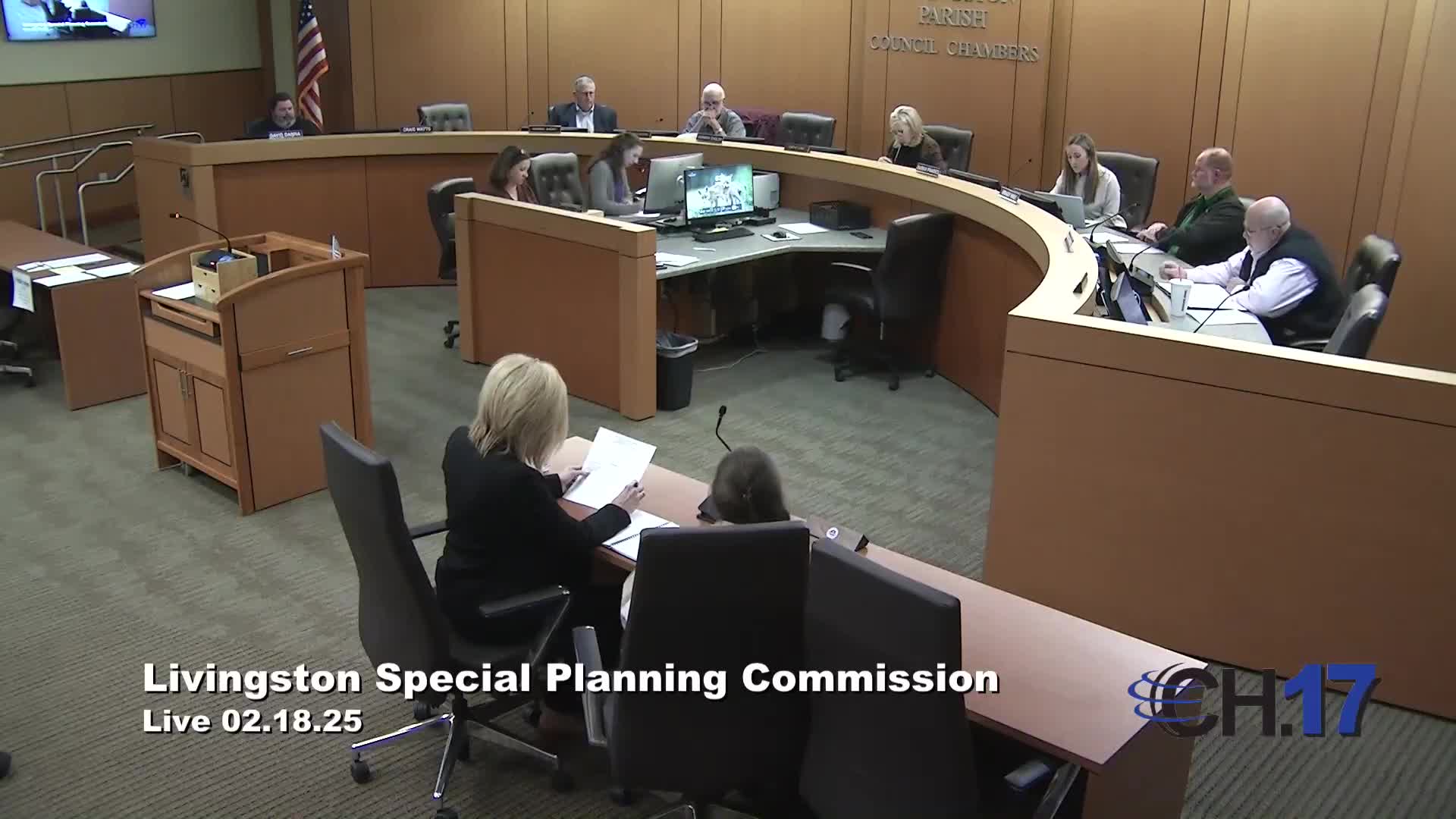
Summary
At a Feb. 18 special meeting the Livingston Parish Planning Commission voted to forward proposed amendments to Chapter 125, Section 125-68 of the parish code to the parish council with edits addressing the 60-day approval trigger, as-built drawing timing, flood-map and FONSI definitions, and a maintenance-bond percentage.
The Livingston Parish Planning Commission on Feb. 18 voted to forward a proposed ordinance amending Chapter 125, Section 125-68 of the Livingston Parish Code to the parish council with several clarifying edits, including changing a maintenance-bond percentage and spelling out when the 60-day statutory approval clock begins.
Commissioners moved the package after discussion about several technical items in the draft ordinance: how the 60-day approval period specified by state statute is triggered, how and when as-built drawings must be submitted, explicit definitions for the FEMA Flood Insurance Rate Maps (FIRM) and the term “FONSI,” and corrections to maintenance-bond language. The planning commission’s motion sent the ordinance to the council “with the amendments we discussed, particularly rewording from 15 to 20% of the maintenance bond.” The motion passed with seven yes votes and no opposing or abstaining votes.
Why it matters: The changes aim to align local subdivision procedures with state law and remove ambiguities that commissioners said could cause unintended approvals or inconsistent review. Planning staff told the commission the proposal intends to set a clear trigger for the state-mandated 60-day review period so plats are not automatically deemed approved because the commission did not act within the statutory window.
Planning staff read the relevant statute into the record, saying, “A planning commission shall approve or disapprove a plat within 60 days after the submission thereof to it. Otherwise, such plat shall be deemed to have been approved, and a certificate to that effect shall be issued by such permission on demand.” The ordinance amendment, staff said, defines the 60-day clock as starting when the planning department notifies the applicant that a “full and complete” application has been received, not necessarily the date the file first arrived.
Commissioners asked for a clearer procedural detail about the department’s completeness review. Planning staff confirmed there will be a short window for the department to assess completeness and then notify the applicant; commissioners asked that the ordinance explicitly reflect that the clock begins only after the planning director declares an application complete. Staff also noted that some applicants provide documents in stages (for example, grading or drainage materials submitted before paving) so the ordinance language should allow staged as-built submissions while making clear that final as-built drawings are produced after construction.
Several commissioners raised concerns that one provision’s current wording implies an as-built must be submitted before construction begins. One commissioner said the language “makes it sound as if you're submitting an as-built before you begin construction,” and planning staff agreed to revise the wording so it clearly requires as-built drawings after completion of the applicable construction phase and allows staged submissions when necessary to review drainage prior to covering surfaces.
The commission also requested clearer definitions in the ordinance for two acronyms that appear in the draft. Planning staff agreed to add language defining FIRM as the Federal Emergency Management Agency’s Flood Insurance Rate Maps and to explicitly identify what is meant by “FONSI,” which the draft currently references but does not define.
Commissioners discussed how the ordinance will capture input from external agencies. Planning staff said the parish normally solicits comment from entities such as the school district; however, school officials typically provide a letter showing estimated student counts by grade rather than a formal impact study. Planning staff said those letters are informational and should be included in the application packet so the commission and council can consider school impacts.
After finalizing the clarifications discussed at the meeting — including correcting typos, changing the maintenance-bond language to reflect 20% (and updating the related expiration timing to the agreed period), and adding definitions and completeness language — the commission voted to forward the amended ordinance to the Livingston Parish Council.
The discussion also included a brief announcement from Nathan Lipson of WSP, the firm preparing a parish master plan and zoning-code materials; Lipson told the commission that the parish website under the council’s zoning tab is the official source the WSP team is using for existing zoning information in Districts 17 and 8 and that WSP has posted recommended changes there. Lipson said signs had been posted in the community to advertise the Feb. 27 council hearing on the zoning code.
The planning commission’s recommendation, with the amendments discussed at the meeting, will be considered by the Livingston Parish Council at its next scheduled hearing.