Get Full Government Meeting Transcripts, Videos, & Alerts Forever!
Get email alerts on the Zoning topic
No spam. Unsubscribe anytime.
Livingston Parish Council adopts interim parish-wide zoning ordinance after extended debate
Summary
After hours of public comment and multiple amendments, the Livingston Parish Council voted to rescind and reenact Chapter 1-17 of the parish code as an interim, parish-wide zoning framework. Council members said the action stabilizes development until a new parish master plan is finished, which staff estimates around July 2025.
The Livingston Parish Council on Feb. 27 adopted an interim, parish-wide zoning ordinance — rescinding and reenacting Chapter 1-17 of the parish code — after a series of clerical and map-correction amendments and several hours of public comment.
Councilmembers and planning staff said the measure is a first-phase move meant to stabilize land use across the parish while the administration and consultant finish a new master plan. "It is estimated that the new master plan will be ready in about July 2025," said Steve Everett, who presented the ordinance changes to the council.
Why it matters: The ordinance establishes a temporary, uniform zoning framework across council districts that previously lacked consistent maps. Supporters said it reduces legal vulnerabilities that grew out of fragmented zoning notices and court challenges; critics said some landowners learned of zoning changes only when maps were published and asked for more time and outreach.
What the council did: The body considered three sets of amendments before final adoption. The first set made clarifying and definitional edits to uses and definitions in the proposed code language; the second corrected map errors to match previously established legal zoning for parcels in Districts 1, 7 and 8 (the ordinance text identified 3,067 parcels that had been mismatched, including 707 parcels); the third set applied consultant recommendations to hundreds of additional parcels across all districts that previously had no established zoning. Amendment 2 passed on a recorded vote, 8–1; other amendment votes and the final ordinance passed unanimously.
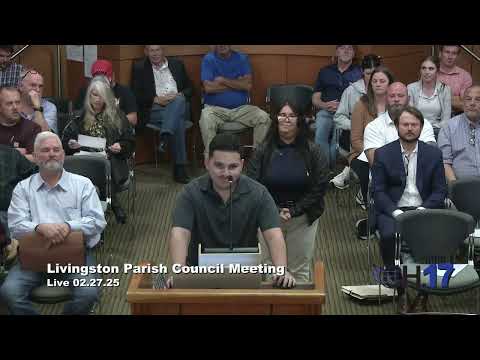
Public comment and council response: Dozens of residents and property owners addressed the council. Eric Tong, a Port Vincent resident, said he worried the maps allowed denser development than his area’s character supports: "I commute from Port Vincent to BR every single day ... I don't think there really should be any more of that high-density development in Livingston Parish." Wade and Stacy Milton, who own 46 acres off 4-H Club Road, asked the council to preserve an R-2 designation for their property because of its intended family use and proximity to existing subdivisions. Planning staff and the presenter repeatedly told speakers that individual rezoning requests can still be filed and will be considered under the new master plan process.
Procedure and next steps: Presenters and staff described the action as "phase 1" or "interim zoning": it applies the existing master plan and previously established zoning where applicable while the parish completes a new master plan. Staff said individual property owners may apply to rezone parcels later; the administration indicated it would waive rezoning fees and try to expedite hearings for affected residents. The council and staff emphasized that the parcel-by-parcel rezoning process requires separate notice to surrounding landowners and therefore will occur after the master plan is completed and published.
Council reaction: Several council members said the outcome was a necessary first step after years of piecemeal zoning attempts. Councilman Joe Gough said the action restores consistent coverage across the parish and pledged that staff would reach out to landowners who missed prior notices. Councilman Mitch Coates said he wanted more public engagement but supported moving the interim maps forward to provide legal clarity.
What the ordinance does not do: The adopted ordinance does not itself finalize long-term zoning decisions tied to the future master plan, and it does not remove the public’s ability to request rezoning. Staff and council members repeatedly distinguished between "discussion only" remarks and formal rezoning actions that require separate application and notice.
Ending: Councilmembers and staff said they expect more hearings tied to the master plan later this year and reiterated that property owners who wish to contest or seek different zoning now can apply to do so during the follow-up process.