Get Full Government Meeting Transcripts, Videos, & Alerts Forever!
Get email alerts on the Parks Recreation topic
No spam. Unsubscribe anytime.
Consultant presents parks and recreation strategic plan; staff eye new staffing, increased maintenance funding and indoor facility needs
Summary
A consultant told Temple City Council at workshop that a 13‑month parks and recreation strategic planning process supports raising maintenance funding, adding mid‑level park operations leadership and communications staff, formalizing cost‑recovery targets and studying an additional indoor recreation facility.
The consultant engaged for Temple's Parks & Recreation strategic plan presented findings from a 13‑month study that combined staff interviews, a statistically valid mailed survey, site and facility assessments, and an organizational review.
The consultant (Pro to Consulting) said the survey obtained 365 responses—meeting the project’s target—and produced a margin of error of about +/-5.2%. He summarized headline findings: Lions Park, Crossroads Park and Miller Park were the most‑used parks; Crossroads Park, Walker Pool and Sammons Community Center received the highest condition ratings; and 52% of respondents reported participating in at least two or three park programs or events in the prior year. The consultant said the top facility priorities were a farmers market, multi‑use paved trails and a dog park; top program priorities included farmers market, adult fitness and senior fitness.
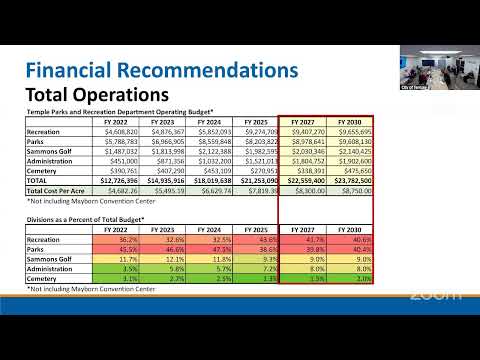
Key consultant recommendations included: strengthen preventative maintenance and raise annual maintenance funding per acre from current levels toward a target of approximately $4,500 per acre; consider a phased conversion of some fields to artificial turf to reduce irrigation demand and increase availability; pursue a formal cost‑recovery framework for programs and facilities; add staff capacity (communications/marketing support, parks division director, a volunteer coordinator, park rangers and mid‑level crew leads); and evaluate the need for an additional indoor recreation facility or field house.
The consultant described the city’s capital spending on parks over the past 30 years (inflation‑adjusted) at roughly $80 million, with Crossroads Park accounting for about 30% of that investment. He said the strategic plan flags an asset‑management focus—"take care of what you already have"—as the top community funding priority and recommended a stair‑step budget approach that would increase operations toward an approximate optimal run rate near $24 million annually over several years.
Council and staff discussion noted the plan will support the parks department’s accreditation goals and internal organization. Kevin (city staff) and Leah (parks staff) described internal benefits already realized from the planning process—for example, forming a cross‑department team of staff to carry forward implementation and to give program managers clearer direction on program evaluation and pricing. The parks director said the plan provides both a foundation for an upcoming master plan and a framework to develop a formal cost‑recovery policy and staffing/business plans for core program areas.
The presentation concluded with staff and council agreeing to use the strategic plan’s analysis and recommendations to guide future master planning, program evaluation, and budget proposals; no formal council vote on adopting the plan was recorded at the workshop.