Get Full Government Meeting Transcripts, Videos, & Alerts Forever!
Get email alerts on the Public Transit topic
No spam. Unsubscribe anytime.
Hill Country Transit District reports ridership gains, shorter waits after system redesign
Summary
Hill Country Transit District General Manager Raymond Suarez told the City Council workshop that the transit agency’s year‑long overhaul has produced sharply improved on‑time performance, shorter waits and growing ridership across the region.
Hill Country Transit District General Manager Raymond Suarez told the City Council workshop that the transit agency’s year‑long overhaul has produced sharply improved on‑time performance, shorter waits and growing ridership across the region.
Suarez said the district replaced its fleet, redesigned routes to create a high‑frequency regional commuter spine, extended hours of service and integrated on‑demand trips with Uber and other providers to fill gaps. “For the record, I’m Raymond Suarez, the general manager of the Hill Country Transit District,” he said, and added the changes followed a 2021 consultant assessment and a 2023 strategic visioning process.
The changes matter because they aim to reverse declines in transit use and to make the system useful for more trip types, Suarez said. The district now runs about 14 hours a day (up from roughly 12), reports average waits of about 10–12 minutes on many services (versus roughly one hour under the prior design) and on‑time rates near 92–93 percent compared with about 60 percent previously. Suarez credited a new business intelligence platform, electronic fare payments, vehicle tracking and expanded staff for the improvements.
Nut graf: The board hired a private manager and executed multiple technical and operational changes—fleet replacement, consolidated banking and payroll systems, regional route redesign and a contractual integration with Uber—that agency leaders say produced measurable early gains in service reliability and ridership growth.
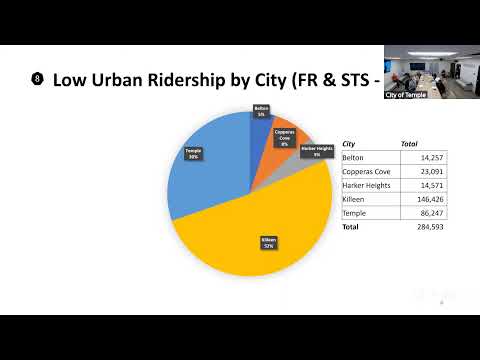
Key results and details described by Suarez included: about 284,000 total passenger trips across the district in the reporting period, roughly 86,000 trips in Temple, and a separate commuter service that reported about 230,000 trips in its first year. Suarez told the council that Fort Cavazos is contributing approximately $500,000 a year to the commuter connector and that, if formally recognized as a public transit stop, the district would be able to count those rides for federal apportionment purposes.
Suarez also described governance and territorial changes. He said five counties previously in the district are migrating to neighboring transit agencies, asset transfers have been negotiated and the Hill Country Transit District will operate a smaller, reconstituted district covering Killeen, Temple, Belton, Copperas Cove and Lampasas (as described by Suarez) when a March governance reorganization takes effect. Suarez said the board will reduce from 14 to nine members and elect a new chair and vice chair at the March meeting.
On operations, Suarez said managers replaced the fleet in one year, negotiated new parking to reduce “deadhead” (nonrevenue) miles, consolidated three service types (nonemergency medical, demand response and fixed route) into a single integrated system, removed underused shelters and hired additional drivers—mixing part‑time and full‑time staff to reduce overtime and overall cost. He said the district consolidated 13 bank accounts and migrated payroll and accounting systems to the cloud; the financial systems remain an area for further work.
The agency also reported reliance on a mix of provider types to maintain service during staffing shortages. Suarez said roughly 20–30 percent of on‑demand trips are currently performed by Uber under the district’s brokered arrangement; he described the integration as trip‑by‑trip and federally required to preserve paratransit and on‑demand access options.
Council reaction was positive in the meeting record. A councilmember described the result as “government at its best,” and several thanked agency staff and the private manager for the work. Suarez noted remaining priorities: marketing and community engagement, bylaw and governance housekeeping at the board level, and continued work on communications and brand awareness so residents understand how to use the new system.
The workshop closed with the council moving into executive session to seek legal advice on a separate matter: “to receive advice from the city attorney regarding legal ramifications of a contract termination,” cited under Texas Government Code section 551.071, with no final action to be taken, according to the meeting record.
Ending: Suarez told the council he considers the transformation “an honor” and said staff plans further outreach, marketing and future reporting once the district completes six months of operating data under the redesign.