Get Full Government Meeting Transcripts, Videos, & Alerts Forever!
Get email alerts on the Drainage And Flood Mitigation topic
No spam. Unsubscribe anytime.
Harlingen, drainage districts outline projects, maintenance schedule and funding gaps after heavy March rains
Summary
City staff and leaders of Drainage Districts 5 and 6 described emergency response, ongoing detention-pond and channel projects, and delays in federal and state grants following a March storm that dropped more than 20 inches of rain in parts of the region.
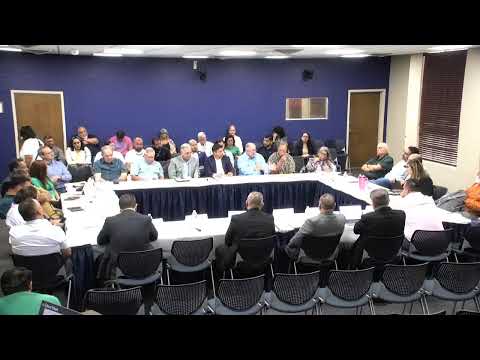
At a joint meeting of the Harlingen City Commission and Cameron County Drainage Districts No. 5 and 6, city and district officials described the local response to heavy March rains, the status of major drainage projects, and the need for clearer public information about who maintains which ditches.
Public Works Director Chris Portoldos summarized the city’s in-house drainage program, including equipment purchases and recent in-house projects that city staff say reduced flooding during the March storm. “We purchased an excavator, 2 dump trucks, 1 double trailer, 1 front loader and 1 backhoe for the total expenditure of $1,200,000,” Portoldos said, and he reported a drainage crew that the city created in fiscal 2023 and annual drainage personnel costs of about $253,000. Portoldos said the city’s detention-pond project is about 78% complete and credited the in‑house work with reducing the duration of flooding in some neighborhoods after the March event.
The March storm brought extremely heavy rainfall. Portoldos said rain gauges and an application used by staff showed the city received “22 inches within a span of 19 hours,” and he described an immediate multi‑agency pumping response that, by Tuesday after the event, largely stopped pumps citywide except in a few subdivisions still being worked on.
Rolando Bella, general manager of Drainage District No. 5, and his engineers outlined longer-term projects and legislative efforts intended to improve valley‑wide drainage. Bella noted that the state now recognizes the term artificial drainage system in the Local Government Code and described recent bills and outreach to state agencies to speed environmental reviews and require drainage planning be included in transportation projects. “Flood mitigation means lessen the severity of water,” Bella said, framing the district’s goal as reducing the frequency and depth of flooding rather than preventing every flood in an extreme storm.
Eric Seiby, drainage engineer with Shibe Consulting, placed recent rainfall in context: “A 100‑year event in these models is somewhere around 11 or 12 inches in 24 hours,” he said, noting that the March totals substantially exceeded model design storms and that the district’s master plan and 2‑D modeling done since 2016 were used to identify candidate projects.
Officials described a long pipeline of projects—detention ponds, channel reshaping and levee certification—many of which are at design or right‑of‑way acquisition stages and are awaiting environmental clearance or formal funding awards. Bella and district engineers said several projects funded or conditionally approved years ago are stalled in environmental review and federal approval processes. Bella said one large mitigation grant was canceled by executive order at the federal level after the district had worked on the application and technical assistance.
Drainage District No. 6 Board President Josh Rubison and General Manager Javier Jimenez reported rapid startup since the district’s 2021 creation: voters approved a $22.5 million bond package, the district has put roughly $5 million of local funds into design and right‑of‑way, and the district submitted 10 Flood Infrastructure Fund (FIF) applications totaling about $42.5 million (roughly $19.7 million in grant-eligible portion, the rest structured as low-interest loans). Rubison said pumps and temporary measures during March helped speed drainage in many areas and that several projects are “shovel ready” pending final funding.
Speakers and multiple staff emphasized public confusion about maintenance responsibility for ditches inside city limits that are owned by irrigation or drainage districts. Commissioners and district leaders agreed to publish maintenance schedules and links so residents can see which agency is responsible for a particular ditch and when maintenance is planned. District staff said they typically schedule ditch mowing and maintenance about three to four times a year, but heavy rain and access problems can extend that timeframe.
Officials also agreed to increase staff coordination: district and city managers will pursue a regular (monthly) coordination call or Zoom to share schedules, urgent maintenance needs and project status. City and district leaders asked the public for patience while they complete right‑of‑way acquisitions and environmental clearances that they said are prerequisites for construction of large detention and channel projects.
The meeting closed with officials urging residents to consider flood insurance and to watch for soon‑to‑be‑published maps and schedules showing district maintenance and major project timelines.
Ending: City and district staff said they will provide copies of the presentation to commissioners, publish a maintenance and work schedule linked from the City of Harlingen website, and pursue coordinated outreach to lawmakers and federal agencies to speed environmental reviews and funding approvals.