Get Full Government Meeting Transcripts, Videos, & Alerts Forever!
Get email alerts on the State Legislation topic
No spam. Unsubscribe anytime.
City staff outlines state legislative items that could affect Temple, including property tax relief and water-storage proposal
Summary
A city staff member gave a legislative briefing at a Temple City Council workshop, reviewing Governor Abbott and lieutenant governor priorities, dozens of filed bills that could affect local zoning, property tax calculations and public safety, and local plans to pursue legislation supporting an aquifer storage and recovery (ASR) project.
A staff member delivered a legislative update at the Temple City Council workshop on Feb. 18, summarizing state priorities and dozens of bills already filed this legislative session that could affect the city.
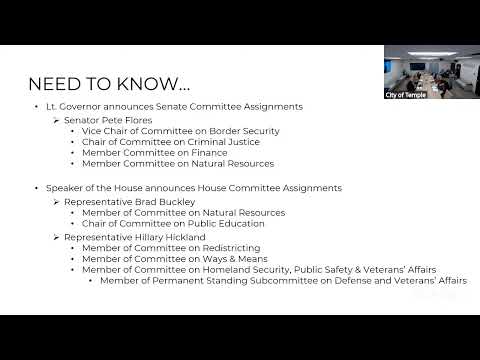
The presentation listed Governor Greg Abbott’s emergency items including proposals for property tax relief and other priorities the speaker said included investments in water infrastructure, teacher pay, career training and school choice. The lieutenant governor’s agenda was summarized as well; the staff member said the lieutenant governor has released part of a 40-item list of priorities.
Why it matters: the city is actively tracking bills that could change local authority over zoning, annexation, tax calculation and other routine municipal activities; staff said some proposals may require new local action or could constrain city options.
Key items the presenter identified - Property tax relief: the staff member said the governor is proposing a significant property tax relief package and changes to homestead exemptions; several bills were filed that would limit appraised-value increases and change how the first-year appraised value is set for newly acquired homesteads. The presenter cited House Bill 1898 (limit to annual appraisal increases) and Senate Bill 244 (appraisal rules for homesteads). - School choice: Senate Bill 2 and House Bill 3 on school choice were flagged as high-profile and potentially contentious items that could draw floor time away from other measures. - Zoning, annexation and notice changes: bills the presenter named included HB 2687 (revising zoning regulation procedures), SB 1160 (extending notice from 15 to 30 days and expanding notification radius to 1,500 feet) and HB 2484 (petition-based disannexation where services are not provided). - Impact fees and capital planning: HB 2225 was described as amending local government code on land-use assumptions, capital-improvement plans and impact-fee processes, including public-notice timing and a three-fourths governing-body vote for new fees. - Property-tax forms and reinvestment zones: SB 1023 (tax-rate calculation and electronic forms) was mentioned; the presenter said it would require electronic calculation forms and separate calculations for reinvestment zones. - Local finance and procurement: HB 1998 was listed as raising the competitive procurement threshold from $50,000 to $100,000. - Public safety and labor: the staff member summarized several bills affecting police and fire departments, including HB 2098 (civil-service changes for municipalities of 25,000 or more) and HB 2175 (rights for police and fire employees to circulate petitions and related meet-and-confer items while on duty). - Immigration/ICE and intergovernmental agreements: staff described a bill under discussion that would require cities with police departments to reach out to ICE and to make officers available for ICE activities; staff said they are recommending that statute put the onus on ICE to request local assistance rather than forcing cities to contact ICE proactively. - Group-home rules and DFPS: SB 104 (as discussed by staff) contains new rules for group homes; the presenter said the bill includes exceptions for state and federal agencies and for some facilities and that staff are working to narrow its scope and to ensure any DFPS facilities that meet the bill’s definition are routed through the same notice and planning process the city would expect for similar uses.
Local legislative action and next steps - Staff said they are working with lobbyist Fred Shannon and consultant Emily Lindsey on legislation to support the city’s aquifer storage and recovery (ASR) project; Representative Buckley was identified by staff as set to file the ASR legislation imminently and city members plan to travel to Austin Feb. 27 to meet with committee staff and representatives. - The presenter recommended continued monitoring of the bills and coordination with municipal advocacy groups such as the Texas Municipal League (TML) and Focused Advocacy.
What the council did: the presentation was informational; no formal council action or vote was taken during the workshop. Staff said the legislative task force and city lobbyists will continue outreach in Austin.
Closing note: the presenter warned that many bills remain in early form and that staff would continue refining the list for council review.