Get Full Government Meeting Transcripts, Videos, & Alerts Forever!
Get email alerts on the Wastewater Operations topic
No spam. Unsubscribe anytime.
Temple examines bringing wastewater operations in-house as plant expansion nears
Summary
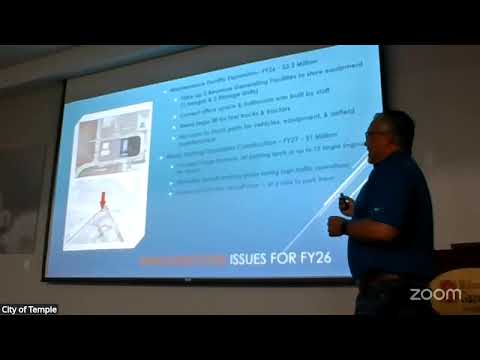
City staff told the council at a March 26 budget retreat that Temple is weighing taking over operation of the Temple–Belton wastewater plant from the current contractor, citing operational control during a planned expansion and persistent compliance issues under the contract.
City Manager said the city is actively considering assuming operational control of its wastewater plants from the current contractor to align operations with an imminent plant expansion.
At a March 26 budget retreat, City Manager summarized the case for change: “You either do this now so that the city of Temple is managing the plant. Now the expansion occurs, there’s a lot of benefits to that,” and said the city could accelerate its prior plan to move operations from fiscal 2027 into fiscal 2026.
Why it matters: Temple and a partner municipality share a major wastewater treatment plant that the contractor operates under a roughly 75/25 flow-based split. Council and staff said the timing of a planned expansion to the membrane treatment plant makes the question of who operates the facility strategically important: having city-employed staff in place as construction and commissioning occur would keep operational knowledge and change orders local.
Discussion and evidence: Utilities staff reported the city currently contracts plant operations and pays management and overhead fees to the contractor. City Manager said the city ‘‘overpay[s] about 1 and a half million every year’’ in contract-related overhead that could instead be directed to city staffing or equipment. Utilities presenters and council members raised two operational drivers for change: (1) recurring compliance and performance issues reported under the contract, and (2) the desire to have direct control over treatment decisions while the membrane expansion is built.
Kenton, a utilities staff member, told council that the wastewater program has reduced annual sanitary sewer overflows from roughly 300 to ‘‘down to, like, 70. Our goal is 0,’’ attributing progress to investments in interceptors, manhole rehabilitation and crew capacity.
Staff also flagged contract mechanics: the current agreement includes a 6‑month notice provision for termination and a management fee structure the city now questions. Utilities staff estimated the contractor’s local team is roughly in the mid-teens of people (about 15 operators/managers) and said the city could hire a comparable team if it chose to transition.
Council questions centered on timing, risk and coordination with the partner city. City Manager said the city would seek to ‘‘bring them along with us every step of the way’’ and that the council should decide whether to accelerate the planned transition to avoid changing hands while the expansion is under construction.
What was not decided: Council did not vote on any formal action at the retreat. Staff requested direction on whether to accelerate planning and outreach to the partner city and contractor; City Manager said that would require further coordination and would not be unilateral.
Next steps: Staff recommended continuing planning, refining cost and staffing estimates, and initiating formal conversations with the partner municipality and the contractor if council wants to move the transition earlier than the current plan.