Get Full Government Meeting Transcripts, Videos, & Alerts Forever!
Get email alerts on the Parks Recreation Grants topic
No spam. Unsubscribe anytime.
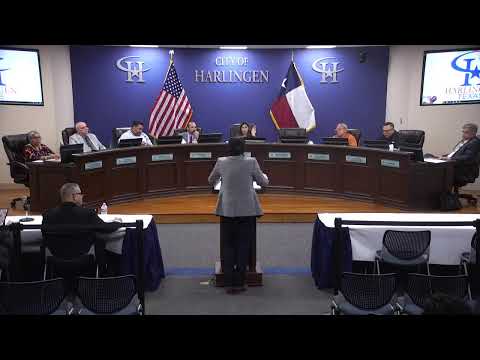
Harlingen commission approves three projects to pursue Outdoor Recreation Legacy Partnership grant
Summary
The Harlingen City Commission approved a slate of parks projects — including the soccer complex, Wilson Sports Complex and Royal Park — to submit for the Outdoor Recreation Legacy Partnership grants program, with commissioners debating turf, parking, accessibility and costs before the vote.
The Harlingen City Commission voted to submit three projects for the Outdoor Recreation Legacy Partnership grants program, approving a proposal that lists the Arlington Soccer Complex, the Wilson Sports Complex and Royal Park as the city’s candidates for funding. The commission discussed project details, local matching commitments and likely grant-application strengths before voting to approve the list.
City staff and commissioners said the grant round allows a project cap of about $6,000,000 with a local match of roughly $3,000,000. Luis Vargas of the Special Projects group presented site plans and conceptual cost estimates, saying, “Right now we have 8 fields and 2 championship fields. Total of 10.” Vargas also walked the commission through proposed parking, shaded bleachers, playgrounds and “mini pitch” (small-sided soccer) layouts.
Why it matters: the grant targets outdoor-recreation improvements and scores projects on factors such as proximity to neighborhoods, population served, and recreational diversity. Commissioners pressed staff on elements that could strengthen an application — walking access, green infrastructure, regional draw for tournaments and demonstrated community partnerships — and sought cost refinements before staff’s pre-application call with the grantor.
Most of the discussion focused on three themes: whether to install artificial or hybrid turf, how to score proximity to residents, and what scope the city can afford to match. Commissioners and staff debated turf’s pros and cons: Vargas described “hybrid” turf as a newer option that stitches artificial fibers into natural grass; staff estimated about $1,000,000 per field for full artificial turf in some scenarios, while restoring a natural championship field was estimated around $90,000–100,000. Commissioners raised maintenance, injury concerns and the temperature and “turf burn” issues for artificial surfaces; staff noted artificial fields have higher play capacity and draw tournaments, which can strengthen an application.
Commissioners also discussed parking and neighborhood access. One commissioner asked how the grant scoring treats “proximity to neighborhoods”; staff said the NOFO (notice of funding opportunity) weights how many people would gain new access within set radii and that for regional facilities, using a two-mile service radius may be appropriate. Commissioners suggested staff quantify populations within two miles and emphasize the complex’s current heavy usage to make a case for eligibility.
Local partnerships were highlighted as application strengths. Commissioner Mesmer noted the Rotary Club of Harlingen has pledged $100,000 toward covered bleachers. Staff proposed adding green-infrastructure elements (permeable surfaces and pond improvements) to score on environmental priorities and recommended follow-up outreach to stakeholders such as the Audubon Society before finalizing proposals for Hugh Ramsey (a birding site) and other parks.
Commissioners asked staff to refine cost estimates (for example, landscaping and pond repairs were not fully priced) and to produce a tally of the city’s matching commitments across proposed projects. Staff said they will present two to three options to the grant program and can reduce scope if the preliminary estimate is judged too large.
The commission motioned to approve the three-project slate — the Arlington Soccer Complex, Wilson Sports Complex and Royal Park — subject to the oral amendments discussed; the motion passed and the item carried.
The commission directed staff to (a) confirm populations within applicable radii for grant scoring, (b) refine cost estimates including landscaping and pond work, (c) document match sources and amounts for each project, and (d) consult directly with stakeholder groups such as the Audubon Society and the Rotary Club before the application is submitted. Staff said they will schedule outreach and provide requested match tallies to commissioners prior to the grant-call meeting.
Tally and next steps: staff said the grant application call with the funder will allow them to present two or three project options; there is no limit on the number of projects the city may discuss with the funder, but staff recommended narrowing the formal submission to the strongest candidate after that guidance. The commission did not set a final submission that night beyond approving the list to pursue and directing the stated follow-up work.
Ending: Vargas and other staff will refine estimates and prepare materials for the grant-call; commissioners requested the match breakdown and additional neighborhood-access data be circulated in advance of the application window.