Get Full Government Meeting Transcripts, Videos, & Alerts Forever!
Get email alerts on the Flood Control District topic
No spam. Unsubscribe anytime.
Harlingen commissioners back exploring a Rio Grande Valley watershed flood-control district after residents press for regional plan
Summary
After repeated flood losses, Harlingen residents urged the City Commission to support a regional, watershed-based flood-control district. The commission directed staff to merge competing draft resolutions, meet with drainage districts and produce an action timeline for further review.
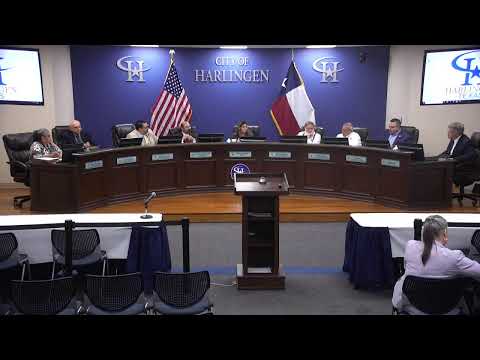
Harlingen commissioners on Tuesday agreed to pursue a coordinated, regional approach to recurring flood damage after residents and a local advocacy group urged creation of a Rio Grande Valley watershed flood-control district.
Residents and the Rio Grande Valley Coalition of Drainage Advocates told the City Commission Harlingen’s repeated flood losses require a response beyond single-district or city-only projects. “We are tired of the flooding and tired of dealing with, the repeated flooding in the area,” coalition representative Miss Garcia told the commission, adding the group includes “repeat flood victims, business owners” and volunteer scientific advisers.
The commission’s vote does not create a new taxing or governing body. Instead the panel directed staff to merge two draft resolutions — one that expresses support for exploring a regional flood-control district concept and a second that adds concrete steps and timelines — and to work with drainage districts, the city’s floodplain manager and county partners to present an implementation timeline. Commissioner Daniel Lopez made the motion to merge and add concrete steps; Commissioner Mike Mesmer seconded it and the measure passed.
Why it matters: local leaders, elected officials and residents said Harlingen sits in the path of regional watersheds — notably the Arroyo Colorado — and that man-made drainage-district boundaries can block larger, coordinated funding and construction plans. Coalition members pointed to the Texas Water Development Board planning process (Region 15), a state Flood Infrastructure Fund created after 2019, and large recent awards to nearby districts as evidence regional planning could unlock additional state and federal support.
What the commission discussed: residents described repeated, localized flooding in neighborhoods including Los Ranchitos and Lakeside-area blocks, with speakers saying some homes flooded multiple times in recent years. Miss Wendy (Wandy) Velasquez said she has flooded twice in seven years and urged support for the resolution. Dawn Graves and Peter Ritten Harbour described repeated household flooding and asked the commission to back the resolution. Experts and volunteers described technical material: watershed mapping for the Arroyo Colorado, the difference between man-made drainage-district boundaries and natural watersheds, and projections from the U.S. Fifth National Climate Assessment that the region can expect more frequent flood events through midcentury.
What commissioners said: the panel debated pacing and legal exposure. Several members, including Mayor Norma Sepulveda and Commissioner Ford Kinsley, said they support regionalism but want assurances Harlingen will not lose funding or decision authority. Commissioners asked staff to produce clear, actionable milestones that will protect Harlingen’s interests and to coordinate with Drainage Districts 5 and 6 before any final commitment.
Outcome and next steps: the commission approved language directing staff to merge the two drafts, arrange meetings with drainage districts and other stakeholders, and return with a timeline and a revised resolution that retains an explicit option for Harlingen to withdraw if local concerns are not satisfied. The commission also asked staff to post progress publicly and keep the city’s floodplain manager engaged in the conversations.
Community response and context: speakers referenced a recent Cameron County award of more than $40 million to one drainage district, concerns about unfunded drainage districts in Cameron County, and the importance of a regional approach to access state Flood Infrastructure Fund dollars. Coalition speakers said the group is organizing as a nonprofit and has met with state lawmakers and the Texas Water Development Board.
What the vote did not do: commissioners explicitly declined to create or authorize a district in the meeting. The action authorized only staff-level work (drafting a merged resolution, scheduling stakeholder meetings and producing timelines) for commission review.
Ending note: commissioners and citizen advocates agreed to meet with drainage-district staff in a planned workshop and continue the discussion before taking any binding step toward creating a regional flood-control district.