Get Full Government Meeting Transcripts, Videos, & Alerts Forever!
Get email alerts on the Budget And Management topic
No spam. Unsubscribe anytime.
Laredo city manager outlines nine- to 16‑month efficiency study to guide budgeting and bond readiness
Summary
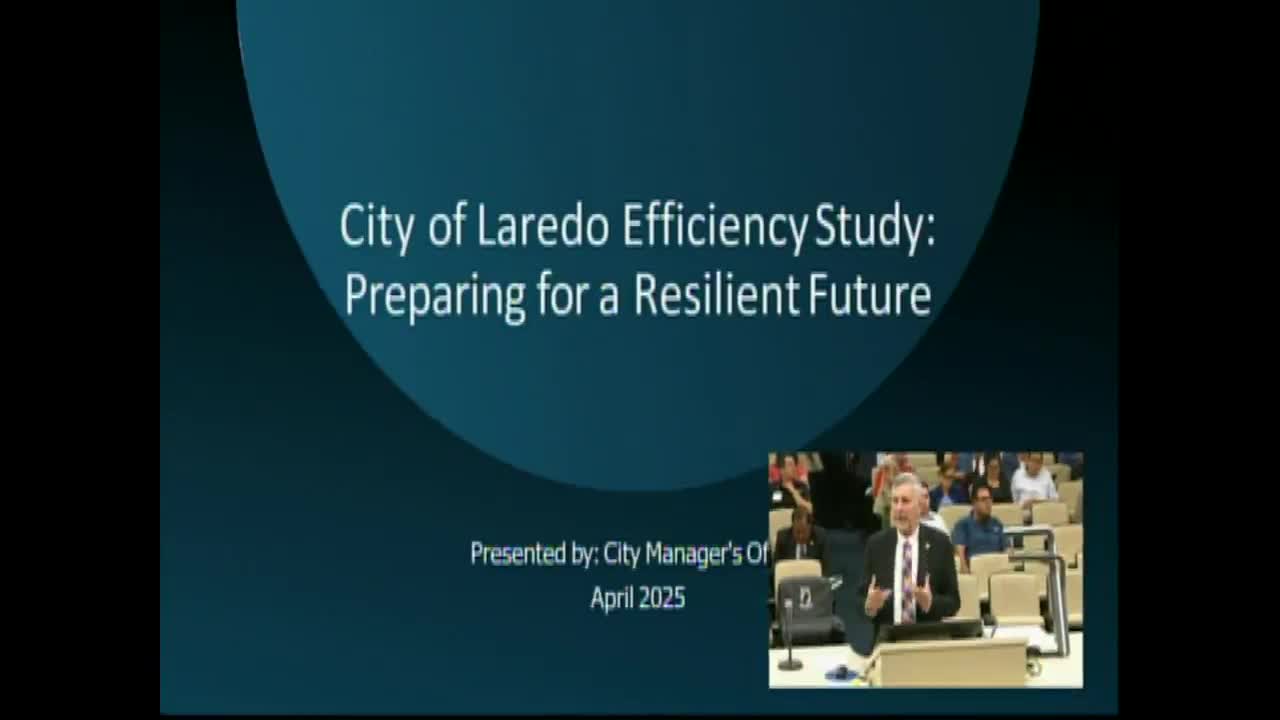
City Manager Knapp presented a citywide “Laredo Efficiency and Innovation Program,” asking council to endorse a 9–16 month internal review of departments, services, and spending to inform budget choices and the pending bond referendum; council endorsed the study framework (item 59a1).
City Manager Knapp presented a framework on April 7 for a citywide efficiency and innovation study he said is intended to align departmental operations with council priorities and to inform bond-readiness and budget decisions. “We want to complete a comprehensive citywide efficiency review,” Knapp said, outlining a 9–16 month timeline for data collection, benchmarking, scoring and public feedback.
Knapp told the City Council the initiative — branded in staff materials as the Laredo Efficiency and Innovation Program — would be run as a division inside the budget office, use cross‑functional city staff rather than an outside consultant, and emphasize standard operating procedures, workforce modernization and service‑level scoring. He said the study will prioritize public safety and basic services while testing fee and equity options such as deferred payment plans for utilities.
“Data‑driven budgeting tied to service priorities” is the goal, Knapp said, and he asked the council to endorse the study framework so staff can form an internal task force, coordinate academic partners and begin stakeholder outreach. He described the study methodology as a sequence of department self‑assessments, external benchmarking and a public engagement stage followed by KPIs and a monitoring phase.
Mayor Dr. Victor D. Treviño, who placed the item on the agenda, and Mayor Pro Tem Vanessa Perez emphasized the study’s timing amid economic uncertainty and grant reductions. Perez said the study should separate wants from needs and direct staff to propose installment plan options for residents if the economy worsens. Council members asked that the study explicitly tie its metrics to the city’s comprehensive plan and that prioritization account for equity and service‑level essentials.
Council then voted to approve the staff request. The motion to endorse the framework (item 59a1) carried; the council also approved related instructions for staff to prepare program structure and subsequent updates to the council.
Knapp said success would look like measurable improvements in service delivery, clearer budgeting decisions and a structure that can be updated annually and scaled to changing fiscal conditions. He cautioned that some recommendations may require additional funding and that the council would retain authority over timing of capital commitments if a bond measure passes.
The council directed staff to proceed with the study framework and to return with metrics, stakeholder plans and regular updates to the council.