Get Full Government Meeting Transcripts, Videos, & Alerts Forever!
Get email alerts on the Air Quality Ethylene Oxide topic
No spam. Unsubscribe anytime.
Council presses Midwest Sterilization after mixed air-monitoring reports; asks company whether it sought federal exemption
Summary
City councilmembers heard three independent air-monitoring studies finding elevated ethylene oxide (ETO) near the Midwest Sterilization plant and voted to send a formal inquiry asking whether the company sought a presidential exemption from new EPA sterilizer rules and to describe its compliance and storage protocols.
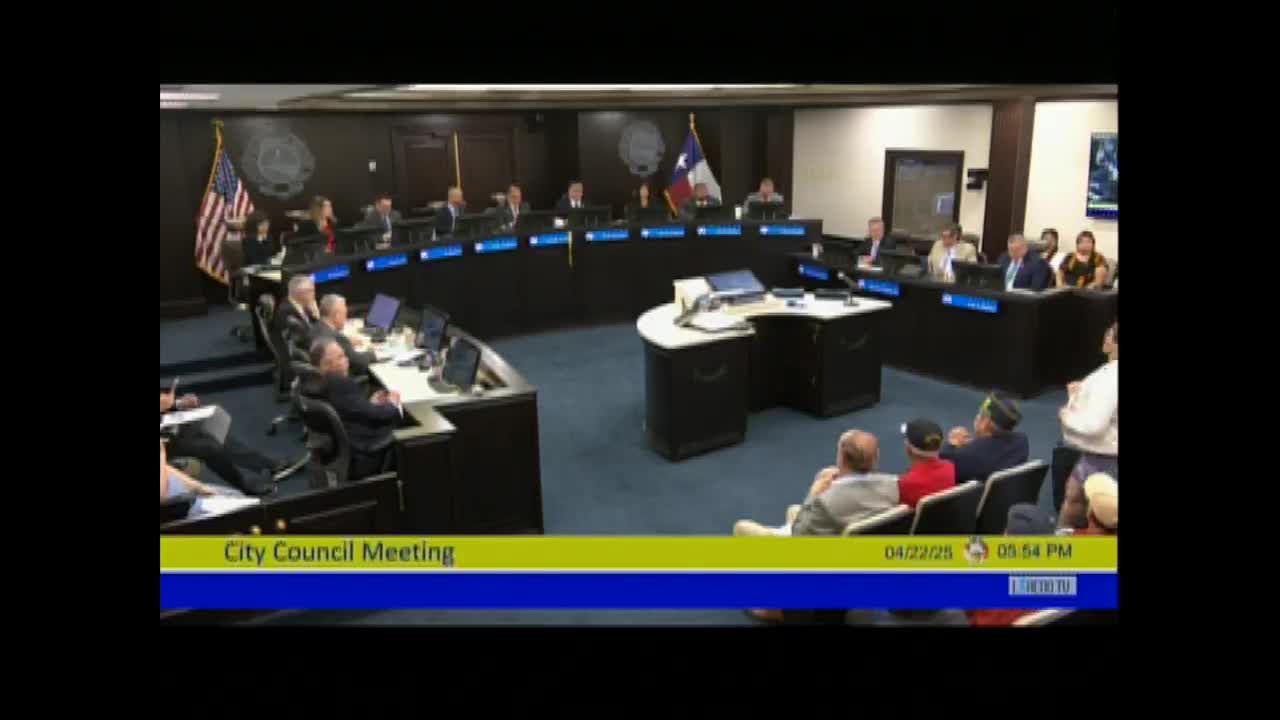
Laredo City Council members voted to send a formal inquiry to Midwest Sterilization after hearing that multiple independent air-monitoring efforts detected elevated ethylene oxide concentrations near the company’s plant. Councilmember Vanessa Perez moved the measure and the council approved it by voice vote.
The council took up the item after two outside presentations and comments from local health advocates. Tricia Cortez, representing the Clean Air Coalition, summarized three monitoring efforts that found ETO well above levels that the U.S. Environmental Protection Agency (EPA) has identified as a benchmark for cancer risk. “There were concentrations as high as 23 parts per billion,” Cortez said during public comment, referencing a local fence-line study; she contrasted that with the EPA’s cancer-threshold guidance described in technical terms as 11 parts per trillion.
Why it matters: Ethylene oxide is a colorless gas used to sterilize medical equipment. The U.S. EPA and the International Agency for Research on Cancer list ETO as a human carcinogen. The city action aims to clarify whether Midwest applied for a presidential exemption from new EPA sterilizer rules and to learn what interim steps the company is taking to reduce community exposures.
What council heard: The City’s public health director, Dr. Richard Chamberlain, summarized results from three sources: (1) a TCEQ mobile-monitoring deployment that recorded short-duration elevated readings but concluded no immediate short-term health risk; (2) an EPA canister study that found higher ETO closest to the plant (the EPA’s highest 24-hour sampling point was reported in the meeting summary as roughly 7.8 parts per billion); and (3) a Rio Grande International Study Center fence-line study that recorded peak canister concentrations described in the presentation as up to 23 parts per billion at locations downwind of the facility. Dr. Chamberlain emphasized that each study used different samplers and schedules and that all three showed the same pattern: higher concentrations nearest the plant and lower concentrations with distance.
Advocates pressed the council for stronger oversight. Cortez and other presenters cited a contemporaneous National Academies of Sciences review that criticized the Texas Commission on Environmental Quality’s (TCEQ) risk-assessment methodology as “insufficient, inaccurate, incomplete” and urged more rigorous approaches. Cortez also noted EPA’s updated sterilizer rule requires continuous emissions monitoring, total enclosure systems and new emission controls for facilities using significant quantities of ETO; she said Midwest sterilizer reportedly uses more than 1,000,000 pounds of ETO per year and therefore falls under the rule.
Council action and next steps: Councilmember Vanessa Perez moved that staff send Midwest a written request asking (a) whether Midwest applied for a presidential exemption from complying with the new EPA sterilizer rule, (b) what steps Midwest is taking and has budgeted to meet new controls and continuous monitoring, and (c) where and how sterilized product is stored and for how long. Perez amended the request on the floor to include a question about storage protocols after discussion. The motion passed by voice vote. The council asked staff to report back with Midwest’s response and with any additional information the city can obtain about monitoring results, health department capacity, and regulatory timelines.
What the city cannot yet say: The council did not adopt any enforcement action or regulatory finding against Midwest; it instructed staff to seek information. No numerical personnel vote was recorded on the inquiry motion in the public transcript; council members voiced “aye” and the mayor declared the motion passed.
Background and technical context: Presenters explained that ETO is highly mutagenic and that the EPA’s risk framework often expresses acceptable incremental cancer risk as “1 in 10,000” and translates to extremely low concentrations measured in parts per trillion. Monitoring methods vary: TCEQ used mobile vans for short-term, high-resolution sampling; EPA used three‑day integrated canisters across multiple sites; and the Rio Grande International Study Center deployed a multi-site, multiweek canister network. The city’s public health department told the council it will begin an internal air-quality monitoring program that will include ETO as resources allow.
What council members asked staff to do: (1) Send the formal inquiry to Midwest asking whether it sought the presidential exemption and describe its compliance timeline and storage protocols; (2) compile the three monitoring reports and the National Academies review for distribution to the council; (3) present options for how the city will expand its own air-monitoring capacity and what budget or grant steps are needed; and (4) report back to council at a future meeting.