Get Full Government Meeting Transcripts, Videos, & Alerts Forever!
Get email alerts on the Recycling topic
No spam. Unsubscribe anytime.
Coos Bay committee hears plan to implement Oregon Recycling Modernization Act; full rollout likely years away
Summary
Waste Connections outlined changes under the Oregon Recycling Modernization Act—expanded curbside materials, 96-gallon carts and producer-funded payments—while officials flagged equipment, timing and contamination challenges for Coos Bay residents and haulers.
The Coos Bay Livability Committee heard a detailed briefing on implementing the Oregon Recycling Modernization Act at a committee meeting, where Waste Connections explained new curbside rules, funding mechanics and a phased rollout that officials said will take years to complete.
Luke Pike, district manager with Waste Connections, told the committee the statewide overhaul will change what can be placed in curbside recycling, who pays for collection infrastructure and how material is processed. “This is gonna start July first of 2025,” Pike said, “but this is gonna be years into the making.”
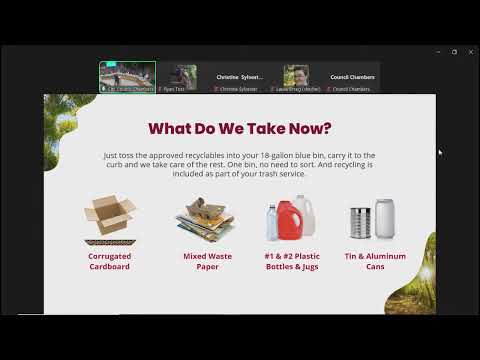
The act centralizes recycling policy across Oregon so all municipalities and haulers follow the same rules, Pike said. Key operational changes described for Coos Bay include switching most households from the existing small 18-gallon bin to a single 96-gallon roll cart collected every other week, accepting additional material types curbside (including plastics labeled 1, 2 and 5, small metals under about 10 pounds, plastic tubs and some cartons) and expanding depot acceptance for items not suitable for curbside (plastic bags and certain types of expanded polystyrene).
Pike described the program’s financing mechanism as a “producer responsibility” model: companies that put packaging on the market in Oregon will pay into a fund to cover collection, education and transportation costs. He said producers will begin paying July 1, 2025, but that funds and operational changes will roll out over time. “Producers will start paying into the fund July 1,” Pike said, adding that purchasing carts, trucks and other infrastructure will be expensive and that equipment lead times and contract details mean communities should expect a phased schedule.
Committee members and hauler representatives emphasized three near-term challenges: procuring trucks and carts (manufacturers’ lead times can be a year or more), building or upgrading local transfer facilities and managing contamination. Pike estimated a typical baler for staging materials could cost in the mid-hundreds of thousands of dollars, and noted councils and haulers will face long-term replacement costs for carts and vehicles. He said existing local sorting capacity is limited, so much collected material will continue to be shipped to larger processing centers in the Eugene–Portland region (Pioneer Recycling in Portland for plastics and Pacific Recycling/EcoSort in Eugene for metal and cardboard stages).
On contamination, Pike described probable enforcement and outreach measures: visual monitoring of cart hoppers, a three-strike education-and-warning approach, and fees or cart removal for repeated offenders. He singled out batteries, hoses and cords as frequent contaminants that damage equipment and create fire hazards and said depots will accept certain items—such as grocery plastic bags—that cannot be processed when mixed in commingled curbside loads.
Committee members discussed education and local outreach as an immediate role for the Livability Committee and partner organizations. Stephanie Gilmer, co-chair of the committee, and others said local grassroots campaigns, school programs and coordination with the state’s Circular Action Alliance (CAA) or equivalent education coordinators will be important to prepare residents before new material rules take effect.
Pike and committee members repeatedly stressed that material changes established by the law will take effect prior to full operational rollout: while plastics 1, 2 and 5 and other items are defined as acceptable under the Recycle Modernization Act beginning July 1, 2025, widespread collection changes, cart distribution and full service expansion are expected to take additional years and depend on manufacturer delivery, contract details and prioritized community scheduling. “Maybe sometime in ’26, but probably more like 2027 for a rollout,” Pike said when asked about realistic timing.
The committee did not take formal action during the meeting. Members agreed to continue coordination with city staff, Waste Connections and regional partners, and to consider a future council work session and local education steps to prepare residents.