Get Full Government Meeting Transcripts, Videos, & Alerts Forever!
Get email alerts on the Comprehensive Plan topic
No spam. Unsubscribe anytime.
Planning commission continues public hearing on Fredericksburg Forward comprehensive plan update
Summary
City staff presented the latest draft of the Fredericksburg Forward comprehensive plan, described new online map tools and implementation steps, and continued the public hearing to the commission's May 28 meeting for final consideration and possible recommendation to city council.
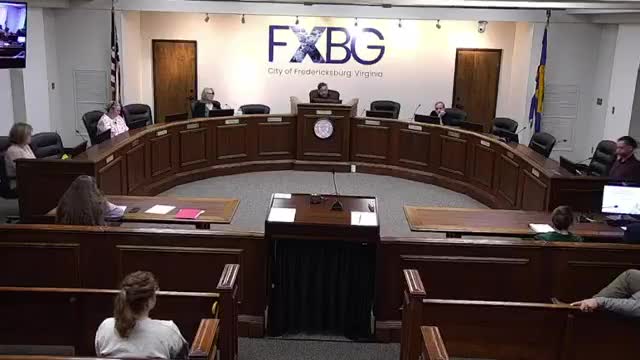
Fredericksburg — City staff opened a public hearing on the Fredericksburg Forward comprehensive plan update and demonstrated online mapping tools, then continued the hearing to the commission's May 28 meeting for further public input and a possible recommendation to city council.
Mr. Crump, a city staff member who presented the draft plan, said the document is “a long term policy document that guides the future land use of the city” and described a systems-oriented structure linking housing, transportation and public space. Crump showed an online slider that compares the existing and future land-use maps and said the plan’s future mobility map includes project pages (for example the William Street Corridor study) that list origin, destination, description, cost and timing.
The nut graf: the plan is intended to replace the city’s prior element-based approach with a unified framework of goals and implementation steps, and serves as a reference for small-area plans, transportation projects and capital improvements. Crump said each chapter contains objectives, strategies and action items designed to be “implementable and trackable.”
Commissioners and staff discussed how the draft will be maintained and used. Crump said the map and project database are delivered through ArcGIS Online and “this will be a tool that's publicly available without a login.” Commissioner Dugan Caswell asked whether users can sign in to save favorites; Crump replied the public-facing viewer will not require a login, though project management behind the scenes uses ArcGIS Online accounts.
Commissioners also raised questions about consistency between descriptive street types and map legends. Commissioner Mary Margaret Marshall praised the plan’s descriptive street typology (for example “gateway entryway corridors,” “walkable boulevards,” “walkable urban streets” and “urban main streets”) and asked that legend text be aligned with the map and with VDOT terminology. Crump acknowledged the difference and said the mobility map uses terms more closely aligned with VDOT standards; he said staff will look for ways to clarify or link the terms in the online viewer.
The presentation included a status update on small-area plans: seven small-area plans have been adopted (with Area 5 approved last night) and three remain to be completed (Areas 8, 4 and 9). Crump and Planning Director Mr. Craig recounted a minor change made in Area 5: one implementation step referencing a neighborhood commercial overlay district was removed and market-section language about College Avenue was altered; staff will integrate that revision into the comprehensive plan package.
Commissioners asked about walking and cycling connectors identified in small-area planning. Crump and staff discussed the Mayfield Connector, which planners have identified as a direct alignment but which they also described as having “serious challenges” because of topography, environmental features along Hazel Run and uncertainty about railroad structures. Craig said engineering and environmental constraints make the route costly and that staff will consider alternatives or an alternatives analysis as the area plans progress. By contrast, staff said the Dixon Park connector already has funding and investigative engineering under way; Crump said engineering work and environmental analysis are underway and that construction timing is being coordinated with related infrastructure work.
No members of the public spoke in person, and staff reported there were no electronically received comments on the planning commission agenda item. Chair David Durham continued the public hearing and said the commission aims to complete the hearing at its May 28 meeting so it can consider forwarding a recommendation to city council.
The commission took no formal vote on the plan at the meeting; the hearing remains open and staff encouraged the public to review posted documents and submit comments before the May 28 meeting.