Get Full Government Meeting Transcripts, Videos, & Alerts Forever!
Get email alerts on the City Budget topic
No spam. Unsubscribe anytime.
City manager presents $2 billion FY2026 spending plan, highlights public safety, schools and coastal project
Summary
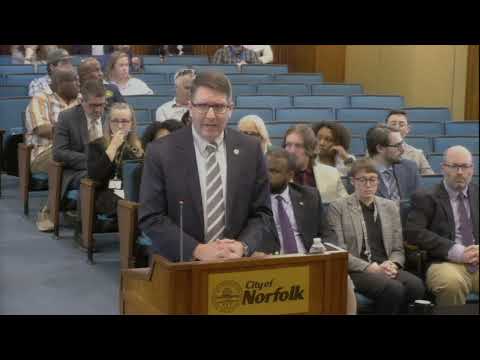
City Manager Patrick Roberts on March 25 presented the proposed FY2026 operating budget and five-year capital improvements plan to Norfolk City Council, outlining a near-$2 billion consolidated plan and priorities including public safety staffing, a $260 million first-year CIP, school investments and coastal storm risk management.
City Manager Patrick Roberts presented the proposed fiscal year 2026 operating budget and five-year capital improvements plan to the Norfolk City Council on March 25, proposing a consolidated financial plan just under $2 billion and asking council to adopt the final budget May 13.
Roberts said the General Fund, the city’s primary operating fund, totals just under $1.2 billion in combined revenues and expenditures for FY2026 and that the first year of the capital improvements plan (CIP) requests about $260 million. "I want to reiterate often that this is a plan, not a budget," Roberts said, describing the CIP as a five-year roadmap with only year-one expenditures requested for funding.
The nut graf: The manager outlined major focus areas — public safety and health, transportation safety and maintenance, housing and neighborhood revitalization, beach and tourism investments, and increased support for Norfolk Public Schools — and identified specific proposals that would require council approval during the April hearings and May adoption.
Roberts walked the council through revenue assumptions and drivers. He said the city is forecasting roughly 4.4% growth in general fund revenue (about $38 million), driven primarily by rising real property values and strong consumption and sales tax receipts; personal property collections were described as flat or slightly down. Roberts cautioned that operating costs — especially labor — remain elevated amid low regional unemployment and flagged uncertainty tied to federal spending and trade activity.
On public safety and health, the manager proposed adding 20 paramedic positions and three captains in Fire & Rescue, purchasing one ladder truck and two pumpers, replacing self-contained breathing apparatus, replacing at least 18 police vehicles and improving jail security systems at the sheriff’s request. The budget seeks increased funding for the Homeless Task Force — described as a threefold increase to scale the program citywide — and a consolidation of certain programs into a proposed Department of Military and Community Affairs that would continue military-affairs work while bringing together violence-intervention programs and related federally funded efforts.
Roberts identified the Coastal Storm Risk Management Project as a major CIP priority. He said the project is on schedule for phase 1a structural components, pump stations and related work, and that while the General Assembly and governor had not specifically allocated project funding, the administration intends to pursue competitive grant funding the governor included in the budget guidance.
Transportation and neighborhood infrastructure proposals include enhanced traffic-signal and intersection work in FY2026, planned signals in later years (including Tidewater Drive at Marvin Avenue), reconstruction of Westminster Avenue in Chesterfield Heights and Grandy Village, bridge repairs (notably the Military Highway crossing at Virginia Beach Boulevard), Complete Streets and Vision Zero pedestrian-safety investments, conversion of roughly 34,000 streetlights to LED, and an EV-charging station plan. Roberts also asked for operating funds this summer to help manage traffic during upcoming Harbor Park area construction tied to a large private investment.
On housing and community development, the manager proposed funding demolition and environmental remediation at the former Globe Iron site to enable redevelopment and homeownership opportunities in Broad Creek and Bruce’s Park neighborhoods; infrastructure build-out at the former JT West site in Huntersville; continued funding for revitalization in the St. Paul’s/Kindred area; and broadened language for an existing reserve fund to enable housing projects, with $2 million currently allocated to that reserve.
The proposed budget includes facilities and service maintenance items — water-system pump-station and culvert work including a Lake Smith culvert, a neighborhood pump station in Fox Hall, multi-year meter replacement to enable remote reads, enhanced beach-cleaning and trash collection, extended curbside recycling and a proposed 17-cent-per-day increase in the waste-management fee (about $5 per month) to sustain those services. The manager also proposed adding Sewell’s Point Road and Church Street corridors to a commercial-corridor façade grant program and funding waterfront infrastructure repairs and selected demolition of blighted properties in Willoughby and Wards Corner.
Tourism and cultural investments listed in the CIP include a proposed $20 million in the first five years for Harbor Park improvements aligned with an anticipated lease extension with the Norfolk Tides; renovations to Chrysler and Scope; a local match for a private donation to expand the Jean MacArthur Research Center; additional event-marketing staffing across seven venues; free first-hour parking pilot downtown; free game-day parking at McArthur Center garage for Norfolk Tides home games; and continuation of $30-per-month semester student parking for TCC, ODU and NSU.
On personnel costs, Roberts proposed a 2.5% general wage increase for general, constitutional and non‑sworn employees effective July 1 and step increases for sworn public-safety employees and 9‑1‑1 telecommunicators. He outlined a phased rollout of a market-based step-and-grade compensation plan, beginning with public-safety staff in the fall and moving other employees in stages after the new year. The manager said the budget would preserve current employee health-care premium levels for another year and include a one-time retiree supplement of $625 for qualifying long-term retirees, if council elects to allocate it.
Norfolk Public Schools would receive an additional $9 million in combined federal, state and local funds for a total school budget of $450 million in FY2026, Roberts said, and city local support is expected to increase by about $6.4 million to $170.6 million. The CIP proposes increased school maintenance funding and a multi-year plan for Maury High School replacement, for which staff estimate $220 million in total cost pending a guaranteed maximum price from the design-build team.
Roberts closed by summarizing the budget-development timeline: the proposed budget was posted March 25; two council work sessions are scheduled in April for follow-up; a public hearing on the budget is set for April 9 at 6 p.m. at Granby High School; a state-mandated public hearing on the real-estate tax rate is set for April 29; and staff is asking council to adopt the final budget, capital plan and consolidated plan on May 13. He invited public engagement via the city’s online materials and an interactive Balancing Act tool.
No council questions followed immediately after the presentation.