
RACC shares draft SIP chapters, outlines 'control‑strategy blueprint' to guide actions after reclassification
Get AI-powered insights, summaries, and transcripts
Subscribe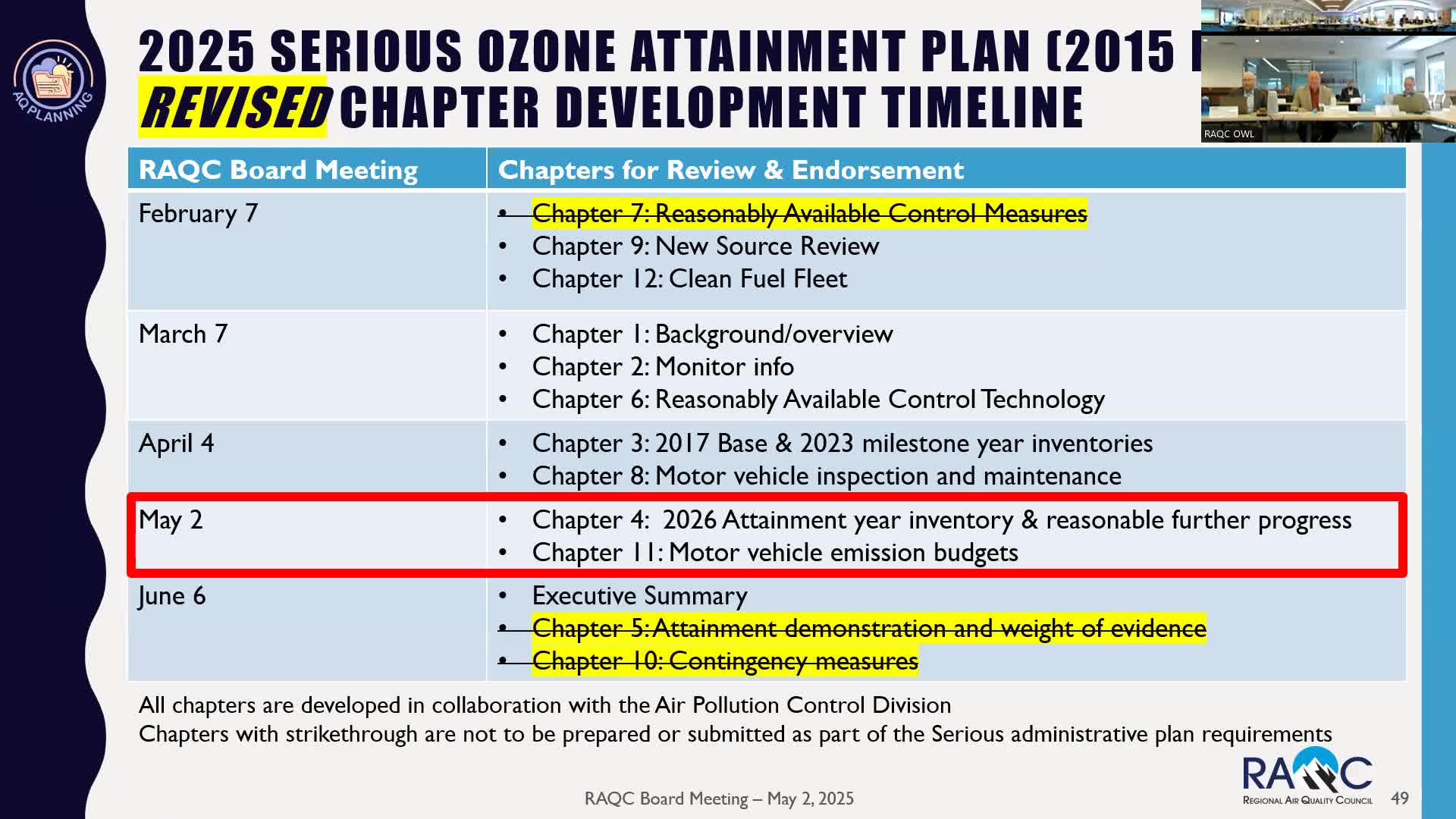
Summary
The council reviewed two draft State Implementation Plan chapters—2026 attainment inventory and transportation conformity/mobile budgets—and described a proposed control‑strategy ‘blueprint’ to organize short‑, medium‑ and long‑term actions after a voluntary reclassification to severe nonattainment.
RACC staff told the board on May 14 that updated drafts of two State Implementation Plan (SIP) chapters—Chapter 4 (2026 attainment‑year inventory and reasonable further progress) and Chapter 11 (transportation conformity and mobile‑source budgets)—were posted and that the executive summary will follow ahead of the June meeting.
Kira, RACC staff, said Chapter 4 summarizes the inventory methodology and presents the reasonable‑further‑progress (RFP) demonstration required under the Clean Air Act. She said Chapter 11 documents the history and process for establishing mobile‑source emissions budgets (often called motor‑vehicle emissions budgets or MVEBs) and proposes budgets for the nonattainment area and subareas to support transportation conformity.
RACC and division staff stressed these chapters are modeling‑based and require further updates. Tom, planning staff, said several data elements remain placeholders and that the division and RACC will update modeling inputs prior to the June 30 deadline for revised SIP materials. “This chapter has several gaps in it because there is a lot of analysis that has to happen,” Tom said.
The council also framed a control‑strategy “blueprint” as a planning product to identify short‑, medium‑ and long‑term control strategies following the decision to pursue a voluntary reclassification to severe nonattainment. Mike summarized the intent: the blueprint will set a recommended sequence of strategy options and actions the council will bring forward to the state and the Air Quality Control Commission as the SIP development proceeds next year.
Board members asked about the accuracy and validation of the MVEBs and modeling inputs. Doug (DRCOG) described household travel surveys and regular model recalibrations used by metropolitan planning organizations and said MPO data and traffic counts inform the modeling inputs that generate the budgets. Staff said budgets and inventories are modeling outputs based on current assumptions and will be refined as modeling inputs are finalized.
Ending: Staff set a May 23 deadline for comments on the two chapters and said they will circulate updated drafts in advance of the June meeting. The board will consider endorsement of the assembled SIP package and the executive summary at the June meeting.