
Regional Air Quality Council details electrification grants, vehicle-repair and outreach programs
Get AI-powered insights, summaries, and transcripts
Subscribe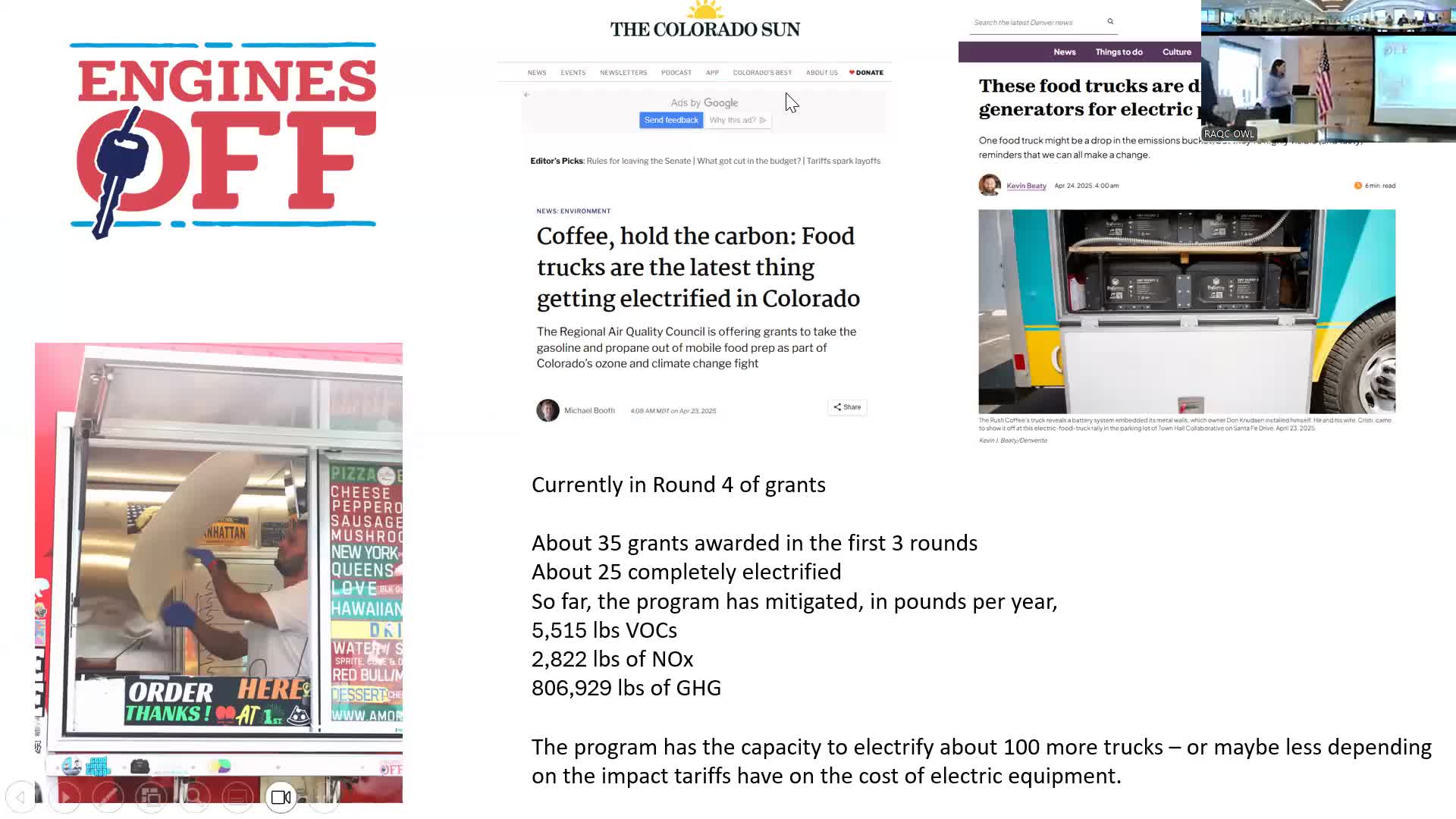
Summary
At its May meeting the Regional Air Quality Council presented updates on several incentive and education programs including electrified food-truck grants, an e‑bike pilot for subsidized housing, a vehicle repair program targeting high-emitting cars, and lawn-and-garden electrification and public outreach campaigns.
The Regional Air Quality Council updated its board on May 14 about a suite of incentive and outreach programs it runs to reduce mobile-source emissions across the region.
Programs director Dave Spados described the presentations as an opportunity “to gain perspective about what RACC does to actually reduce emissions through our incentive and education outreach programs.” Staff members then reviewed four program areas: an engines-off food-truck grant, an e‑bike pilot for subsidized-housing residents, a cleaner-auto-repair (CAR) program for high-emitting vehicles, and mower/lawn‑equipment exchanges and grants.
Sammy, RACC program staff, said the engines‑off food‑truck grant covers 80% of electrification costs up to $1,000 for mobile food businesses that replace gas or diesel generators with batteries, electrified conversions or solar. “We are in the midst of round 4,” Sammy said. He described the program as popular, noting roughly 25 trucks have completed electrification and that retrofit costs vary widely: “The average that we're paying per truck is around $12,000,” Sammy said, and “I think the most expensive one was a $40,000 job.” Sammy added that the program runs demonstration events to showcase quieter, no-exhaust trucks.
Staff also described the Accessible Bicycle Community pilot (ABC), an e‑bike program operated with partner Equal Access Mobility for residents of subsidized housing. Kelsey, program manager for Simple Steps Better Air, said the pilot sites include Denver Housing Authority’s Sun Valley property and another site in Lakewood. The program will provide shared e‑bikes for exclusive resident use and track trips to estimate whether riders substitute e‑bike trips for cars, rideshare or other modes. “We will be tracking trips and then trying to determine if those are mode shift trips,” Sammy said.
Jacob, who manages the CAR program, outlined efforts to identify high‑emitting vehicles and provide no‑cost repairs when owners received state waivers that temporarily exempt them from passing emissions inspections. He said the program now averages roughly two heavy repairs per week and that the state’s testing data help target owners who received waivers. Jacob estimated that when the program fixes a targeted vehicle, it can reduce emissions from that vehicle by about 90% compared with pre‑repair test results.
On lawn‑and‑garden equipment, staff described a long‑running mower-exchange effort and a newer landscaper grant program. The council budgeted about $120,000 for mower‑pollution efforts in 2025; staff said Ace Hardware provided an $80,000–$90,000 contribution this year. RACC grants to landscapers average about $6,000 per award and require a 50% match; staff said those city‑ and private matches turn roughly $200,000 in RACC funds into about $400,000 worth of electric equipment deployed by contractors.
Kelsey also summarized Simple Steps Better Air, a summer outreach campaign that sends ozone‑action alerts in English and Spanish, runs a media buy across the seven‑to‑nine county area, attends community events, and operates a refreshed bilingual website (simplestepsbetterair.org) with a new blog and FAQ pages.
Board members asked for program performance data. Jacob and Sammy said staff track per‑vehicle and per‑program emissions estimates and cost‑per‑ton metrics and that more detailed cost‑effectiveness data could be provided in future reports. Kelsey said the website and outreach metrics will support evaluation of public‑education work.
The council’s executive summary of the presentations noted staff had submitted a large grant application to expand many of these programs beyond the Denver‑metro footprint to the broader nonattainment area; staff said they expect selection results by late summer.
Ending: Board members praised the programs and encouraged staff to provide more comparative data on cost per ton of emissions reduced when available.