Get Full Government Meeting Transcripts, Videos, & Alerts Forever!
Get email alerts on the Land Use topic
No spam. Unsubscribe anytime.
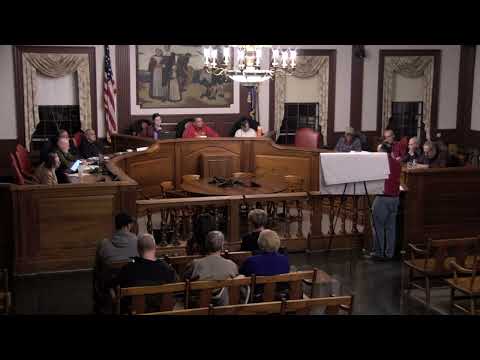
Public hearing on Cut Spring Road development draws broad neighborhood opposition; commission asks for more information and tables decision
Summary
The Inland Wetlands Commission heard a 24-unit townhouse proposal for 1245 Cut Spring Road and, after technical presentation and extensive public opposition focused on flooding and geology, voted to table the application until February for more information and possible conditions.
The Inland Wetlands Commission heard an application (2024-241245) for development at 1245 Cut Spring Road — a proposed 24-unit townhouse project on roughly 2.25 acres — and then voted to table further action to the commission's February meeting after extensive public comment and technical discussion.
Applicant representative Manny Silva, a registered civil engineer, described the proposal as 24 townhouse units behind an existing house with no permanent disturbance within the 100-foot upland review area except for a single sewer manhole and an associated sewer extension. Silva told the commission the closest permanent disturbance to the mapped wetland is about 90–95 feet. He described a multi-stage stormwater treatment train that includes hooded catch basins with snouts, a vortex/oil‑water separator, and approximately 550 lineal feet of 4-by-4 concrete galleries to store and infiltrate runoff. Silva said the design reduces modeled existing peak discharges: the 2-year storm from 0.429 cubic feet per second (CFS) to 0.329 CFS, the 10-year from 3.4 to 2.4 CFS, and the 25-year from 5.4 to 2.8 CFS. He also said maintenance would be required on the storm systems, with inspections and vacuuming of sumps every six months per the maintenance agreement shown on the plans.
Neighbors raised repeated concerns about stormwater capacity, the local geology and the history of flooding on Cut Spring Road. Public commenters said past nearby development increased runoff and that the town storm drainage and downstream channels are already overwhelmed in heavy storms. Julia Gray, a Cut Spring Road resident, told the commission she was “vehemently opposed” and urged denial to protect the wetland. Other residents, including Shailyn and John Sedgwick, Robert Lombard, Tony Riccchio and Pauline Mojichik, described observed flooding near their homes, concerns about ledge removal or blasting, and fears that additional impervious surface could worsen neighborhood flooding.
Kelly Kerrigan, the commission's staff liaison, recommended several follow-up items: (1) consider substituting nonnative plantings with native species in the landscape plan; (2) explore a conservation easement to protect the bulk of the upland review area in perpetuity; (3) clarify bedrock depth and whether blasting or rock removal will be required; and (4) confirm how pre‑development hydrology that currently feeds the wetland would be preserved post-construction, including the path between the proposed subsurface storage and the wetland.
Commission discussion reflected divided views: some commissioners said the engineered controls could reduce peak surface runoff by capturing and infiltrating water, while others cited the neighborhood's flood history and urged caution about relying on maintenance-dependent systems. Several commissioners emphasized enforcement and maintenance language should be a condition of approval if the project moves forward.
After hearing public comment and staff input, a commissioner moved to table the application to the February meeting to allow the applicant and staff to provide additional information and proposed conditions; the motion passed by voice vote. The commission also closed the public hearing prior to deliberation.