Get Full Government Meeting Transcripts, Videos, & Alerts Forever!
Get email alerts on the Solid Waste Service topic
No spam. Unsubscribe anytime.
Rowlett council reviews Republic Services option for weekly bulky‑waste pickup; staff recommends subsidizing mid‑year rate increase
Summary
City staff and Republic Services proposed a new weekly bulky‑waste collection option (2 cubic yards weekly) with an immediate mid‑year subsidy and a future October CPI adjustment; council gave majority support to return the amendment for formal consideration on May 6.
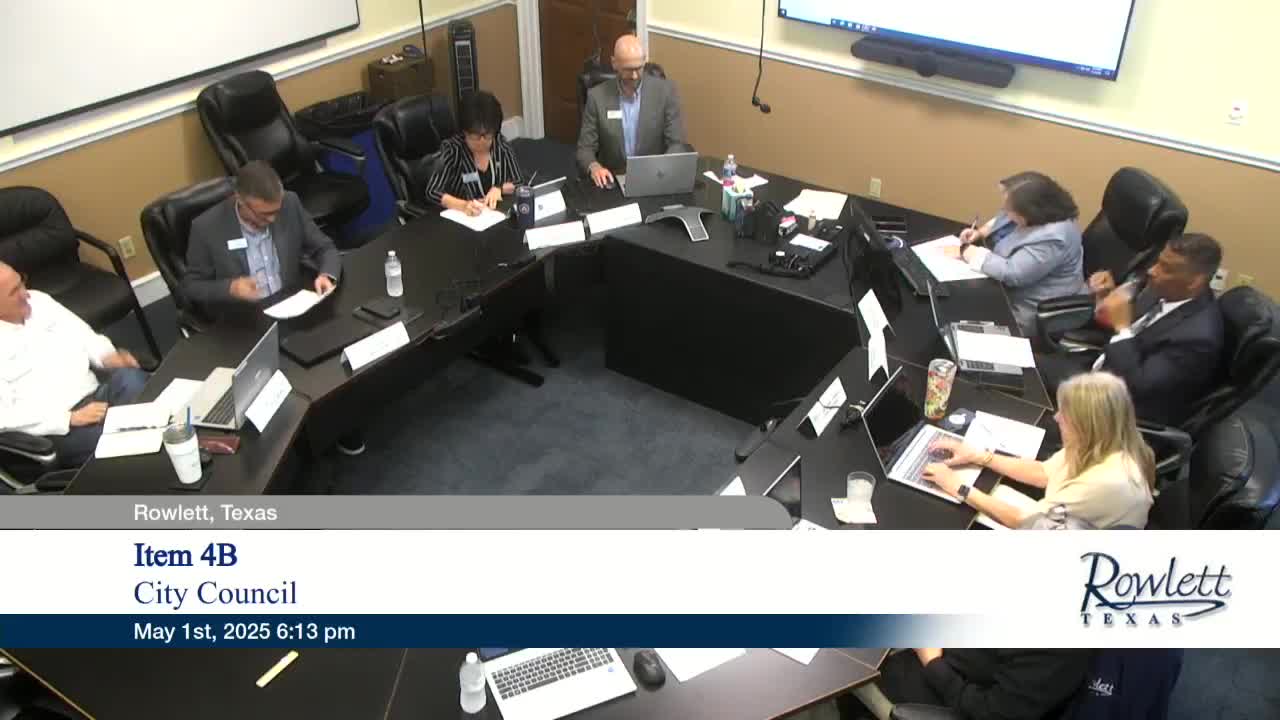
City Manager David Hall and a Republic Services representative presented a new contract option to the Rowlett City Council on May 1 that would change bulky‑waste service from once a month (up to 8 cubic yards) to a weekly collection limited to 2 cubic yards per week.
"Option 4 ... is a weekly option. It's a 2 yard service option," Hall said, describing the proposal as roughly equivalent to "two washing machines" per collection and saying compliant loads would be collected the same day as regular waste and recycling.
Under the plan presented, oversized or excess loads — defined as greater than the 2 cubic‑yard weekly allowance — would be treated as they are today: customers would call Republic for a quote and arrange paid pickup. Hall said Republic is developing an email/photo intake process to speed quotes and reduce in‑person assessments.
City staff presented estimated rate impacts. The city is currently charged $18.30 per residential account by Republic; the proposed monthly city charge would increase to $19.60 and the city’s current residential bill to customers is $20.36. Hall said a contract CPI adjustment of about 4.98% would take effect Oct. 1 and would raise the city charge by roughly $0.98 to $20.58 under the contract assumptions presented. Hall proposed that the city absorb (subsidize) the mid‑year cost increase for the remainder of fiscal year 2025 and that the council address longer‑term rate changes during the FY‑26 budget process.
Hall summarized the operational impact: the weekly plan would not increase the monthly allowance (2 yards weekly equals the same roughly 8 yards per month) but would reduce the time bulk material remains at the curb and speed removal of small, frequent loads such as lawn clippings. "If you have a non compliant load in today's service model, it could wait as long as 30 days," Hall said. He added that under the new model a noncompliant load should not wait longer than about six days before follow‑up action.
Republic representative Rick Bernas described field operations for the option and confirmed drivers would tag noncompliant loads, take a photo and the image would route to dispatch and code compliance to create a log for follow up. Bernas also said routes and staffing would be adjusted to support the service change and that July 1 was the targeted service start date, with billing to customers effective in July and the contract amendment to be brought back to council on May 6 for formal consideration.
Council members debated timing, the communication strategy and whether residents could adjust from monthly to weekly service. One council member said, "I am all in on option 4," while another urged a more gradual public‑education approach and questioned whether residents should absorb longer‑term cost increases.
By the end of the discussion a majority of council members indicated support for bringing the formal amendment to the May 6 meeting; staff said they would prepare the ordinance amendment for council consideration and would roll out a communications plan with Republic Services before the change took effect.
No formal vote was taken that evening; staff recorded a council consensus to return the amendment for formal action on May 6.