Get Full Government Meeting Transcripts, Videos, & Alerts Forever!
Get email alerts on the Vape Shop Regulation topic
No spam. Unsubscribe anytime.
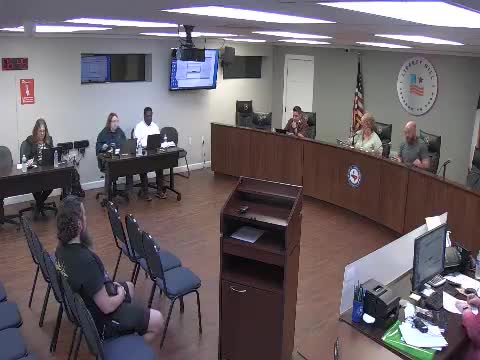
Liberty Hill commissioners review draft vape-shop regulations, request zoning map and legal review
Summary
The Planning and Zoning Commission reviewed a draft ordinance to regulate vape shops in the Unified Development Code, debated zoning vs. business licensing authority, and asked staff to produce a map and consult the city attorney before returning the item.
The Liberty Hill Planning and Zoning Commission on an evening meeting discussed a draft ordinance to regulate vape shops under the city’s Unified Development Code, focusing on whether the commission has authority to regulate land use only or also business licensing and signage.
Staff member Mary Anne Banks, who provided legal and procedural guidance during the discussion, told commissioners that the commission’s authority is primarily zoning and land use and that business licensing or direct regulation of retail products typically requires council action. Banks said zoning-based controls would make existing shops “nonconforming uses” allowed to remain, while licensing provisions would be outside the commission’s usual power and should be considered by council.
The draft ordinance under review included zoning restrictions, spacing requirements (including a proposed 1,000-foot buffer from “vulnerable populations”), controls on flavored products, display and signage rules, and a licensing section. Business owner Jordan Weckler of Starlight Vapor, 14745 State Highway 29, addressed the commission in public comment and cited Texas Senate Bill 21 and Texas Health and Safety Code §161.089 to argue the state preempts local rules on age and sale of tobacco and vaping products. Weckler also disputed claims of a youth-vaping epidemic, saying, “There is no youth vaping epidemic that's pure propaganda.”
Commissioners and staff debated several specific issues raised by Banks and others: whether a 1,000-foot spacing requirement would effectively ban new businesses in Liberty Hill’s limited commercial footprint; whether regulating flavored-product sales should be framed as a product-sale restriction rather than a use prohibition aimed at youth; and whether sign or display limits would raise First Amendment concerns. Banks recommended mapping likely commercial parcels to see whether spacing rules would leave available locations and suggested that the commission consider permitting vape shops by-right in some zoning districts with conditional-use permit (CUP) options in others rather than layering a CUP plus a broad spacing requirement.
Commissioners agreed they did not intend to push existing businesses out of the city. Banks clarified that nonconforming-use status typically remains unless a business is closed for the ordinance’s specified abandonment period (discussed in the thread as six months under the existing code). Commissioners said they would remove licensing provisions from the commission’s recommendation because those provisions appear to require council-level authority; one commissioner noted the licensing matter might be enforced at the state level (TABC or similar) rather than by the commission.
Rather than advancing the draft that night, commissioners asked staff to prepare a zoning map that overlays the proposed spacing buffers so the commission can see where vape shops could lawfully locate under several spacing scenarios. Commissioners also asked staff to consult with the city attorney about which regulatory elements are appropriate for the UDC versus items that must be handled by ordinance or licensing at council. The commission requested that staff incorporate notes and suggested edits already submitted by commissioners and provide the map and legal input at the next meeting. The commission discussed the possibility of a joint working group with city council but did not form one at the meeting.
What happened next: staff agreed to provide the requested map and legal review and to bring an updated draft and packet materials — including commissioner comments and relevant state code references — to a future meeting for further consideration.
Why it matters: the item would change where vape and tobacco retailers can locate in Liberty Hill and could restrict display, flavored-product sales, or advertising; the scope of changes depends on whether the city uses zoning to shape location and signage or whether it pursues business licensing or product-sale restrictions at the council level.
Quotes in context: Jordan Weckler, owner of Starlight Vapor, told the commission, “There is no youth vaping epidemic that's pure propaganda.” Staff member Mary Anne Banks cautioned that broad spacing requirements can operate like bans in small cities and recommended mapping before adopting a fixed buffer.
Ending: The commission did not take a final vote on the draft ordinance. Staff will supply a zoning map and legal analysis and will return the item for further review at a later meeting.