
Wilmington council adopts zoning for recreational marijuana, backs companion revenue resolution
Get AI-powered insights, summaries, and transcripts
Subscribe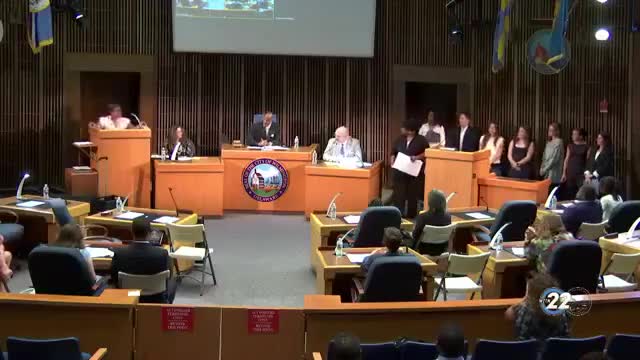
Summary
WILMINGTON, Del. — Wilmington City Council on May 1 adopted substitute ordinance 25-013 to regulate where and how recreational marijuana businesses can operate in the city, and approved a companion resolution proposing a 3% city share of related revenue.
WILMINGTON, Del. — Wilmington City Council on May 1 adopted substitute ordinance 25-013 to regulate where and how recreational marijuana businesses can operate in the city, and approved a companion resolution proposing a 3% city share of related revenue.
The ordinance permits four licensed adult-use marijuana activities — cultivation, product manufacturing, testing and retail — only in specified commercial, manufacturing and waterfront zoning districts (C-5; M-1 and M-2; W-1, W-2 and W-3). Retail sales and testing may be allowed as a special exception in the W-4 mixed-use district with zoning board approval. The law also requires a 300-foot buffer between any marijuana use and residential zoning districts or schools serving kindergarten through 12th grade, requires city business licenses for the four facility types, and adds parking and other technical rules for testing facilities.
Planning Department staff member Gwyneth Kaminski summarized the proposal: "Substitute number 1 to ordinance 25 13 addresses the location and regulation of 4 licensed non medical recreational marijuana uses within the city." The ordinance explicitly does not address medical marijuana dispensaries.
At the council hearing, public commenters included Nick Jenner, who said he was "grateful to the council for shifting its position" but urged further loosening of restrictions as the market matures. Cynthia Fuller, speaking for the Delaware Cannabis Committee and licensed holders, urged support: "I respectfully urge the council to vote in favor of ordinance 25 dash 0 1 3 amendment 34," adding that licensing, security and environmental controls in the measure keep operations away from schools and day cares and that regulation can help displace illegal markets.
Sponsor Councilman Johnson framed the vote as an economic opportunity: "This needs to happen in Wilmington. This has been too long," he said, urging that the city adopt the framework now and expand opportunities later.
The council also adopted Resolution 25-027, a companion measure that would seek a 3% municipal share of revenues from legalized sales; sponsors and several council members said the measure is intended to capture local revenue that can be directed to priorities such as affordable housing and community reinvestment.
The ordinance incorporates recommendations from the Planning Commission (revised resolution 3-25) and city council findings prepared for the public hearing. Council members noted the map and buffer provisions were negotiated as a compromise during committee review; several said they view the adopted map as a starting point that could be revisited after businesses begin operating.
What the ordinance does not change: it does not substitute for state licensing, it does not regulate medical marijuana providers, and it leaves some commercial districts off the permitted list. City business licenses (chapter 5 of the city code) remain required in addition to any state license. Officials said a prior interim measure (ordinance 25-4) had temporarily suspended retail licenses while the zoning language was finalized.
Council recorded the ordinance as adopted and the companion resolution passed; the minutes record the measures as adopted during the May 1 meeting.
Looking ahead, council members and staff said implementation will require coordination with the state licensing process, zoning-board reviews for W-4 special exceptions, and further technical rule-making on matters such as parking for testing laboratories and odor/waste controls. Several council members also urged active outreach to the General Assembly to secure the municipal share the resolution seeks.
The ordinance and resolution were considered at a public hearing after an affidavit of publication dated April 9, 2025, and following Planning Commission review in late March 2025.