Get Full Government Meeting Transcripts, Videos, & Alerts Forever!
Get email alerts on the Water Rates topic
No spam. Unsubscribe anytime.
Missouri City council approves groundwater-reduction fee increase to fund water projects, 5-2
Summary
The council voted 5-2 to raise groundwater reduction plan (GRP) fees by $0.40 per 1,000 gallons to fund surface-water conversion projects required by the Fort Bend Subsidence District; the increase takes effect Oct. 1 and is estimated to add about $4 per month for a household using 10,000 gallons.
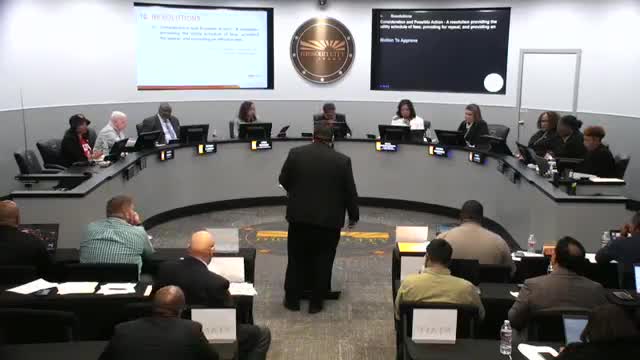
Missouri City — The City Council on Monday approved a utility fee increase tied to the city’s Groundwater Reduction Plan, voting 5-2 to raise GRP fees by $0.40 per 1,000 gallons to help fund projects that will convert more customers to surface water.
City staff and the GRP oversight committee said the rise is needed to pay for capital work — including a transmission line, a new water well and storage-tank upgrades in the Mustang Bayou service area — and to meet a Fort Bend Subsidence District requirement that the region use more surface water. Nicholas Cook, the city’s assistant utilities director, told council the committee “met March 5 and unanimously recommended a fee increase of 40¢ per thousand gallons for all GRP customers.”
The fee change moves surface-water users from $2.58 to $2.98 per 1,000 gallons and groundwater users from $1.99 to $2.39 per 1,000 gallons, staff said. Cook estimated the increase would add about $4 per month for a household using 10,000 gallons. Council set an effective date of Oct. 1 to give municipal utility districts (MUDs) time to include the change in their budgets, city staff said.
Why it matters: Fort Bend Subsidence District measures land subsidence tied to groundwater withdrawals and sets phased reduction targets for the region. Shashi Kumar, a city staff presenter, warned council about the district’s penalty if the city and participating utilities fail to meet conversion targets. “If we do not meet this mandate … the fine or the mandate for [the Fort Bend Subsidence] District will impose on the city and all the GRP area is $6.50, approximately,” Kumar said, adding that fines would be applied per 1,000 gallons of groundwater use that exceeds the permitted amount.
Council debate focused on timing, communication and affordability. Several council members said they wanted more public outreach and clearer explanation of why another increase was proposed less than two years after the last adjustment in 2023. One council member argued the council should consider annual, smaller adjustments rather than larger, less frequent hikes; another said the GRP oversight committee’s three-member composition meant more public engagement was needed.
Supporters said delaying increases would force steeper rates later or expose residents to the district’s disincentive fee. Shashi Kumar and Nicholas Cook told council that the city is “on target” to meet the district’s 2027 conversion goal, and that the proposed revenue is needed to fund multi-year projects (design and construction can take two to three years) that cannot be built without the additional funds. Kumar said the city and partner MUDs have banked credits and planned projects intended to avoid the higher penalty rate.
Council action and next steps: The resolution approving the schedule of utility fees passed on a 5-2 vote; the resolution sets the fee increase effective Oct. 1 and directs staff to coordinate outreach with affected MUDs and surface-water users. Staff told council they will use the months before October to notify customers and that partner MUDs will also notify their residents.
Costs and mitigation: Staff said the increase is intended to fund roughly $15–$20 million in capital projects needed to convert Mustang Bayou service-area customers to surface water. Staff confirmed they are pursuing grants and federal funding opportunities but said grant availability is uncertain.
What remains contested: Several council members requested more direct outreach to Sienna-area residents and broader notice to homeowners associations; some said they were not yet persuaded the increase should proceed now. Councilmembers voting no requested additional briefings and public engagement before further adjustments in future years.
The council packet included maps showing which retail and MUD areas are already converted to surface water (yellow) and which remain groundwater users (green), and staff noted that Missouri City acts as administrator of a regional GRP that covers the city’s retail areas, in‑city MUDs, MUDs in the ETJ and MUDs 23 and 24.
The vote: The resolution passed 5-2. The record supplied a numeric tally but did not list individual roll-call votes in the public transcript; staff confirmed they will include detailed voter names in the official minutes.
The City will begin coordinated outreach with partner MUDs and expects the fee change to take effect Oct. 1, 2025.