Get Full Government Meeting Transcripts, Videos, & Alerts Forever!
Get email alerts on the Rent Control topic
No spam. Unsubscribe anytime.
Highland Park rent control board to finalize memo of recommendations for borough council after debate on CPI, exemptions and vacancy decontrol
Summary
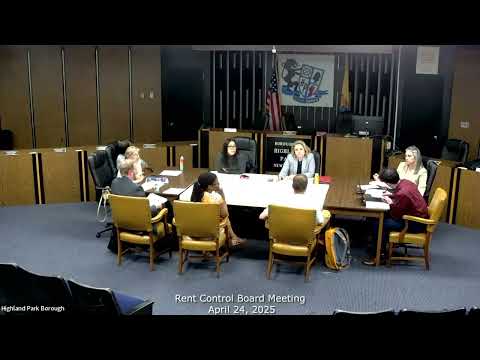
At its April 24 meeting the Highland Park Rent Control Board agreed to finalize and circulate a memo of recommendations to the Borough Council’s finance committee outlining competing views on exemptions, the rent-increase formula, vacancy decontrol and capital improvement surcharges; the board also amended and approved its March 27 minutes.
Highland Park Rent Control Board members on April 24 discussed a draft memo of recommendations to the Borough Council’s finance committee covering exemptions from rent rules, how annual rent increases should be calculated, vacancy decontrol and capital improvement surcharges, and agreed to finalize and circulate an updated memo. The board also amended and then approved the minutes from its March 27 meeting.
The memo, prepared by board staffer Jacob and circulated to members in advance, compiles a range of opinions the board and members of the public offered at prior meetings. Jacob described the document as a summary of “the feedback from the meetings and the public” and said it is intended to inform the finance committee and the council, which will decide whether to change the ordinance and, if so, will do so through the council’s committee and public hearing process.
Why it matters: the memo addresses the core mechanisms of Highland Park’s rent-control program — who is exempt, how much landlords may raise rents annually, how vacancy decontrol should work, and how capital improvements are treated. Those choices affect tenants’ housing costs, landlords’ revenue and incentives to maintain or renovate rental housing.
Board debate focused on three linked issues: exemptions, the rent‑increase formula, and vacancy decontrol. Jared, a Rent Control Board member, pushed back on proposed exemptions for owner‑occupied two‑family homes and said limiting annual rent increases to about 2–2.5 percent would be “not sustainable,” arguing many operating costs have risen far faster. Jared said, “It’s not sustainable if you’re going to cap rent growth potentially at below 3 percent,” and described examples—roof replacements and tax reassessments—where costs on his properties have risen sharply since 2019.
Other members pressed for flexibility in the rent‑increase formula. The draft memo suggests linking annual allowable increases to the Consumer Price Index (CPI) with consideration of local wage growth (the draft referenced a 75 percent weighting example used in other ordinances as a possible approach). Board members noted Middlesex County average wage growth of roughly 0.5 percent and compared neighboring municipal caps — Edison (5 percent), Piscataway (6 percent), and New Brunswick (3.14 percent) — as context for the council.
On vacancy decontrol and capital improvements, Jerry and other landlords urged using a structured formula that would allow a landlord to justify a larger post‑vacancy rent increase when they document substantial unit‑level renovations. Jerry proposed tying a vacancy increase to documented expenditures for a unit — for example, receipts for a new kitchen or bathroom — rather than full, unrestricted vacancy decontrol that could produce very large jumps in rent. Diane and other board members warned that broad vacancy decontrol can make some apartments “completely unaffordable” at re‑rental and distinguished a capped unit‑level increase tied to documented improvements from wholesale decontrol.
Board members also discussed the “capital improvement” versus routine maintenance distinction. Several speakers noted that, in accounting terms, capital improvements are capitalized and depreciated (examples cited: roofs, boilers), whereas routine costs such as a refrigerator would generally not be capital improvements. The board asked staff and the borough attorney to propose clearer ordinance language and an updated application to make administration and review more transparent.
On internal governance items, the board agreed language in the draft about the role of the borough administrator must be harmonized with the ordinance; board members said their attorney has flagged inconsistencies and that the attorney will assist with edits.
Procedural actions and next steps: Jacob will circulate an updated version of the memo incorporating feedback from today’s meeting; Jared offered to provide data on expense and wage growth to attach to the memo. The board will not seek formal adoption of the memo as policy but will transmit the working document to the Borough Council’s finance committee (Chair Stephanie said the committee will schedule a work session and that the board will be notified when the item is on the council agenda).
Public comment: Kate Stevens, who identified herself as a renter on Main Street, urged flexibility in the CPI rule and described low wages for some local workers, saying, “My wages now are about $34,000 a year,” and noting that landlords have shifted some costs off rent (she said water charges that were once included are now billed separately). Stevens said small percentage increases on low wages do not yield large income gains and urged the board to consider how wage levels affect affordability.
Minutes vote: early in the meeting the board moved to amend the March 27 minutes to correct an attribution; the amendment was approved. The board then moved to approve the March 27 minutes as amended; the chair announced the motion carried with two recorded ayes and one abstention.
The board will incorporate the meeting feedback and the attorney’s suggested edits into a revised memo and circulate it to members before transmission to the council’s finance committee. The committee’s work session will be open to the public and the board will be notified when that meeting is scheduled.