Lifetime Citizen Portal Access — AI Briefings, Alerts & Unlimited Follows
Highland Park rent control board sends mixed recommendations on exemptions, CPI formula and vacancy rules to borough council
Loading...
Summary
At its March 27 meeting the Highland Park Rent Control Board agreed to send a report to the Borough Council with a range of recommendations on exemptions, the CPI formula used to set annual rent increases, vacancy rules and tightening the "fair return" standard; the board also authorized an executive session and approved minutes from Feb. 27.
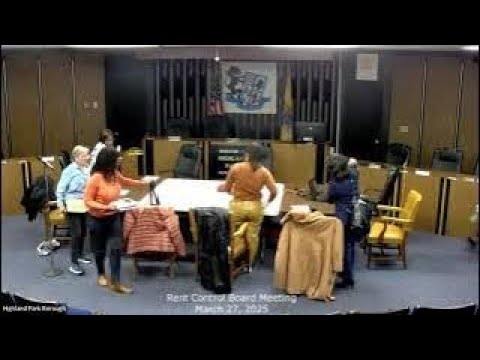
The Highland Park Rent Control Board met March 27 and agreed to draft a memo of recommended changes to the borough's rent-control ordinance addressing which properties should be exempt, how the annual maximum rent increase is calculated, vacancy ("vacancy decontrol") and the definition of "fair return." The board voted to enter an executive session earlier in the meeting, approved its Feb. 27 minutes and then returned to public discussion before taking public comment.
The board will forward a written report compiling the range of views expressed at the March meeting to the Borough Council and asked staff and the board committee to draft proposed ordinance edits for review at a follow-up meeting next month. The committee said any final ordinance language would then move through council procedures, including finance committee review.
Why it matters: The changes under discussion affect how much landlords can raise rents, which rental units are covered by the ordinance and how the town enforces rent limits when units turn over. Board members and public commenters said those decisions could materially affect students, working families, seniors on fixed incomes and other residents who rent in Highland Park.
Board discussion and recommendations
Exemptions: whether owner-occupied duplexes should be excluded from the ordinance was the first major topic. Diane, Rent Control Board member, argued in favor of exempting owner-occupied two-family homes, saying many are owned by long-term residents and seniors: "I do think that owner occupied 2 families should exist," she said. Several other board members said they prefer no exemptions; Terry, Rent Control Board member, noted uncertainty in local records about how many two-family structures are owner-occupied and suggested confirmation from the tax assessor.
The board recorded two approximations during discussion: one speaker estimated about 400 two-family properties in town but later clarified that the 400 figure referred to two-unit buildings generally and that roughly 60 of them might be owner-occupied. The board did not adopt a formal exemption but agreed to record the differing positions for the council to consider.
CPI formula for annual increases: staff and board members reviewed the current method for setting the annual maximum rent increase, which the board said is the simple average of the Consumer Price Index figures for New York City and Philadelphia. Heather, staff member, explained the board's materials showing that CPI-based increases compound faster than local wage growth and proposed using a percentage of CPI (for example, 75% of CPI) rather than the full CPI average to limit annual increases.
Board members discussed alternatives, including a flat percentage cap used in other municipalities, but did not vote on a specific numeric cap. The board instructed staff to include the proposal to use a percentage-of-CPI approach in the memo to council for further consideration.
Vacancy rules and revolving tenancy: members debated whether units that become vacant should be allowed to be re-rented at market rate (vacancy decontrol) or remain subject to rent control (vacancy control). Lucinda, Rent Control Board member, advocated vacancy control to protect affordability when units turn over. Several members raised enforcement and tracking concerns if vacancy control were adopted, noting it would require tracking new leases and possibly changes to related borough inspection or rental registration ordinances.
The board discussed an alternative narrower rule, "revolving tenancy" (often seen in student housing), where replacing a tenant within an existing tenancy would not trigger a return to market rent if the unit remained substantially the same. Board members asked staff to research administrative approaches used in other New Jersey ordinances to ease enforcement burdens.
Fair return definition and process: board members agreed they should tighten and define the "fair return" standard in the ordinance so that hardship or fair-return applications are clearer. The board did not set a specific numeric standard at the meeting but instructed staff to propose language and, where appropriate, a recommended percentage or calculation for the council to review.
Timeline and next steps: Jake, staff member, and board member Terry said they would draft the committee memo compiling the range of opinions, include any public comments, circulate it to the board for review and present it to the Council's finance committee and then to the full council. The board agreed to reconvene next month for a short meeting to review that draft before it is forwarded.
Public comment: three residents spoke during public comment. Jessica Huntison, Montgomery Street resident, criticized the borough attorney's tone toward volunteers and urged council to consider how the attorney's engagement affects public participation: "I think it diminishes. I think it is condescending. I think it is disrespectful," she said. Jake Stevens, Wayne Street resident, urged the board to review a 2024 report, Rent Control in New Jersey, and supported a percentage-of-CPI approach and better recordkeeping. Selena, Wayne Street resident, said vacancy control is essential for many residents who would otherwise be priced out if their units became market-rate.
Formal actions recorded
- Approval of minutes from Feb. 27, 2025: motion made and seconded; voice vote recorded as "Aye" and minutes were approved. - Resolution authorizing executive session (to discuss potential litigation): motion and second; roll-call votes recorded in transcript as Pauline: yes; Lucinda: yes; Diane: yes; "HP": yes; outcome recorded as passed. - Motion to adjourn: moved, seconded and approved.
Quotes from the meeting
"I do think that owner occupied 2 families should exist," Diane, Rent Control Board member, said during the exemption discussion.
"I think it diminishes. I think it is condescending. I think it is disrespectful," Jessica Huntison, Montgomery Street resident, said of the borough attorney's engagement with volunteers.
"It's called Rent Control in New Jersey. What is it? Where is it? How does it work?" Jake Stevens, Wayne Street resident, urged the board to review the 2024 report and resources he cited.
What the board did not decide
The board did not adopt numeric limits for a revised CPI calculation, did not create or remove exemptions, and did not change vacancy rules at the meeting. Instead it asked staff to draft a memo that records the range of board positions and options for the Borough Council to consider. Any final ordinance amendments would be decided by the Borough Council and might require parallel changes to the borough's inspection or rental registration processes.
Background and context
Highland Park enacted a municipal rent-control ordinance that sets a maximum annual rent increase; the board's role is advisory to the Borough Council. Board members referenced comparisons with Newark and other New Jersey ordinances and a Rutgers survey of state rent-control ordinances. Board members repeatedly noted enforcement capacity and data availability limits (the town lacks an official CPI for Highland Park and local wage data at the borough level).
Next steps
Board members asked staff to compile a memo reflecting the full range of positions discussed at the meeting, circulate a draft to the board and reconvene next month for a short meeting to review that draft before it moves to the Borough Council and the finance committee.