Get Full Government Meeting Transcripts, Videos, & Alerts Forever!
Get email alerts on the Automated Traffic Enforcement topic
No spam. Unsubscribe anytime.
Stratford to install 10 speed cameras at five school and pedestrian locations
Summary
Town officials detailed a plan to deploy 10 automated traffic-enforcement devices at five locations — mostly school zones — and described warnings, calibration, appeals and data-retention rules at a public information session.
Officer Brian Sharnick, Stratford Police Department Traffic Division, told a town public information session that the Town of Stratford will install 10 automated traffic enforcement safety devices (two at each of five locations) in school zones and pedestrian safety areas as part of a plan the town approved in July 2024.
Sharnick said the devices are intended to reduce speeding, crashes and serious injuries. “We as a department have a vision of having 0 fatal crashes on our roadways,” Officer Brian Sharnick said, describing the cameras as “one way of helping ensure that vision becomes a reality.”
The devices and the locations are authorized by a local ordinance adopted July 8, 2024 — chapter 203, article 6, sections 203-38 through 203-50 of the Town Code — and by state law governing automated enforcement. Sharnick said locations will be identified in the town’s plan and submitted to, and approved by, the Connecticut Department of Transportation.
Town officials listed the five target locations and presented speed-study results the vendor collected. The sites named in the presentation were:
- Huntington Road and Bulldog Boulevard (in front of the high school): posted limit listed as 30 mph in the presentation; study data shown included an average daily traffic (ADT) of about 9,800 vehicles and 7,671 violations observed in the study sample cited. The presenter said 16.8% of traffic was clocked at 40 mph or higher during the survey period.
- Nichols Avenue (in front of Nichols Elementary School): ADT about 11,800; 71,938 vehicles reviewed with 2,165 violations observed; the presentation listed a 35 mph posted limit and that roughly 3% of traffic exceeded 45 mph in the study period.
- Barnum Avenue (in front of Franklin Elementary School): posted limit listed as 30 mph; ADT about 18,400; 108,877 vehicles reviewed with 2,755 violations observed; about 2.5% of daily traffic exceeded 40 mph in the study period.
- Broadridge Avenue at Strepus Road: the presenter acknowledged an error in the printed handout about the posted speed limit and said the handout had been corrected. The presentation cited about 10,600 ADT and that roughly 7.5% of traffic exceeded 40 mph; participants in the meeting raised the area as a long-standing safety concern.
- Nichols Avenue at Barber Lane / Marina Drive vicinity: presentation listed a 35 mph posted limit, ADT about 11,800 and 160,000 vehicles assessed with about 7,000 violations observed in the sample cited; about 4.7% of traffic exceeded 45 mph during that period.
Sharnick outlined how the program will operate under state law and the town ordinance. Key points the presenter gave:
- Two cameras per site (one for each direction where appropriate), for 10 devices total in the first phase.
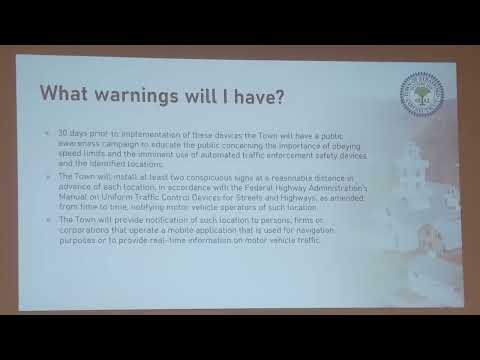
- A 30-day warning period after activation, during which violators will receive a courtesy notice rather than a civil penalty.
- Civil fines under Public Act 23-116 (codified in state statute 14-307 and related subsections cited during the presentation). The presenter said the civil penalty amounts discussed were $50 for a first violation and up to $75 for a second or subsequent violation; he contrasted that with the typical criminal speeding fines an officer ticket would carry, which he said start at larger amounts under standard traffic enforcement.
- Devices will be calibrated at least annually by an independent testing laboratory, and a sworn municipal employee or other designated municipal reviewer will review recorded images before any citation is issued.
- The town will install at least two conspicuous warning signs in advance of each camera location, and the town will notify navigation services (for example, Google Maps, Waze, Apple Maps) that cameras are present.
- There will be an administrative hearing process for contested violations; contested cases are handled administratively rather than through criminal court, the presenter said.
Rick Welling, identified in the presentation as a representative of the vendor (CensusGatsso in the meeting materials), described a “Vision Zero” approach to monitoring and periodically reassessing the program. Welling also cited an example from another municipality in which the vendor said the school-zone program produced an approximately 80% reduction in violations from the first month after activation to the average of the final three months of the school year. Welling presented that example as an illustration of potential effects; he attributed the result to the vendor’s program in that other city.
Members of the public asked about privacy, data security, mixed/incorrect plates, how long cameras will remain in place and program cost. Town presenters said:
- The town will not retain non-violation images; records tied to violations would be retained and purged according to state law. The presenter named the state statutory reference cited in the presentation for data retention and privacy rules.
- Registered-owner notices will be mailed; the system allows online review of still images and online payment or requests for administrative hearings.
- Each camera installation is planned to remain at its location for three years, after which the town will reassess whether the camera is still justified by crash and violation data.
- The program contract structure presented described the vendor paying installation and being reimbursed through the administrative fee assessed with citations; the presenters said the $15 administrative fee attached to tickets is intended to pay for project costs.
The session included multiple public commenters who raised concerns about surveillance, data breaches and the accuracy of plate-reading; presenters responded that registered-owner data is obtained from a secure federal repository used for criminal justice purposes and that the town will follow security protocols and state requirements for data handling.
The presentation closed with the town saying it will publish aggregate camera counts and program data on the police department website and provide public awareness mailings before enforcement begins. The presenters emphasized that the first 30 days after activation are a warning period.
Ending: Officials said the first phase will focus on school-zone speed enforcement; red-light automated enforcement was discussed as a possible future phase but was not on the immediate schedule. The town indicated it will submit the plan to the Connecticut Department of Transportation for required approvals and will publish periodic program metrics online.