Get Full Government Meeting Transcripts, Videos, & Alerts Forever!
Get email alerts on the Wetlands Permit 160 Didsboro topic
No spam. Unsubscribe anytime.
Stratford panel approves permit fee and plantings after retroactive wetlands review at 160 Didsboro Street
Summary
The Town of Stratford Inland Wetlands and Watercourses Commission on Tuesday voted to require the owner of 160 Didsboro Street to pay the estimated permit fee and install wetland‑compatible plantings after a soil scientist’s report showed wetland areas near recently placed fill.
The Town of Stratford Inland Wetlands and Watercourses Commission on Tuesday voted to require the owner of 160 Didsboro Street to pay the estimated permit fee and install wetland‑compatible plantings after a soil scientist’s report showed wetland vegetation at the rear of the property.
The vote followed a review of a soil‑science report and photographs that showed wetland flags and a blue dashed line marking the wetland edge; commission staff recommended charging the fee that would have been due had a permit been obtained and asking the applicant to submit a planting plan to help buffer the wetland.
Commission staff member Kelly said she had “reviewed the report” and told the commission it often works with property owners “to try and do some sort of retroactive permit,” and that in similar matters the commission could consider sampling, allowing fill to remain, or requiring plantings as a buffer. Kelly estimated the permit fee “in the $400 range” based on aerial imagery and the apparent area of impact.
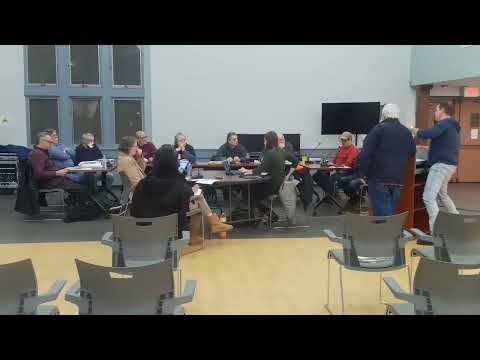
George Meyer, who identified himself as the neighbor at 121 Didsboro Street, and Jason Talbot, who represented the 160 Didsboro property, described site conditions. Talbot told the commission that the milling material was placed away from the flagged wetland and that the mapped boundary on aerials appeared to place the wetland slightly differently than the field flags. Meyer said the area “fills in with all the ground foliage” in summer and that trees in the backyard absorb much of the water.
Commission discussion focused on options for remedy: a retroactive permit fee in lieu of a penalty, a planting plan tailored to the existing tree canopy and shade conditions, and whether removal of asphalt millings should be required. One commissioner noted concerns about hydrocarbons in asphalt binder and said removal was “another consideration.” Kelly advised that the commission could require a revised restoration plan and follow standard terms and conditions for any permit.
The motion adopted by the commission charged the applicant the permit fee the commission estimated would have applied, required a planting plan consistent with wetland protection that staff would review, and directed staff to work with the applicant to finalize details. Commissioners approved the motion; one commissioner recorded a dissent on the record.
The commission did not require a doubled penalty fee. Commissioners and staff agreed that the precise planting palette, locations, and any further sampling would be worked out between Kelly and the property representatives. Talbot said he would “send you an email, and we’ll get together.”
The commission also discussed—but did not mandate—removal of the millings if testing showed contaminants; Kelly noted the commission’s enforcement power is to find permit violations and apply applicable permit remedies.
The commission’s action is recorded as an approval with conditions; staff will return to the commission if additional enforcement or sampling is necessary.
Ending: The applicant and conservation staff agreed to follow up by email and submit the planting and restoration details for staff review. The commission closed the item and moved on to the next agenda item.