Get Full Government Meeting Transcripts, Videos, & Alerts Forever!
Get email alerts on the Tidal Flats Remediation topic
No spam. Unsubscribe anytime.
Contractors begin tidal-flats remediation at former Army Engine Plant; dredging and upland capping planned
Summary
Developers and contractors described underway remediation work on the Housatonic River tidal flats in Stratford, including sheet piling, dredging of roughly 200,000+ tons of sediment, on-site treatment, and import of fill to raise the upland parcel.
Developers and contractors told a Town of Stratford public session that work is under way to remediate contamination in the Title (tidal) Flats at the former Army Engine Plant, with dredging, material treatment and upland capping planned over the next year.
Jim Cabrera, co-managing partner of the project team, said the project team closed on the upland parcel April 2, 2024, and “we're bringing in a million tons of fill to bring the site to elevation where we can build something on it. That's a FEMA requirement, and that's underway.” He said the team signed an Environmental Services Cooperative Agreement (ESCA) with the Department of Defense and that a record of decision from December 2019 set the remediation path for the tidal flats.
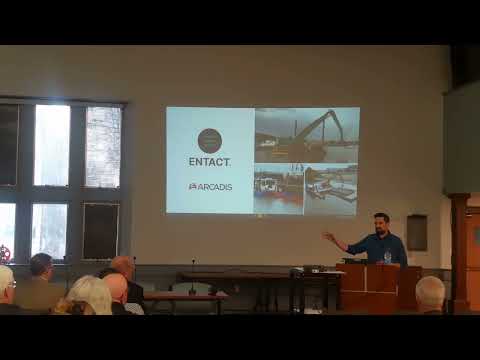
The remedial work in the tidal flats is the Department of Defense’s responsibility and will be executed by the Army Corps of Engineers and a private contractor selected through a competitive bid, the presenters said. Bernie Bonsai, project director for the contractor identified in the session as NTACT, said the project design was updated after the contractor joined and that the team received final design approval in February. "We have over 200,000 tons of material. We have to pull out of bridal flats," Bonsai said, adding that the team aims to begin dredging in May with completion targeted by June of the following year.
Why it matters: the work is intended to remove contaminated sediment from the Housatonic River tidal flats, treat or dispose of dredged material, and cap cleaned areas with imported sand. The developers said accepting lightly impacted sediment on the upland parcel and placing it under an engineered cap will reduce local truck traffic by roughly 10,000 trips compared with off-site disposal.
Scope and methods: presenters described a sequence of controls and processing steps. Steel sheet piling — driven roughly 15 to 20 feet to isolate work areas — will be combined with floating turbidity curtains and four telemetric turbidity monitors positioned upstream, inside the work zone and downstream. Bonsai said the monitors report every 20 to 30 seconds and will alert the team if readings change; "When we're within, 30 MTUs, which is the measurement of turbidity, we'll get alerts on our phone to know if something's going on," he said. The sheet piling is intended to allow float operations throughout the day rather than only at high tide.
Dredged material will be loaded into floating containment barges (described as "material arches"), moved to a dock on the causeway, and transported to an on-site processing area the presenters called a "spa." There the material will be blended with Portland cement to solidify it before off-road transfer to licensed disposal facilities or, for lightly impacted material, placement on the upland parcel as part of site fill. The team said depths to be dredged will range about 1 to 4 feet depending on contamination results from prior sampling.
Regulatory oversight and history: the presenters listed oversight from the U.S. Environmental Protection Agency, the Connecticut Department of Energy and Environmental Protection (DEEP), the Department of Defense and the Army Corps of Engineers. Jim Cabrera and others noted the site entered the BRAC process in 1995, that the record of decision was signed in December 2019, and that an ESCA followed in 2021. The project team said it signed an agreement with the Department of Defense in September 2024 to proceed with the tidal-flats work.
Schedule and logistics: the contractor said design submittals and more than 16 technical plans were reviewed by regulators and the town, and that mobilization began in March, with some sheet piling and dock construction already completed. Capping material will be clean sand imported from a local quarry and staged in a north lot before barging to the flats for placement. The presenters said GPS-equipped dredge equipment will be used to control cut depths and to restore grades.
Community engagement and next steps: presenters advised residents that the project website and the Town of Stratford site link to a project information site where submitted questions and technical answers will be posted. The team encouraged the public and media to follow up with their PR representatives after the session. No formal municipal votes or approvals were reported during the presentation.
Quotes in context: all quoted material below is from attendees at the Town of Stratford information session. "We're bringing in a million tons of fill to bring the site to elevation where we can build something on it. That's a FEMA requirement," said Jim Cabrera, co-managing partner. "This will reduce truck traffic, in the area by about 10,000 trips," Cabrera added when describing the upland placement option. Bernie Bonsai, project director for the contractor, said, "We have over 200,000 tons of material. We have to pull out of bridal flats," and described the monitoring system: "When we're within, 30 MTUs, which is the measurement of turbidity, we'll get alerts on our phone to know if something's going on."
Ending: The team said they will continue remediation activities and return to the town with development proposals for the upland parcel after remediation and site grading advance. Staff from Connecticut DEEP and contractor representatives remained available for questions after the public presentation.