Get Full Government Meeting Transcripts, Videos, & Alerts Forever!
Get email alerts on the Housing Production topic
No spam. Unsubscribe anytime.
West Linn council adopts six-year housing production strategy with accessibility changes
Summary
The West Linn City Council adopted a six-year Housing Production Strategy that outlines zoning, incentives and a construction excise tax (CET) as possible tools; the council added two minor edits to emphasize accessible housing and delayed potential CET implementation.
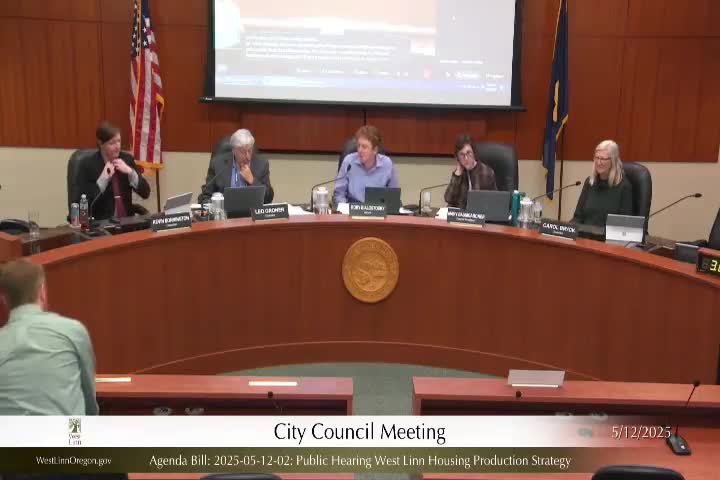
The West Linn City Council adopted the city's Housing Production Strategy on May 12, 2025, voting to approve Resolution 2025-02 as recommended by the Planning Commission with two minor edits to address accessible housing needs.
The strategy lays out actions the city will pursue over the next six years to increase housing supply and affordability, including rezoning for higher-density and mixed-use development, incentives for smaller units and affordable housing tools such as tax increment financing and a possible construction excise tax. Council members asked for more study of the CET and directed staff to emphasize accessibility for older residents and people with disabilities.
Darren Wise, the city's planning manager, said the strategy is a required report that the city will submit to the State Department of Land Conservation and Development for review. Consultant Matt Hasty summarized the project's year-long process and the document's key actions. "We are at the tail end of the process here," Hasty said, describing how the team narrowed an initial set of ideas into prioritized strategies and timeframes.
The Planning Commission recommended adoption but asked that implementation of a construction excise tax be shifted toward the latter half of the six-year period. Hasty described how the CET works under Oregon rules: residential CETs are capped at 1% of permit value; jurisdictions commonly set lower rates; half of residential CET revenues must be returned to developer incentives (for example, fee or SDC reductions), about 35% must be used for affordable-housing programs, and 15% is remitted to the state. Hasty noted jurisdictions often exempt certain housing types, such as affordable units, accessory dwelling units or accessible units, and that the CET typically serves as local gap financing to leverage other funding sources.
Council discussion focused on clarifying definitions and trade-offs. Councilor Groener observed that some new infill replaces single-story, accessible housing with tightly clustered multi-story units and asked that the strategy explicitly consider housing types appropriate for older or disabled residents. Council President Baumgartner and Councilor Bridal pressed for clearer definitions of "affordable" and emphasized the need for options to attract families and stabilize school enrollments. One councilor said the city should study the CET further before implementing it and noted experience in other cities where builders pushed back strongly.
No members of the public testified at the hearing. The council's adoption is final and staff will submit the strategy to the state for compliance review. Planning staff said the work was funded by a grant and that the city's housing-capacity work dates to earlier state-required analyses. "This was a required state submittal," Darren Wise said; the council's vote adopts the locally-preferred mix of strategies and a timeline that explicitly delays CET implementation to allow further study.
The strategy includes targeted actions to encourage smaller unit types, zoning changes to add sites for medium- and higher-density housing, incentives and tax tools for affordable and workforce housing, and reminders about fair-housing obligations. Council members said they expect continued public engagement, additional analysis of CET impacts, and periodic reporting as staff begin implementation steps.