Get Full Government Meeting Transcripts, Videos, & Alerts Forever!
Get email alerts on the Data Centers topic
No spam. Unsubscribe anytime.
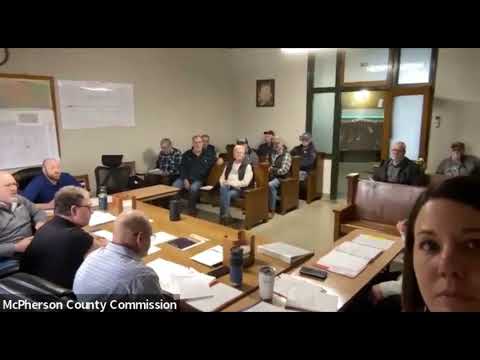
McPherson County commissioners table data-center zoning ordinance after heated hearing; legal counsel warns limits on county authority
Summary
The McPherson County Board of County Commissioners tabled consideration of a proposed data-center zoning ordinance after a multi-hour public hearing and a legal review that flagged limits on the county's authority to require certain technical studies.
The McPherson County Board of County Commissioners tabled consideration of a draft data-center zoning ordinance after a lengthy public hearing and legal review, saying the county needs time to define what it can legally require from prospective operators.
Commissioners debated a set of 12 studies that zoning board members had proposed for conditional-use review of data centers, including energy-use studies, water-use studies and environmental impact items. Austin, the county's state's attorney, told the board that state law gives the Public Utilities Commission (PUC) authority over electric utilities (SDCL 49-34A-4) and that courts have voided local ordinances that duplicate state law. He recommended against making many of the requested studies mandatory parts of a county ordinance because doing so could expose the ordinance to legal challenge.
Supporters of the studies — including residents who said they wanted more information about a project's effects — said the county should at least request the information so commissioners could make an informed decision on conditional-use permits. Opponents cautioned that mandatory, detailed studies would create a long, costly ordinance and could invite litigation; some commissioners said they were concerned about regulating beyond the county's statutory authority.
After public comment and extended discussion, a motion to table the zoning ordinance and associated amendments carried by voice vote. Commissioners said they will return to the issue at a later meeting with clearer options: whether to (a) ask a prospective developer to provide requested studies voluntarily, (b) send specific questions to the applicant as part of an informational/public meeting, or (c) seek statutory change at the state level to expand county authority. The board scheduled follow-up work and indicated it will request a formal informational session with any data-center applicant that approaches the county.
The board also set an April 22 public hearing on a separate matter (comprehensive-plan extension) during the meeting; commissioners asked staff to prepare materials and to advertise the hearing per state notice requirements.
Why it matters: Commissioners must balance local information needs against legal constraints. The outcome leaves the county without new mandatory zoning rules for data centers; officials said they want more facts on potential projects but must avoid ordinance language that a court could invalidate.