Get Full Government Meeting Transcripts, Videos, & Alerts Forever!
Get email alerts on the Air Quality topic
No spam. Unsubscribe anytime.
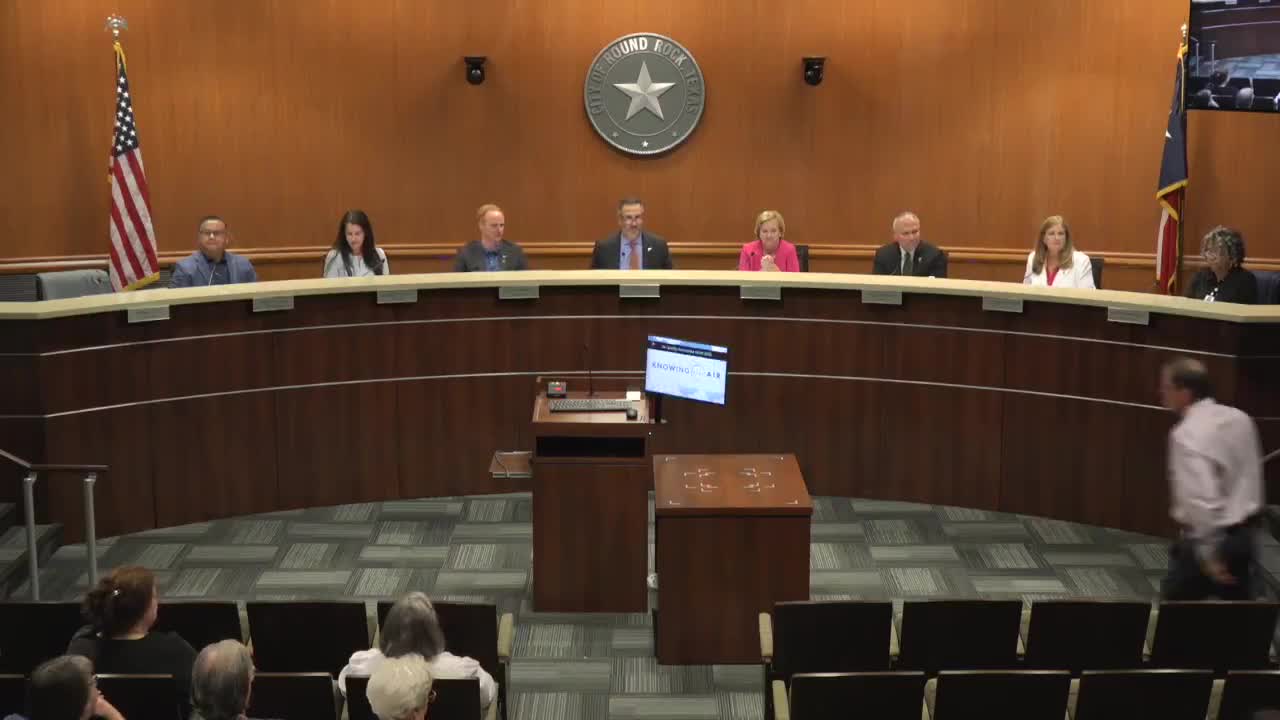
Round Rock proclaims Air Quality Awareness Week; staff highlights monitoring and regional ozone concerns
Summary
The Round Rock City Council proclaimed May 2025 as Air Quality Awareness Week and received a staff briefing about local monitoring, outreach efforts and regional air‑quality conditions, including 2024 exceedances of federal ozone and PM2.5 standards in the Austin‑Round Rock‑San Marcos MSA.
Round Rock City Council proclaimed May 2025 as Air Quality Awareness Week for the Capital Area Council of Governments (CAPCOG) region and heard a staff briefing on local monitoring and actions to support air quality.
City staff presented the city’s outreach and operational steps to reduce emissions, including an idling ordinance, urban forestry/tree planting by the forestry division, fleet efficiency measures, ozone action day notifications and an air‑quality monitor the city operates at the West Wastewater Treatment Plant on Austin Street. Staff recommended residents use regional monitoring resources such as PurpleAir and AirNow and CAPCOG’s Air Central Texas website to check daily air quality.
The staff presentation included regional data for 2024: the Austin‑Round Rock‑San Marcos metropolitan statistical area recorded days with moderate or worse air‑quality index (AQI) readings and exceeded the federal 8‑hour ozone standard and the annual fine particulate matter (PM2.5) standard in 2024, which raises the region’s risk of a formal nonattainment designation. The city’s air‑quality monitor reports particulate matter and ozone and provides data to CAPCOG.
Council member Montgomery was noted for service on the CAPCOG board and staff thanked city representatives serving on CAPCOG committees. The mayor and council proclaimed the week publicly and encouraged residents to be “air aware,” particularly people with lung or heart disease, children and older adults who are more affected by poor air quality.
No regulatory actions or new local controls were adopted at the meeting; the item was a proclamation coupled with an informational briefing.