Get Full Government Meeting Transcripts, Videos, & Alerts Forever!
Get email alerts on the Development Fueling Station topic
No spam. Unsubscribe anytime.
Planning commission approves Vaquero fueling station and preliminary plat at Jack Borden Way and Fort Worth Highway
Summary
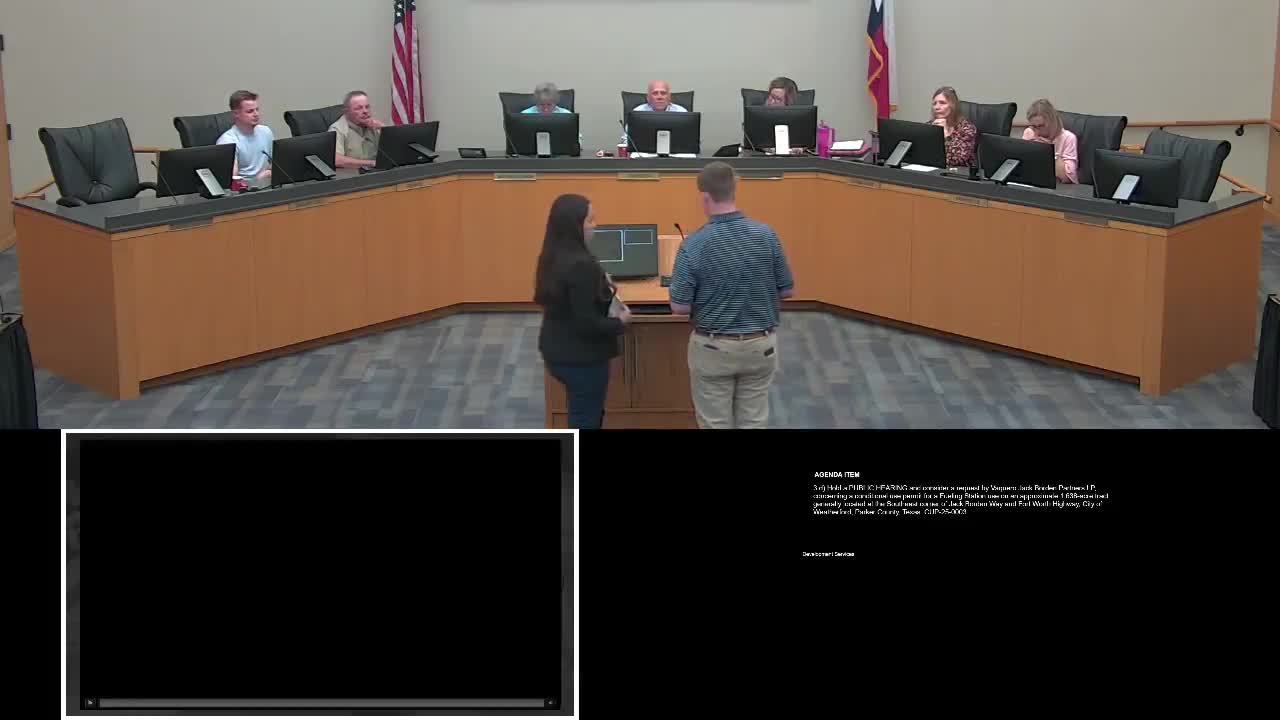
The City of Weatherford Planning and Zoning Commission on Wednesday approved a conditional use permit for a fueling station and a preliminary plat for the Vaquero Weatherford addition, a two-lot commercial subdivision totaling about 2.923 acres at the southeast corner of Jack Borden Way and Fort Worth Highway.
The City of Weatherford Planning and Zoning Commission on Wednesday approved a conditional use permit for a fueling station and a preliminary plat for the Vaquero Weatherford addition, a two-lot commercial subdivision totaling about 2.923 acres at the southeast corner of Jack Borden Way and Fort Worth Highway.
The vote, taken by the commission at 2:46 p.m., passed unanimously. The conditional use permit (CUP-25-003) covers the fueling-station use presented by developer Vaquero Ventures; the preliminary plat (SBDP-25-001) divides the property into two commercial lots. The commission approved the preliminary plat subject to eight staff conditions listed in the staff report and recommended approval of the CUP subject to two conditions in staff’s recommendation.
Why this matters: the corner has been the focus of redevelopment interest and public-safety questions. Neighbors said increased traffic and a cluster of recent and proposed convenience-store fuel sites create safety and congestion concerns that staff said will be reviewed during site-plan and traffic-impact analysis stages required before final development permits.
Brad White, representing Vaquero Ventures and identifying his address as 2627 Tiller Street, Fort Worth, described the fueling station as part of a larger convenience-store concept with a roughly 5,000-square-foot store and visible pump canopy, and said the owner is “within 60 days of closing” on nearby parcels needed to assemble the corner. “It’s just an overall a newer nicer concept that we’re proposing here,” White said.
During public comment, Corinne Lewin, 113 Oakwood Drive, questioned the need for another fuel station in a short area and said: “some idiot’s gonna try and turn left from Fort Worth Highway in there and get in another accident.” Bob Tollington, a nearby property owner, said redevelopment that “cleans up that old lot” and provides lighting and activity could improve safety and security.
City staff said a traffic-impact analysis (TIA) and detailed site-plan review are required before any site work or permits are approved. Caleb Kentner, director of development and neighborhood services, said access, vehicle movement and right-turn/left-turn treatments will be evaluated in the site-plan phase and that the city can require features intended to reduce unsafe turning movements.
Commissioners discussed a broader pattern of recent convenience-store fueling station proposals in the city and directed staff to prepare a comprehensive analysis of fueling stations — including truck stops and convenience-store fuel outlets, spacing/locational metrics, and per-capita or traffic-based benchmarks — for a future meeting so the commission and City Council can consider spacing or other land-use regulations.
The commission also approved the related preliminary plat, SBDP-25-001, by a unanimous vote; staff recommended approval with eight conditions that will be resolved before final platting and development permits. The CUP and the preliminary plat approvals are separate actions; final site-plan approval, issuance of a site-development permit and any traffic improvements will be required before construction.
Votes at a glance: the transcript records each motion as passing unanimously; the meeting record states “Motion passes unanimously.” The transcript does not provide a roll-call tally or the names of movers and seconders for these particular motions.
What happens next: the developer must submit a site plan and technical reviews (including a traffic-impact analysis). The commission’s direction instructs staff to prepare a citywide fueling-station analysis for a future meeting; that study will inform any changes to zoning or spacing requirements.