Get Full Government Meeting Transcripts, Videos, & Alerts Forever!
Get email alerts on the Fleet Management topic
No spam. Unsubscribe anytime.
Arlington details $12 million fleet budget, proposes 32-vehicle leasing pilot with Enterprise
Summary
City staff told the Arlington City Council the Fleet Services budget is about $12 million annually, highlighted recent cost controls and audit implementation, and proposed a limited 32-vehicle pilot with Enterprise to test leasing and resale advantages.
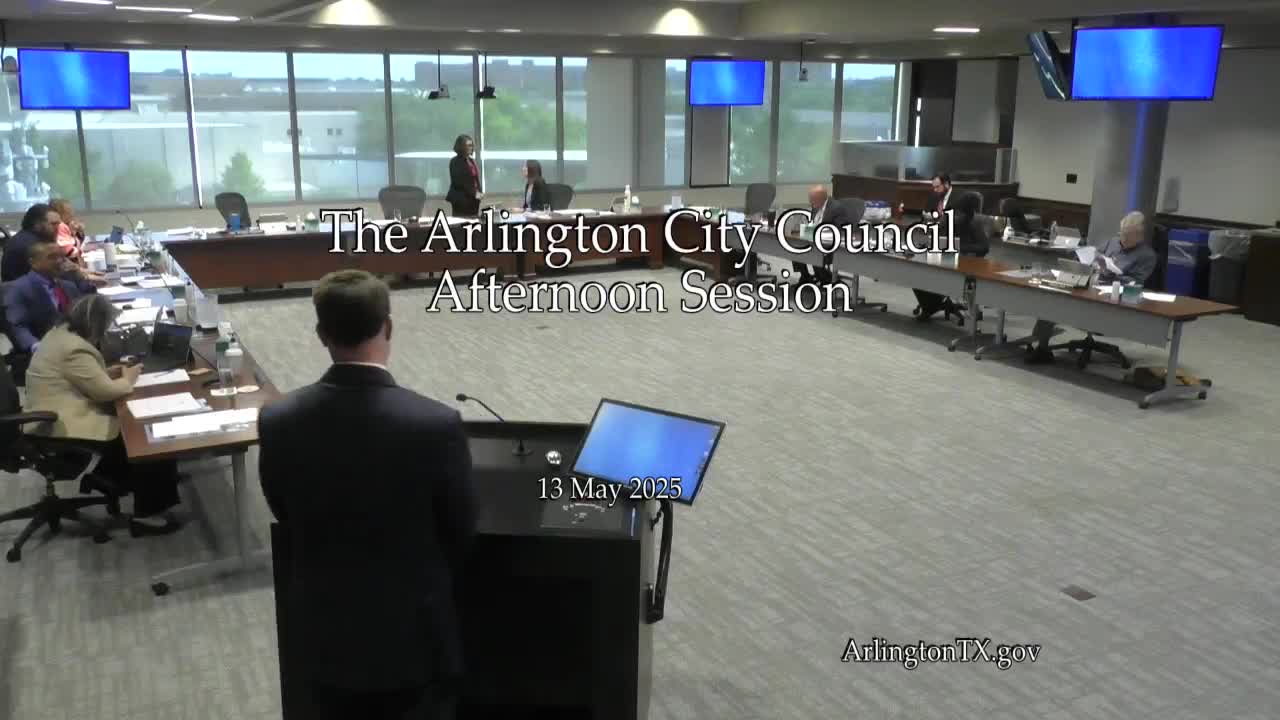
Jay Warren, director of communication and legislative affairs for the City of Arlington, told the City Council on May 13 that Fleet Services operates on an approximately $12,000,000 annual budget and is proposing a limited leasing pilot with Enterprise covering 32 vehicles.
Warren said the city's fleet budget is divided among vehicle replacement, planned and unplanned maintenance, and fuel, and that fuel has been “stable of late” at about $3,000,000 annually. He told council members the city plans to invest about $3,800,000 in vehicle replacements in fiscal year 2026.
Warren said Fleet Services merged with Communications and Legislative Affairs in September and that the department now measures fleet size with a vehicle-equivalent (VE) count rather than a simple vehicle tally; he said police accounts for roughly 31% of the VE count and that the overall fleet VE count was about 1,350 last year but is intentionally being reduced.
The department described replacement thresholds it uses by vehicle type — for example, general sedans and white pickups at roughly 150,000 miles or 10 years, police patrol vehicles at about 120,000 miles or seven years, and fire engines at 200,000 miles or 12 years — and a goal that no more than 15% of the fleet exceed those thresholds.
Warren outlined recent cost-saving measures: tighter review of unplanned maintenance, shifting some vehicle wrapping in-house to avoid vendor upcharges, completing a Volkswagen grant-funded deployment of 38 level‑2 EV charging stations, and completing 16 audit recommendations from the 2024 and 2025 fleet audits. He said the city reduced unplanned maintenance costs by about 25% year over year and identified 56 VE reductions (roughly 35 vehicles) that staff estimate will avoid about $1,700,000 in purchases over five years, with auction proceeds of about $250,000.
On vendor relations, Warren said King George is the city's largest maintenance contract (collision repairs use a different vendor) and that the King George contract is approaching its fourth year with renewal due in August.
Warren proposed a limited leasing pilot with Enterprise Fleet Management for 32 vehicles drawn mainly from the pool fleet and Planning and Development Services. He said Enterprise could provide resale timing advice, wider procurement options, and potentially higher resale values. Warren said maintenance under an Enterprise lease would use a network of partnered vendors and would include notifications to vehicle custodians when service is due. Council member Pham asked about lease terms; Warren said terms vary but that Enterprise also advises on the best time to sell to maximize resale value. Warren said the pilot would be evaluated and could be expanded or ended based on results.
Warren also discussed electric vehicles: the city has 38 level‑2 chargers (all grant-funded) and 12 EVs in the fleet; staff said level‑3 chargers would be preferable for city operations if EV adoption grows.
Council members asked about specific items: Council member Odom Wesley asked whether Enterprise could supply EVs (Warren said yes, Enterprise can recommend EVs where appropriate); Wesley also asked whether drones are part of fleet (Warren said drones are managed by the departments that own them and are not part of Fleet Services). Council member Gonzales raised collision-repair backlog visible at local facilities; Warren said collision repairs are routed through a collision vendor and staff work to return patrol vehicles to service quickly.
Warren said staff will bring pilot results and analysis back to council after the test period.
The presentation was informational; no formal council action was recorded in the transcript on the pilot during the meeting.