Get Full Government Meeting Transcripts, Videos, & Alerts Forever!
Get email alerts on the Trees Urban Forestry topic
No spam. Unsubscribe anytime.
Council approves UDC changes to strengthen tree preservation and mitigation
Summary
The Arlington City Council approved a Unified Development Code amendment revising tree preservation incentives, defining heritage and significant stands, and raising penalties for unauthorized removal; supporters cited protection of the Cross Timbers and long review by staff and community groups.
The Arlington City Council on first reading approved revisions to the Unified Development Code (UDC) that change how the city awards development incentive points for preserved trees, add definitions for ‘‘heritage’’ and ‘‘enhanced significant’’ tree stands, and raise penalties for unauthorized removal.
John Chapman, Long Range Planning Manager with Planning and Development Services, said the revisions respond to analysis identifying a net loss in canopy after the prior bonus structure and aim to preserve the Cross Timbers oaks while still offering development incentives. “There’s a lot of, from my understanding, support on what we are considering this evening,” Chapman told council members.
The amendment reduces the bonus credit for preserved Cross Timbers oaks to 1.5 points per caliper inch and for other bonus trees to 1.25 points per caliper inch, increases the bonus for ‘‘significant stands’’ and creates a heritage-tree category (Cross Timbers oak greater than 40 caliper inches) that receives double bonus points if preserved and a double penalty if removed. An ‘‘enhanced significant stand’’ is proposed as at least 10 protected trees with five Cross Timbers oaks of at least 8 caliper inches; that configuration would receive triple bonus points.
Under the proposal a minimum inventory of 300 protected caliper inches would be required to qualify for development incentives (a figure Chapman said was derived from an average of the last several years of planned development applications). Single-family preservation would still require at least 35% preservation. The incentives would allow reductions in lot area, dimension requirements and dwelling size up to 15% once preservation thresholds are met; multifamily and nonresidential incentives and parking-reduction formulas are also described in the staff presentation.
Speakers from the community urged adoption. Sherry Capehart of Impact told the council they had worked with city staff and developers and urged passage: “Arlington has a forest…we have the largest remaining stand of the Eastern Cross Timbers forest and we need to protect it,” she said. Laura Capek, another community supporter, said prior rules had not worked and that the updated approach gives the city ‘‘a little bit of more bite.’’
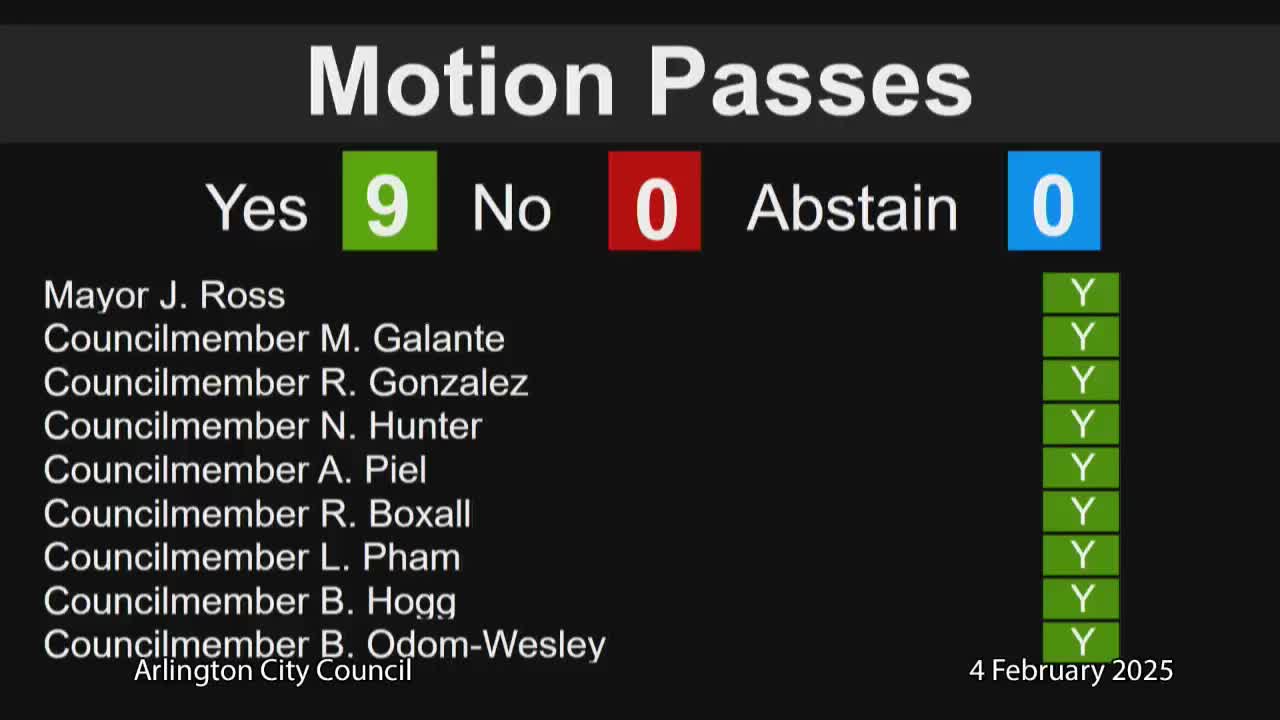
Councilmember Barbara Odum Wesley and others thanked residents and advocates for their months of engagement. After public comment, Councilmember Boxall moved to approve the revised ordinance; Councilmember Hunter seconded and the motion passed. The staff presentation said the ordinance would take effect April 1 if approved on subsequent readings.
The ordinance also proposes exemptions for the Arlington Municipal Airport related to FAA regulations, an exemption for Form-Based Code where explicitly adopted, stepped-up enforcement for unauthorized removal, and a proposed $600-per-caliper-inch fee for unauthorized removal to be considered at a future meeting.
The council and staff noted the item had been the product of months of meetings with the Planning and Zoning Commission, Landmark Preservation Commission, municipal policy committees and developers’ groups. Chapman said the item would return to council for additional readings per the UDC adoption schedule.