Get Full Government Meeting Transcripts, Videos, & Alerts Forever!
Get email alerts on the Midtown Development topic
No spam. Unsubscribe anytime.
College Station council hears decade-long Midtown history as residents push for rec center, developer pitches tourism complex
Summary
City staff presented a 14-year history of Midtown development and its financing; Midtown residents pressed the council about rising Municipal Management District (MMD) taxes and unbuilt amenities; the Midtown developer proposed a large public–private tourism and recreation project and asked the city to vet it through economic development.
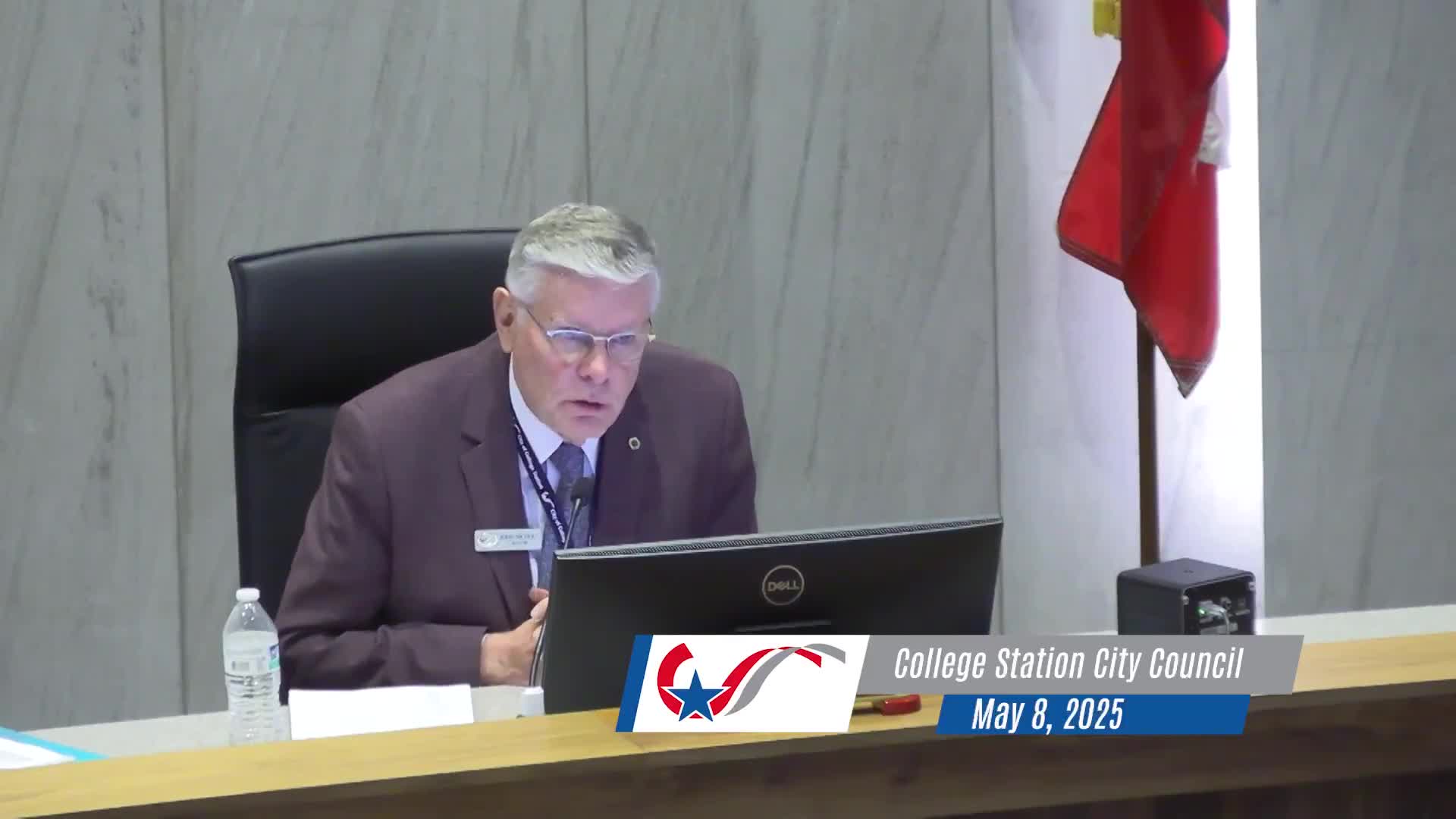
College Station City Council members and Midtown residents heard a detailed history of the Midtown development and its financing on May 8, 2025, then spent more than two hours debating rising Municipal Management District taxes, unmet neighborhood amenities and a new public–private proposal from the Midtown developer.
Assistant City Manager Jennifer Prochaska told the council the presentation had been requested so members who were not on earlier councils could understand the sequence of planning, incentives and infrastructure investments. “When the developer builds his required infrastructure … and realizes at least $50,000,000 of value in that area and builds 150,000 square feet of non-residential use, the city will give all of the city property tax money it has collected on the increased value since 2016 to the developer and will make an annual payment to him until 2036,” Prochaska said in summarizing the economic development agreement (EDA) between the city and the developer.
Why it matters: Midtown residents pay an extra property tax to Rock Prairie Municipal Management District No. 2 (MMD), and some told the council that local services and promised commercial amenities have not appeared while their bills rose. The council asked staff to vet a newly presented public–private partnership concept and requested additional financial information so members can weigh next steps.
Most of the council meeting’s Midtown discussion reviewed past actions and agreements. Prochaska said the city and the developer worked together during the medical‑district master‑planning process; the city consented in 2013 to creation of two MMDs and established tax increment reinvestment zones (TIRZs) for the area. She said the city has constructed roughly $48 million in infrastructure in the area and still has additional capital responsibilities estimated at roughly $60 million.
Prochaska described three incentive features residents raised questions about: a) tax increment and EDA payments that would funnel increased city property‑tax revenue for the tract to the developer once performance thresholds are met; b) an MMD tax (her presentation noted the district’s assessment began at $0.50 per $100 valuation and was increased to $0.65 this past year) whose proceeds are governed by the district; and c) negotiated credits and fee reductions the developer received, including about $4.4 million in roadway impact‑fee credits and roughly $400,000 in parkland credits.
Residents and council members repeatedly asked for clarity about which revenues the city controls and which are controlled by the MMD or captured by the EDA. Prochaska said the EDA’s tax‑sharing structure is “unprecedented” for the city and that the agreement includes both debt service and the operations & maintenance portion of city property taxes on the increment, a point she said is unusual compared with past agreements.
Developer response and proposal
Mr. Murr, the developer and principal landowner in much of Midtown, told the council he agreed the original vision was ambitious and blamed a combination of changed conditions, added city fees and departing partners for some missed outcomes. “The grandiose vision created by the city is still impossible if the city doesn't fulfill its promises,” he said, adding that the developer had relied on the public commitments to make long‑term private investments.
Mr. Murr also presented a new, large public–private development concept and asked the city to work with him on a proposal. He described a mixed tourism‑and‑events complex he termed an entertainment, convention and recreation destination, with hotels, an indoor water park, a convention/sports center convertible to tournaments and conventions, a family entertainment center and a proposed outdoor “Texas Caribbean” water feature. He asked the council to: - instruct staff to create an identity/branding plan for the area, including monument signage; - “grandfather” Midtown fees (he asked the city to preserve fee schedules in effect when the original infrastructure/EDA was negotiated) so new fee increases would not apply to his project; and - task staff to work with him on a public–private partnership and return to council with options.
Resident concerns
Multiple Midtown homeowners described recent tax increases and said they had bought homes based on the city’s earlier planning materials and public statements. Shelby Boehm, a Midtown resident who spoke during the council meeting, said she saw a roughly 30% increase in her MMD tax from 2023 to 2024 and expected another sizable increase for 2025, and that the jump was the driver of a higher overall tax bill: “The sole reason for why I'm paying more … is because of that 30% tax increase,” Boehm said. Other residents said they had been marketed a neighborhood that would include restaurants, a recreation center and other commercial amenities; those amenities have not appeared.
Council response and next steps
Council members pressed both staff and the developer for clarifications. Several members said they wanted to move beyond a finger‑pointing phase and examine concrete, forward‑looking options. After discussion the council directed staff to: - begin a formal vetting of the developer’s public–private partnership concept through the city’s economic development process; and - compile and deliver detailed financial information requested by council and residents, including accounting for TIRZ and MMD revenues and the credits noted in the EDA.
Mayor John P. Nichols closed the Midtown portion of the meeting by urging cooperation: “Let's work together,” he told the developer, the MMD and city staff.
What remains unresolved
Staff and council did not change the terms of the EDA or the MMD tax rates at the meeting. Prochaska noted the last remaining EDA performance threshold tied to payment is a non‑residential floor of 50,000 square feet (Prochaska said roughly 30,000 square feet currently exists in the tract), and that once the developer meets the stated criteria the EDA directs city property‑tax increments to the district/developer for annual payments through 2036. Residents asked for and councilors requested clearer accounting of MMD receipts and spending; council member requests included a recent formal request for MMD accounting that staff agreed to re‑issue so the district and city can supply the records.
The council approved two related, formal items that evening: appointments to the Rock Prairie Management District board (Samuel Kerbel and Logan Lee, four‑year terms) and a motion asking staff to examine the developer’s public‑private proposal through the city’s economic development office. The city indicated the economic development staff will return to council with feasibility analysis and suggested public‑finance options after vetting the concept.