Get Full Government Meeting Transcripts, Videos, & Alerts Forever!
Get email alerts on the Budget topic
No spam. Unsubscribe anytime.
City staff warns of $21.5 million budget gap after appraisal protests, ARPA wind‑down and senior tax freeze
Summary
City staff told the Arlington City Council that a combination of appraisal‑year protests, the scheduled end of American Rescue Plan (ARPA) funding and a voter‑approved senior tax freeze have produced a projected $21.5 million shortfall for fiscal 2026 and prompted a list of possible revenue and cost actions.
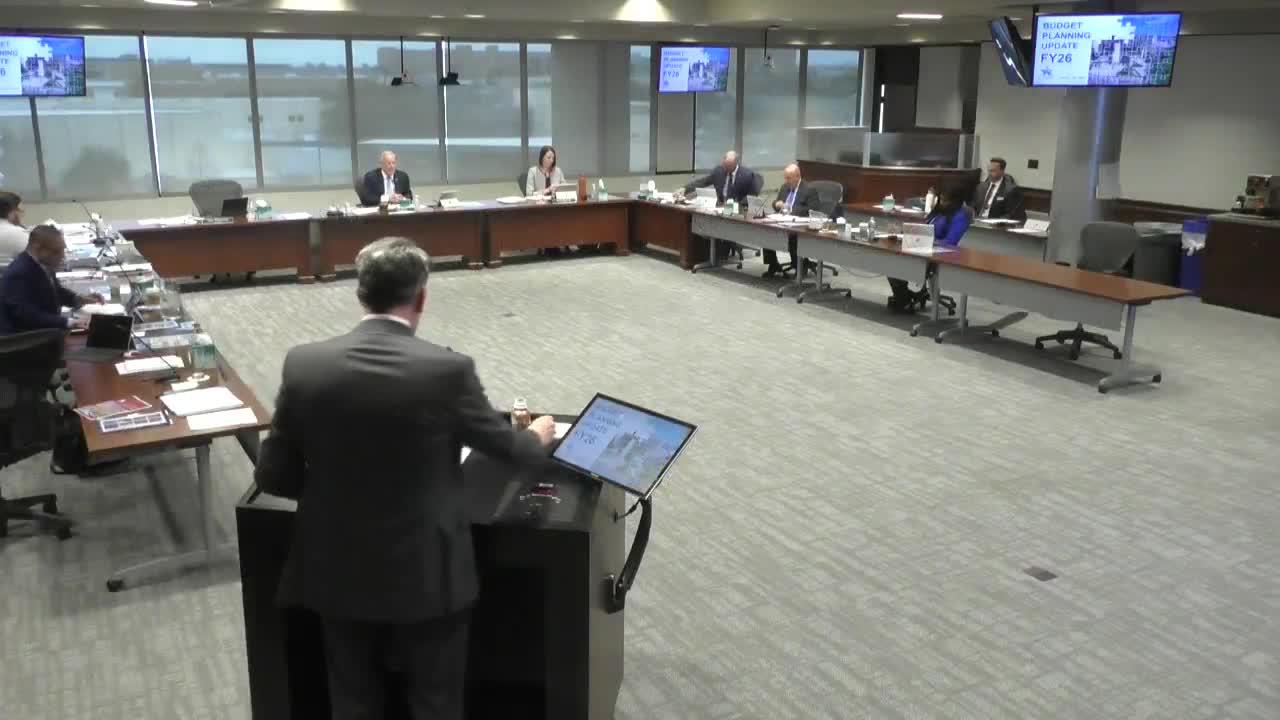
Trey Elvington, city staff and the meeting’s budget presenter, told the Arlington City Council on Monday that the city now projects a $21.5 million budget gap for fiscal 2026 driven largely by a wave of property tax protests, the scheduled end of ARPA dollars and an expanding senior tax freeze.
Elvington said the city’s revenue picture has improved compared with earlier decades because of venues such as AT&T Stadium and the convention center, but recent appraisal changes and heavy protest activity have “pulled the rug out” of the stable history used to prepare budgets. “We’ve updated this to show it’s larger,” Elvington said of the hole the city must close, adding later, “we will essentially be complete with ARPA funding in 2026.”
Why it matters: the gap forces the city to consider a mix of revenue steps, financial restructurings and program reductions to match lower projected revenues without abrupt layoffs. Council members repeatedly pressed staff for options to avoid furloughs and layoffs, and said they preferred using attrition and slower hiring to mitigate impacts.
Key facts and context
- Appraisal and protest activity: Elvington attributed most of the shortfall to a surge of successful protests in commercial and multifamily accounts. He said the city lost about $1 billion of taxable value in the last year, equivalent to roughly $7 million in property tax revenue. He pointed to concentrated reductions among large multifamily and commercial accounts and to a pattern of aggressive appeals by some property owners.
- ARPA and recurring costs: Arlington received ARPA funds that Elvington described as a “lifeline” (about $81 million) used to restore services and expand public safety staffing. The city built some recurring public‑safety costs into the base from one‑time grant dollars; Elvington said the city planned a multi‑year phase‑in but must smooth remaining obligations as the ARPA tranche winds down (one remaining tranche of about $3.8 million). He said roughly $15 million of public safety restorations were funded from ARPA.
- Senior tax freeze and tax relief: The council’s senior tax freeze, which Elvington said was voter‑approved in 2005, has grown to approximately $3.5 million in lost revenue in FY25 (previous year about $3.3 million). He noted the city provided roughly $80 million in tax relief last year through exemptions and rate choices.
- Budget makeup and priorities: In the current budget Elvington reported roughly $130.6 million for police, $73 million for fire and $77 million for streets. He said that allocation leaves only about $30 million for the rest of general fund services (code enforcement, parks, libraries, finance, HR). His high‑level options to close the gap include fee adjustments, targeted departmental reductions, use of reserves and program sunsets; he stressed preference for structural solutions rather than one‑time fixes.
- Savings already taken: The current budget included $5.8 million of base‑year savings, elimination of 22 positions, and other measures (airport enterprise fund separation, elimination of a legacy IT system). Elvington said the city still faces roughly another $6–8 million of immediate pressure to balance the current year and $21.5 million for FY26.
Potential measures under consideration
- Revenue and rate actions: fee reform, increases in cost‑recovery fees, franchise fee reviews and possible utility rate refinements (including an internal city water rate concept).
- Staffing and hiring: hold positions vacant unless approved by the budget lead; a “semi” hiring freeze requiring Elvington’s sign‑off; slower public‑safety hiring cadence rather than layoffs; targeted command‑level restructuring in fire services.
- Operational changes and efficiencies: right‑sizing and standardizing fleet, consolidating utility locate functions, converting two city holidays to PTO to reduce premium pay, reassessing library inventories and branch roles, and reviewing holding‑facility (jail) usage and costs.
- Reserve use and orderly reductions: the city holds about $66 million in reserves and an additional set of endowed funds the presentation called the Tomorrow Foundation. Staff outlined a possible draw from the business continuity reserve (~$4.1 million) that would lower fund balance from about 20% to 18.7% while preserving policy minimums and allowing orderly program sunsets or time‑phased reductions.
Council reaction and next steps
Councilmembers expressed support for transparent, methodical work to close the gap and urged staff to minimize involuntary separations. Councilmember Trogg said the council’s goal was “no RIF, if at all possible” and urged continued emphasis on revenue options and attrition. Councilmember Gonzales asked staff to review other funds and interfund transfers to identify legitimate opportunities to reduce general fund pressure. Several members volunteered standing committee reviews and requested follow‑up briefings in April and June.
Elvington said staff will return with more analysis in April, then again in June and September as the council refines choices; he said departments were instructed not to submit new funding requests for the forecast cycle and to propose 3% reduction scenarios where feasible.
Ending note
Elvington closed by noting the city’s long record of economic development and job creation, and said staff will pursue both expense and revenue options while seeking council feedback throughout the spring and summer budget process. “The suggestion box is open,” he said, inviting ideas and written proposals.