Get Full Government Meeting Transcripts, Videos, & Alerts Forever!
Get email alerts on the Housing Enforcement topic
No spam. Unsubscribe anytime.
Residents and enforcement group press College Station council on Midtown development and occupancy rules
Summary
Public commenters urged the council on March 13 to consider Midtown for future development and to change occupancy-enforcement rules, asking for earlier photo collection, adjusted vehicle-count rules and civil enforcement options to increase citations for over-occupancy.
College Station — Two public-comment speakers on March 13 urged the City Council to prioritize development in Midtown and to change the city’s occupancy-enforcement ordinance to make enforcement of over-occupancy more effective.
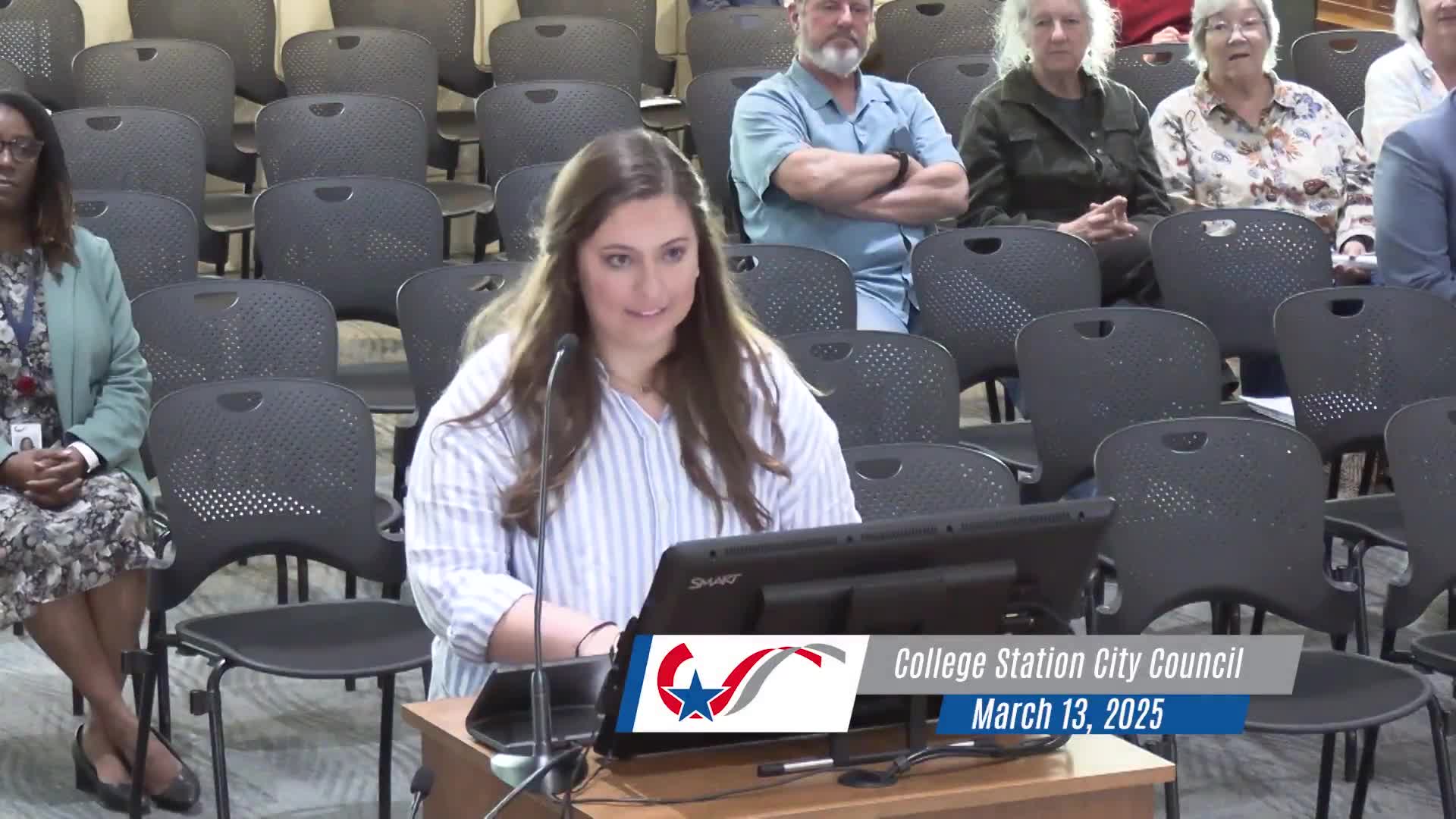
At the outset of the visitors segment, Shelby Beam, speaking as a Midtown resident and neighborhood organizer, told the council she had canvassed the neighborhood and heard frustration over rising fees and a lack of visible development tied to higher taxes.
"If you're a Midtown resident or supporter of Midtown's development, I invite you to raise your hand to be recognized," Beam said. She told the council some residents have seen median monthly charges jump and said the neighborhood feels overlooked as the city evaluates sites for a possible recreation center and convention center.
The concern that Midtown is being bypassed for city projects came up alongside questions about infrastructure and tax burdens. Beam said some residents want a lower targeted tax rate, while others want projects or amenities that match their HOA dues and property taxes. "It's frustrating to see the top locations proposed for these projects ... Midtown's location has less congestion than other areas," she said.
Representatives of the Occupancy Enforcement Alliance followed with detailed recommendations intended to raise the city's citation and compliance rates for residential overcrowding. Fred DuPriest, who identified himself as living in College Park and speaking for the Alliance, said the group supports the council’s earlier decision to trial photographs taken before 7 a.m. but argued that several ordinance and practice changes are needed for the trial to succeed.
DuPriest urged three principal changes: (1) count vehicles parked just past a property line if there is evidence they are parked overnight, (2) revise wording that allows a lease elsewhere to defeat a parking-based determination of residency, and (3) permit civil remedies that shift some burden of proof and create stronger consequences when owners are not residing at the property. "We're only seeking more likely than not," DuPriest said of the standard the Alliance wants used in some enforcement steps.
He also argued the existing sequencing of fines and the ordinance’s prima facie definitions create long delays that blunt deterrence. Under current practice, he said, escalating fines require additional 16–30 day observation windows, which residents treat as an affordable fee rather than a meaningful penalty. DuPriest asked the city to trial the revised approach through spring, gather data from the trial, and be ready to inform students and landlords of changes by April so the measures will affect behavior before next fall’s term.
DuPriest provided additional technical details about accessory dwelling units (ADUs), suggesting that civil procedures be used to prove owner occupancy in cases where criminal prosecution has been ineffective. He said if the city successfully implements the proposed changes, conviction rates could rise from the current low percentage to levels that would deter speculative investment in non-owner-occupied rentals.
No formal council action on ordinance change was taken at the March 13 meeting; the comments were received during the public-comment period. Council members heard the speakers but did not vote on any of the proposed enforcement revisions that night.
Why it matters: Midtown development decisions affect neighborhood services, traffic and tax distribution. Occupancy enforcement affects neighborhoods citywide by determining whether rental properties comply with local occupancy limits and by shaping the effectiveness of penalties and displacement options.