Get Full Government Meeting Transcripts, Videos, & Alerts Forever!
Get email alerts on the Criminal Justice Staffing topic
No spam. Unsubscribe anytime.
County attorney says body-worn camera evidence and victim-redaction workload requires more staff; BRT offers temporary staffing
Summary
County Attorney Caroline Hazarowski told the Board of Supervisors the volume of digital evidence, especially body-worn camera video, has multiplied case-processing work and redaction obligations; she requested five full-time employees but the Budget Review Team proposed temporary staff as a stopgap.
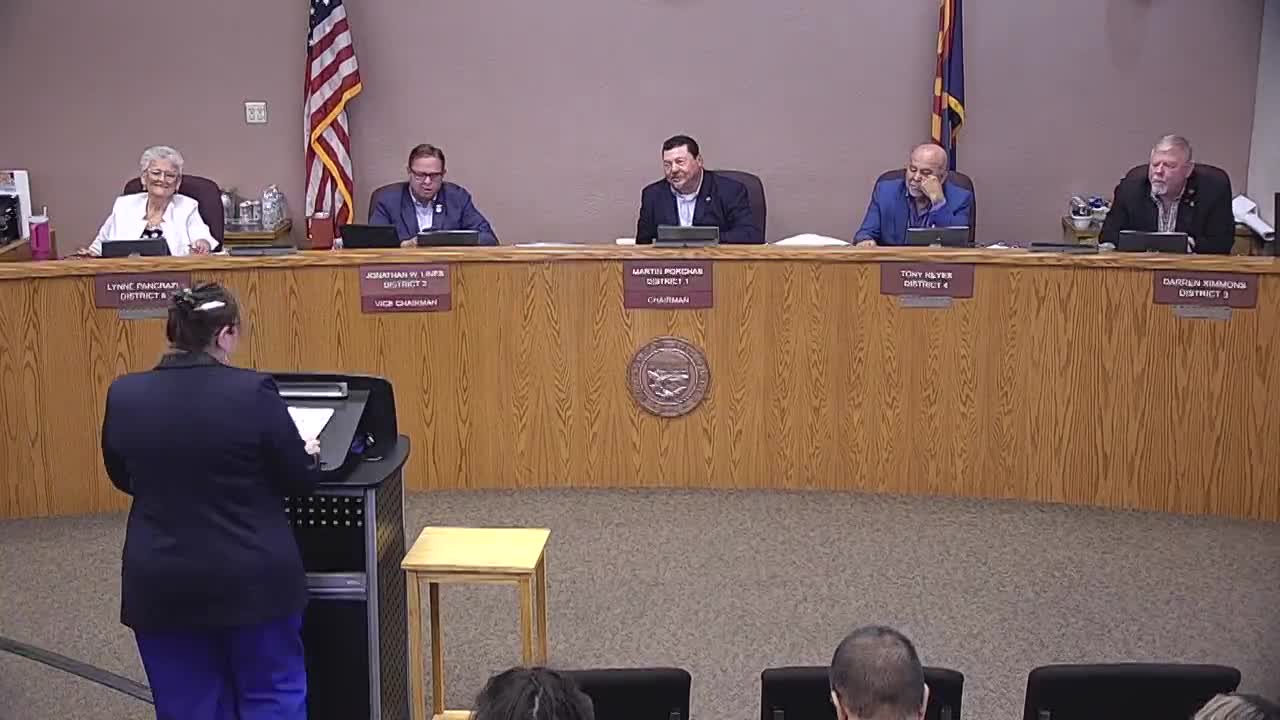
Caroline Hazarowski, Yuma County attorney, told the Board of Supervisors on May 6 that a rapid rise in digital evidence and body-worn camera video has overwhelmed her office's support staff and is threatening the county's ability to meet statutory disclosure and victim-protection obligations.
Hazarowski described a steep workload increase: last calendar year the office received 3,045 felony reports that led to 1,462 new prosecutions, 1,125 new misdemeanor cases and 366 juvenile petitions, she said. That total, she said, equated to 3,313 cases requiring evidence review and redaction. The office operates with about 20 attorney FTEs and 31 other FTEs, she said, and had been short-staffed in recent months.
“Victim rights. Arizona law requires that prosecution redact crime victims' personal identifying information from the evidence we receive from law enforcement before it is disclosed to the defense attorneys,” Hazarowski told the board. She said redacting the volume of body-worn-camera footage is particularly time-consuming, and that legal-support staff must be trained and supported to view highly sensitive footage.
Hazarowski asked the board for five FTEs dedicated to addressing the redaction and disclosure workload. The Budget Review Team offered a compromise meant to bridge the shortfall: a package of temporary employees (four temporary positions for six months and three additional temporary positions for a second six-month period) to perform non-redaction tasks while county LS-Two staff keep responsibility for sensitive redaction work. Hazarowski said temporary workers cannot safely perform the redaction tasks because of the exposure to disturbing material and the need for continuity and trust with victim records.
Board members thanked the county attorney for detailing the operational needs and told Hazarowski they valued the explanation of what additional positions would do. The board directed staff and the BRT to proceed with the temporary staffing solution this fiscal year and to monitor outcomes, while keeping the option of permanent FTEs under review for future budgets.
No formal hiring decision or final appropriation was completed at the May 6 session; the board emphasized the temporary plan is a limited patch and directed staff to report on its effectiveness and on any future permanent FTE needs.