Get Full Government Meeting Transcripts, Videos, & Alerts Forever!
Get email alerts on the County Budget topic
No spam. Unsubscribe anytime.
Yuma County presents conservative FY2025-26 budget; no increase to property tax rate
Summary
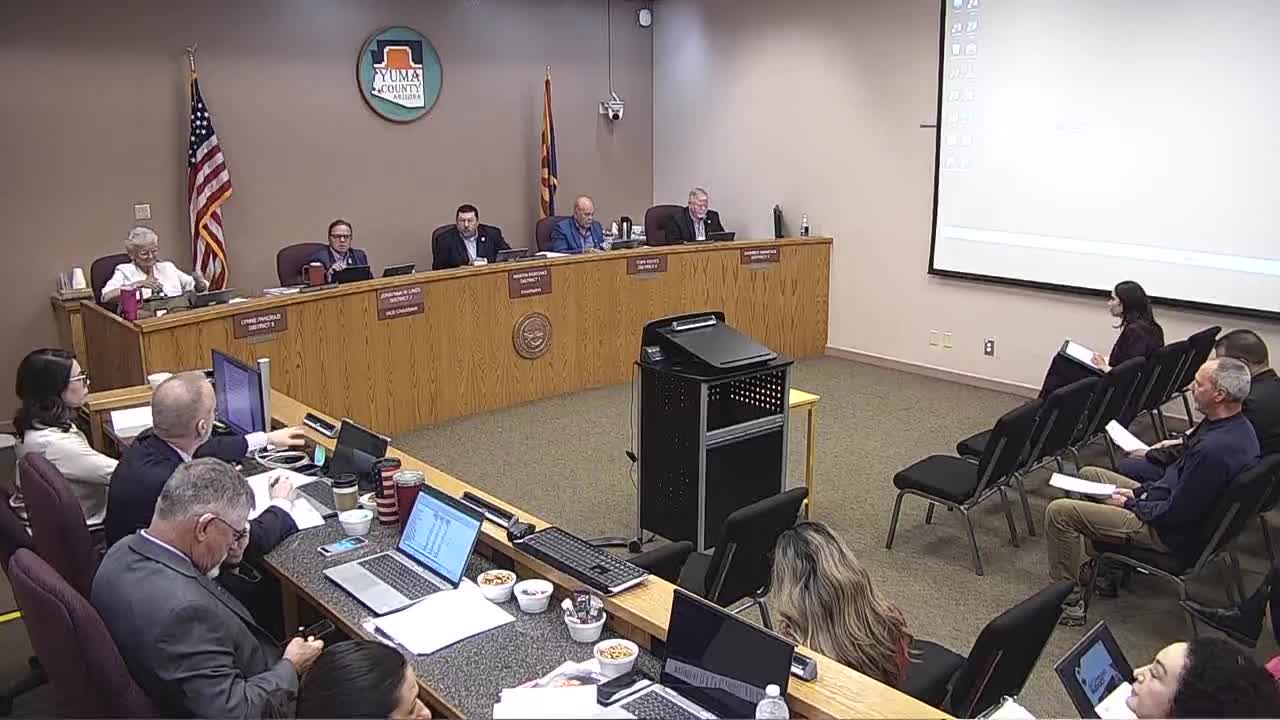
County Administrator Ian presented the Yuma County Board of Supervisors with a recommended fiscal year 2025'026 budget, calling it “a sound fiscally sustainable conservative budget” that does not raise the general fund property tax rate.
County Administrator Ian presented the Yuma County Board of Supervisors with a recommended fiscal year 2025'026 budget on May 6, saying it is “a sound fiscally sustainable conservative budget” that funds capital projects, preserves contingency reserves and does not increase the general fund property tax rate or the combined tax rate for all funds.
The budget review team and department directors collaborated to produce the document, Ian told the board; staff also offered an interactive budget summary and a 10-year financial forecast for supervisors to examine. Chairman of the board reiterated the board's commitment to a conservative approach given economic uncertainty.
Why it matters: the recommended budget sets county spending priorities for the coming year, allocates money for capital projects and emergency reserves, and informs department staffing and program decisions. Board members debated how to balance immediate needs such as public safety and infrastructure against maintaining reserves amid uncertain federal funding and possible cuts to Payment In Lieu of Taxes (PILT).
Board members and staff discussed the long-range forecast and tools to monitor fiscal stress. Ian told the board staff are available to present an interactive forecast and to model scenarios such as adding new full-time equivalents or modest tax-rate changes. The board asked staff to model impacts of small tax-rate adjustments and of adding staff to show how the fund balance would evolve over a decade.
Supervisors flagged several budget risks during the session. Participants noted dependence on federal and competitive grants for several departments, the potential loss or reduction of PILT, and rising construction and materials costs that increase capital project estimates. Board members discussed options — including setting aside additional contingency, using reserves, or pursuing voter approval for a dedicated transportation revenue measure — and asked that those scenarios be available before final adoption.
Board members thanked the Budget Review Team and department directors for the review process and asked that departments rotate participation on the BRT so directors better understand scoring and trade-offs. Ian said the recommended budget aims to preserve reserves to “safeguard against emergencies and revenue shortfalls.”
No formal vote on the budget took place at the May 6 presentation; staff expected to bring a final budget for adoption later in June. The board directed staff to continue scenario modeling and to return with additional details on reserve use, capital funding options, and midyear staffing requests.