Get Full Government Meeting Transcripts, Videos, & Alerts Forever!
Get email alerts on the Courts Budget Corrections topic
No spam. Unsubscribe anytime.
Yavapai Superior Court urges funding for courtroom repairs, security and rising mental‑health exam costs
Summary
The Yavapai County Superior Court told supervisors it needs modest staff reclassifications, upgraded courtroom technology and new detention and security officers as mental‑health and competency evaluations surge. Judges warned of strains on space, jury facilities and a combined Prescott city/justice court caseload.
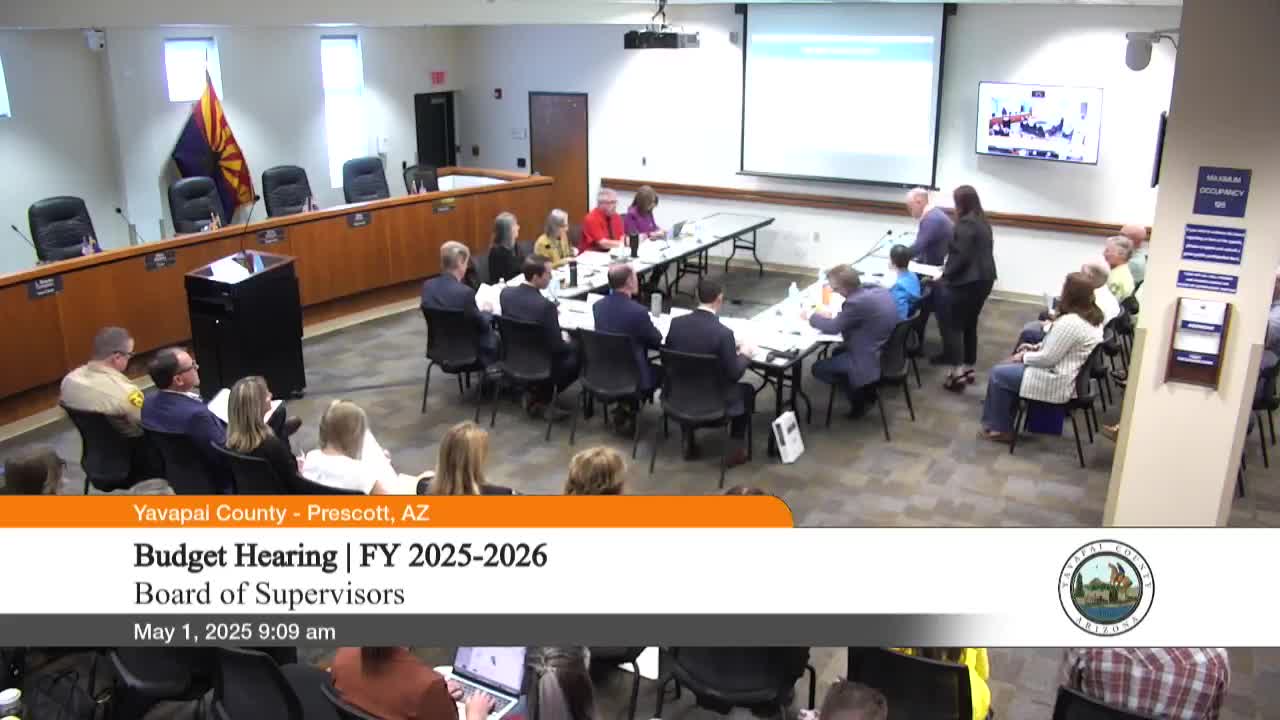
Presiding Judge John Napper and Superior Court Administrator Julie Malinowski presented the court—s FY‑2026 budget requests and program priorities to the Board of Supervisors on May 1, urging funding for courtroom technology, court security and increased mental‑health evaluation costs.
The court outlined several near‑term staffing and infrastructure requests the county manager included in the recommended budget: converting a half‑time bailiff to a full‑time courtroom security officer, four new juvenile detention officers (with two additional positions to be released from contingency as staffing fills), and funding for justice‑court security officers where part‑time posts were previously split across remote precincts.
Malinowski said the courts are working to standardize forms and file practices across the county—s justice and superior courts so public defenders, jails and victims can find key case data quickly. She described the courts— strategic planning and Criminal Justice Coordinating Council work as central to those efforts.
Napper highlighted rising costs tied to mental‑health work in criminal cases. He told the board that "we're looking to triple the number of mental health evaluations that we've done, as compared to last fiscal year," linking the increase to more competency (Rule 11) and Title 36 court‑ordered treatment referrals. Napper said the county bears statutory costs for expert evaluations and restoration proceedings and that more evaluations reflect stronger coordination with treatment providers and expanded Title 36 filings.
The court asked the board to fund audiovisual and cabling upgrades at the Juvenile Justice Center hearing room, which staff described as non‑functional for court hearings; Malinowski said the room has been "exhausted" of cobbled‑together fixes and the upgrade is now urgent.
On justice court structure, Napper warned the board that the combined Prescott City Court and Prescott Justice Court, currently served by a single judge under an intergovernmental agreement, may be unsustainable as city caseloads rise. He said severing the consolidated arrangement would require the city to appoint or elect a separate magistrate and that the presiding judge would like board direction before approaching the city.
Board members pressed the court on space, juror assembly and jury deliberation rooms, and requested a follow‑up presentation on capital and space needs. Napper agreed to work with the board on a study session covering courthouse space and proposed staged capital improvements.